
Free Preparation Discussions
 MENU
MENU
Fortinet NSE7_FSN_AR-7.6 Exam - Topic 2 Question 2 Discussion
Topic #: 2
Refer to the exhibits.
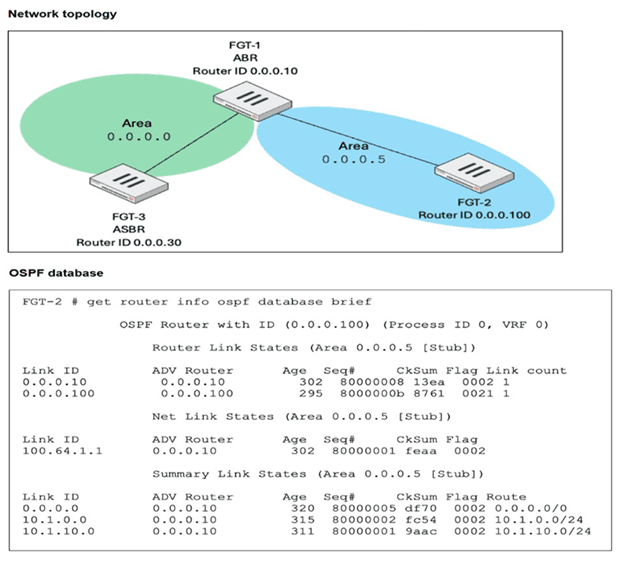
FGT-1 is an area border router (ABR) that has interfaces in OSPF areas 0.0.0.0 and 0.0.0.5. FGT-3 acts as an autonomous system border router (ASBR), importing static routes into OSPF. FGT-2 is an internal router with all its interfaces belonging to area 0.0.0.5. FGT-1 is receiving all advertised routes from FGT-2, however, FGT-3 is not receiving any of the advertised routes from FGT-1. What is the most likely reason for this? (Choose one answer)
The get router info ospf database brief output on FGT-2 clearly indicates that Area 0.0.0.5 is configured as a [Stub] area.
In OSPF, a Stub Area is specifically designed to reduce the size of the Link State Database (LSDB) on internal routers. The primary behavior of a Stub area is that it does not accept Type 5 (AS External) LSAs.
FGT-3 is the ASBR (Autonomous System Border Router) and is importing static routes, which are generated as Type 5 LSAs in the OSPF domain.
FGT-1 acts as the ABR (Area Border Router). Because Area 0.0.0.5 is a Stub area, FGT-1 blocks these Type 5 LSAs from entering Area 0.0.0.5.
Consequently, FGT-2 will not receive the specific external routes advertised by FGT-3. Instead, the ABR (FGT-1) injects a default route (0.0.0.0/0) into the Stub area to allow connectivity to the external world, which is visible in the database output.
While the question text mentions FGT-3 not receiving routes, the definitive configuration shown in the exhibit is the Stub area setting, which directly corresponds to the blocking of Type 5 LSA propagation (Option A).
Thurman
3 days agoBo
8 days agoOcie
13 days agoOllie
18 days agoLavonna
24 days agoBrittani
29 days agoJuan
1 month agoLatanya
1 month agoLisha
1 month ago