
Free Preparation Discussions
 MENU
MENU
Fortinet NSE6_FNC_AD-7.6 Exam - Topic 4 Question 2 Discussion
Topic #: 4
Refer to the exhibit.
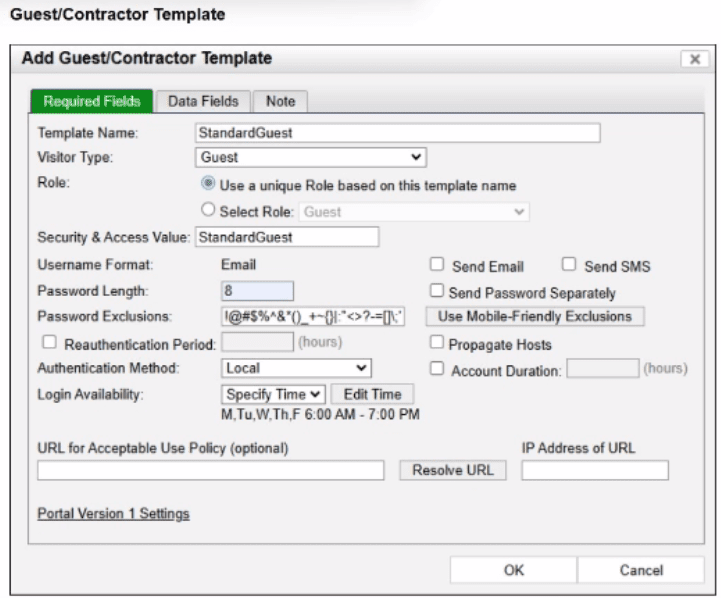
An administrator wants to ensure that guest accounts created from this template are not allowed network access outside of the designated times.
To achieve this, all necessary configurations must be made to force isolation of hosts in which state?
The correct answer is C. The exhibit shows a guest template with Login Availability set to Specify Time, allowing login only Monday through Friday from 6:00 AM to 7:00 PM. The study guide explains that the Account Duration and Login Availability fields define when the account is deleted from the database or what days and times the account is enabled. Therefore, outside the allowed login window, the guest cannot authenticate successfully using that guest account.
To stop network access outside those permitted times, FortiNAC-F must isolate hosts that are in the Not Authenticated state. The guide maps the Authentication captive network to hosts in the Not Authenticated state, and the isolation logic table shows that hosts in the Not Authenticated state are moved to the Authentication network when the point of connection is in the Forced Authentication group.
Option A is wrong because At-risk hosts are isolated to remediation/quarantine due to compliance or security posture problems, not because a guest login is outside allowed hours. Option B is wrong because Disabled hosts are intentionally disabled and sent to the dead-end network; the account here is time-restricted, not necessarily disabled. Option D is wrong because Rogue applies to unregistered or unclassified devices, while this scenario is about a known guest account that is not allowed to authenticate outside its login schedule.
Currently there are no comments in this discussion, be the first to comment!