
Free Preparation Discussions
 MENU
MENU
Databricks Certified Data Engineer Professional Exam - Topic 1 Question 51 Discussion
Topic #: 1
A junior data engineer has been asked to develop a streaming data pipeline with a grouped aggregation using DataFrame df. The pipeline needs to calculate the average humidity and average temperature for each non-overlapping five-minute interval. Events are recorded once per minute per device.
Streaming DataFrame df has the following schema:
"device_id INT, event_time TIMESTAMP, temp FLOAT, humidity FLOAT"
Code block:
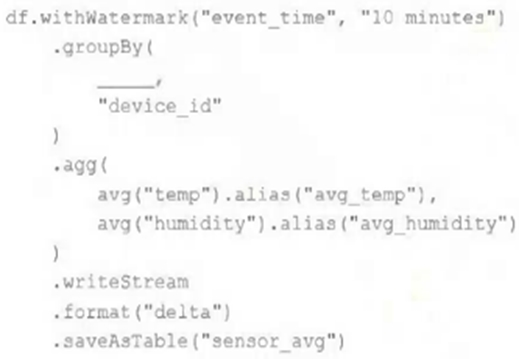
Choose the response that correctly fills in the blank within the code block to complete this task.
This is the correct answer because the window function is used to group streaming data by time intervals. The window function takes two arguments: a time column and a window duration. The window duration specifies how long each window is, and must be a multiple of 1 second. In this case, the window duration is ''5 minutes'', which means each window will cover a non-overlapping five-minute interval. The window function also returns a struct column with two fields: start and end, which represent the start and end time of each window. The alias function is used to rename the struct column as ''time''. Verified Reference: [Databricks Certified Data Engineer Professional], under ''Structured Streaming'' section;Databricks Documentation, under ''WINDOW'' section. https://www.databricks.com/blog/2017/05/08/event-time-aggregation-watermarking-apache-sparks-structured-streaming.html
Kenny
22 days agoFelicitas
27 days agoAn
1 month agoCristal
1 month agoJohanna
1 month agoTheola
2 months agoTimothy
2 months agoHana
2 months agoEllsworth
2 months agoCristy
2 months agoLettie
2 months agoBeckie
3 months ago