
 MENU
MENU
A data engineer needs to apply custom logic to string column city in table stores for a specific use case. In order to apply this custom logic at scale, the data engineer wants to create a SQL user-defined function (UDF).
Which of the following code blocks creates this SQL UDF?
A.
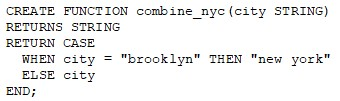
B.
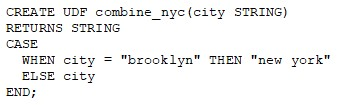
C.
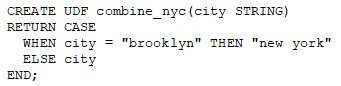
D.
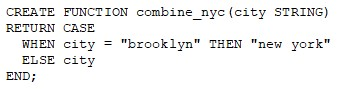
E.
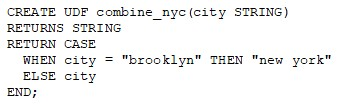
Suggested Answer: E
Get Premium Databricks Certified Data Engineer Associate Questions
as Interactive Web-Based Practice Test or PDF
Real Exam Format
Detailed Explanations
Instant Access
Get Your Practice Test
12 comments · newest first
LE
Levi
11 months ago
I’m surprised this is even a question, UDFs are straightforward!
JA
Jannette
11 months ago
Wait, why is everyone ignoring Option A?
KR
Kristeen
12 months ago
Not sure about Option C, seems off.
JU
Junita
12 months ago
I think Option D is the right choice!
LE
Leoma
12 months ago
Option B looks solid for a UDF.
CO
Corrie
1 year ago
I’m leaning towards Option B, but I can’t recall if we discussed any edge cases that might affect the logic here.
HA
Harrison
1 year ago
I feel like I might be mixing up the return types in these options. Wasn't there something about needing to specify the return type explicitly?
RE
Rebbecca
1 year ago
I think Option C looks familiar; it had a similar structure to the examples we went over in class.
JE
Jennie
1 year ago
I remember we practiced creating UDFs in our last session, but I'm not sure which syntax is correct for this specific case.
TI
Timothy
1 year ago
This question seems straightforward, but I want to make sure I understand the requirements correctly before answering.
MA
Magnolia
1 year ago
Okay, let me see here. I think A and B are the two true statements, since custom dimensions and their members can vary across plan types. I'll double-check the other options, but those seem like the most likely answers.
RA
Rasheeda
1 year ago
The way I see it, the main difference is that managed indemnity plans use precertification and utilization review, while traditional indemnity plans do not. So I'm going to go with option A as my answer.