
Free Preparation Discussions
 MENU
MENU
Cisco 100-150 Exam Questions
- Topic 1: Standards and Concepts: Covers foundational networking models, terminology, network types, cloud service models, and common application-layer protocols.
- Topic 2: Addressing and Subnet Formats: Covers the distinction between public and private IP addressing, IPv4 subnetting, and IPv6 address and prefix formats.
- Topic 3: Endpoints and Media Types: Covers physical cabling types, wireless and wired transmission technologies, endpoint device categories, and OS-level network configuration across multiple platforms.
- Topic 4: Infrastructure: Covers hands-on identification of Cisco hardware, physical cabling in network setups, port types, and the basic concepts behind routing and switching.
- Topic 5: Diagnosing Problems: Covers structured troubleshooting approaches, packet capture with Wireshark, common diagnostic commands, remote access methods, and basic Cisco show commands.
- Topic 6: Security: Covers firewall traffic filtering, core security principles including CIA and AAA, and basic wireless security configuration on home routers.
Free Cisco 100-150 Exam Actual Questions
Note: Premium Questions for 100-150 were last updated On Oct. 06, 2026 (see below)
What is the most compressed valid format of the IPv6 address 2001 :0db8:0000:0016:0000:001b: 2000:0056?
IPv6 addresses can be compressed by removing leading zeros and replacing consecutive groups of zeros with a double colon (::). Here's how to compress the address 2001:0db8:0000:0016:0000:001b:2000:0056:
Remove leading zeros from each segment:
2001:db8:0000:0016:0000:001b:2000:0056 becomes 2001:db8:0:16:0:1b:2000:56
Replace the longest sequence of consecutive zeros with a double colon (::). In this case, the two consecutive zeros between the 16 and 1b:
2001:db8:0:16::1b:2000:56
Thus, the most compressed valid format of the IPv6 address is 2001:db8:0:16::1b:2000:56.
Cisco Learning Network
IPv6 Addressing (Cisco)
Which component of the AAA service security model provides identity verification?
The AAA service security model consists of three components: Authentication, Authorization, and Accounting.
* Authentication: This is the process of verifying the identity of a user or device. It ensures that only legitimate users can access the network or service.
* Authorization: This determines what an authenticated user is allowed to do or access within the network.
* Auditing/Accounting: This component tracks the actions of the user, including what resources they access and what changes they make.
Thus, the correct answer is C. Authentication.
* Cisco AAA Overview
* Understanding AAA (Authentication, Authorization, and Accounting)
During the data encapsulation process, which OSI layer adds a header that contains MAC addressing information and a trailer used for error checking?
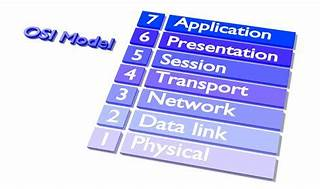
During the data encapsulation process, the Data Link layer of the OSI model is responsible for adding a header that contains MAC addressing information and a trailer used for error checking. The header typically includes the source and destination MAC addresses, while the trailer contains a Frame Check Sequence (FCS) which is used for error detection1.
The Data Link layer ensures that messages are delivered to the proper device on a LAN using hardware addresses and translates messages from the Network layer into bits for the Physical layer to transmit. It also controls how data is placed onto the medium and is received from the medium through the physical hardware.
The OSI Model -- The 7 Layers of Networking Explained in Plain English
OSI Model - Network Direction
Which layer adds both header and trailer to the data?
What is OSI Model | 7 Layers Explained - GeeksforGeeks
Which command will display all the current operational settings configured on a Cisco router?
The show running-config command is used on a Cisco router to display the current operational settings that are actively configured in the router's RAM. This command outputs all the configurations that are currently being executed by the router, which includes interface configurations, routing protocols, access lists, and other settings. Unlike show startup-config, which shows the saved configuration that the router will use on the next reboot, show running-config reflects the live, current configuration in use.
show running-config: This command displays the current configuration running on the router. It includes all the operational settings and configurations applied to the router.
show protocols: This command shows the status of configured protocols on the router but not the entire configuration.
show startup-config: This command displays the configuration saved in NVRAM, which is used to initialize the router on startup, but not necessarily the current running configuration.
show version: This command provides information about the router's software version, hardware components, and uptime but does not display the running configuration.
Cisco IOS Commands: Cisco IOS Commands
Examine the following output:
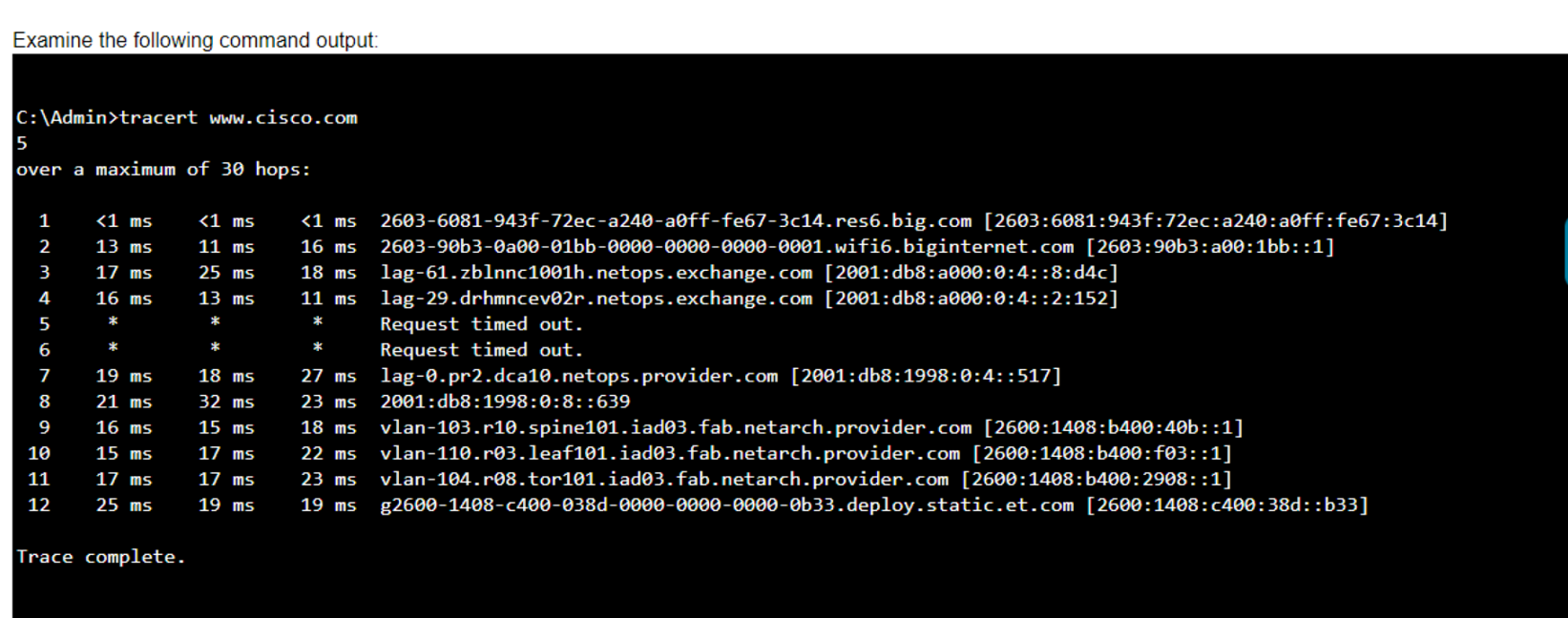
Which two conclusions can you make from the output of the tracert command? (Choose 2.)
Note: You will receive partial credit for each correct answer.
* Statement A: 'The trace successfully reached the www.cisco.com server.' This is true as indicated by the 'Trace complete' message at the end, showing that the trace has reached its destination.
* Statement C: 'The IPv6 address associated with the www.cisco.com server is 2600:1408:c400:38d::b33.' This is true because the final hop in the trace, which is the destination, has this IPv6 address.
* Statement B: 'The trace failed after the fourth hop.' This is incorrect as the trace continues beyond the fourth hop, despite some intermediate timeouts.
* Statement D: 'The routers at hops 5 and 6 are offline.' This is not necessarily true. The routers might be configured to not respond to traceroute requests.
* Statement E: 'The device sending the trace has IPv6 address 2600:1408:c400:38d::b33.' This is incorrect; this address belongs to the destination server, not the sender.
* Understanding Traceroute: Traceroute Guide
- Select Question Types you want
- Set your Desired Pass Percentage
- Allocate Time (Hours : Minutes)
- Create Multiple Practice tests with Limited Questions
- Customer Support
Emily Williams
13 days agoSusan Cooper
1 month agoTimothy Bell
1 month agoLisa King
2 months agoElizabeth Wright
2 months agoHarold Phillips
3 months agoCarol Lee
4 months agoSarah Allen
4 months agoBarbara Carter
5 months agoMelissa Sanchez
5 months agoRachel Adams
6 months agoBrian Peterson
5 months agoAshley Cooper
6 months agoPatricia Flores
6 months agoTimothy Smith
6 months agoJeffrey Murphy
5 months ago