
 MENU

Refer to the exhibit.
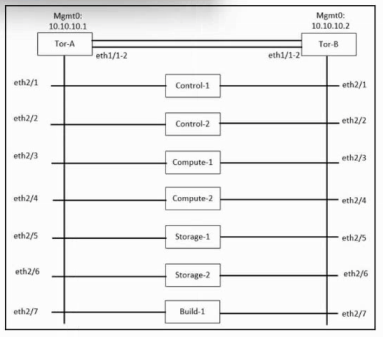
Refer to the exhibit. An engineer needs to configure ToR switches for a Cisco NFVI C-series pod. This configuration was performed on the ToR-A switch already:
feature vpc
feature lacp
interface Ethernet1/1-2
channel-group 110 mode active
interface port-channel110
Which command must be run on ToR-A to complete the port-channel configuration?
In a Cisco NFVI C-Series Pod, the Top-of-Rack (ToR) switches are almost always configured as a vPC pair. A vPC domain requires three mandatory components:
vPC domain ID
vPC peer-link
vPC peer-keepalive link ensures dual-active detection
In the exhibit:
The management interfaces are Tor-A Mgmt0: 10.10.10.1 and Tor-B Mgmt0: 10.10.10.2
These IPs are used commonly as the peer-keepalive endpoints
The physical uplinks to NFVI nodes form Port-Channel110
Since the configuration snippet already includes:
feature vpc
feature lacp
channel-group 110 mode active
The next required step in a Cisco NFVI + vPC configuration is to configure the peer-keepalive from ToR-A toward ToR-B:
vpc domain 1
peer-keepalive destination 10.10.10.2
This ensures:
vPC roles sync
Dual-active prevention
Stable operation for the NFVI C-Series rack
Why the Other Options Are Incorrect
A. vpc peer-link This is required but must be configured on the dedicated peer-link interfaces, not on the server-facing port-channel.
C. channel-group 110 mode on The correct mode is already configured: mode active for LACP. mode on disables LACP.
D. switchport mode access NFVI ToR links use trunking, not access mode, because servers carry multiple networks (control, compute, storage, management VLANs).