
Free Preparation Discussions
 MENU
MENU
Cisco 300-540 Exam Questions
- Cisco Certified Network Professional CCNP Certifications
- Cisco Certified Network Professional Service Provider CCNP Service Provider Certifications
- Topic 1: Virtualized Architecture: This section of the exam measures the skills of Cloud Network Engineers and covers the foundational concepts of virtualized infrastructures used in modern service provider and cloud environments. Candidates are expected to understand constraints in IaaS designs, determine appropriate cloud service models, and demonstrate awareness of container orchestration compared to traditional virtual machines. The exam also evaluates the ability to implement key virtualization functions such as NFV, VNF, NSO, and virtualized Cisco platforms. Learners must be able to deploy NFV with automation tools, manage VNF onboarding, work with NSO-driven orchestration, and use protocols like NETCONF, RESTCONF, REST APIs, and gNMI within automated cloud ecosystems. A general understanding of supporting platforms such as OpenStack also forms part of the required knowledge in this domain.
- Topic 2: Cloud Interconnect: This section of the exam measures the skills of Service Provider Network Engineers and covers how large networks interconnect with cloud platforms and carrier-neutral facilities. Candidates are expected to understand various connectivity options to cloud providers, customer sites, and other neutral facilities, as well as evaluate WAN connectivity models such as direct connect, MPLS or segment routing, and IPsec VPN links. The domain also includes the ability to troubleshoot advanced data center interconnect solutions, including EVPN VXLAN, EVPN over SR/MPLS, ACI-based connectivity, and pseudowire architectures supporting cloud-to-cloud and cloud-to-edge communication.
- Topic 3: High Availability: This section of the exam measures the skills of Cloud Infrastructure Architects and covers the design and implementation of redundancy and resiliency mechanisms in virtualized network functions and distributed cloud platforms. It includes data plane redundancy for VNFs, high availability within a single VIM control plane, and resilient compute, vNIC, and top-of-rack switching. The exam requires an understanding of multi-homing, EVLAG configurations, virtual private cloud deployment, and ECMP strategies for NFVI integrations with physical routing protocols such as BGP, OSPF, and IS-IS. Candidates must also recommend suitable high-availability models involving DNS, routing, and load balancing.
- Topic 4: Security: This section of the exam measures the skills of Network Security Engineers and covers the implementation of infrastructure-level protection in cloud and NFVI ecosystems. It includes topics such as ACLs, uRPF, RTBH, router hardening, BGP flowspec, TACACS, and MACSEC. Candidates should understand DoS mitigation methods and apply security practices within NFVI, focusing on API protection, securing the control and management plane, and segmentation strategies in service provider cloud environments. The domain also evaluates basic knowledge of TLS, mTLS, and general cloud security solutions related to DNS protection, zero-day defenses, and malware detection.
- Topic 5: Service Assurance and Optimization: This section of the exam measures the skills of Cloud Operations Engineers and covers assurance mechanisms used to maintain performance, stability, and visibility across NFVI environments. It includes network assurance concepts such as MANO frameworks, VNF workload monitoring, VIM control plane KPIs, and streaming telemetry with gRPC and gNMI. Candidates must understand cloud infrastructure performance monitoring tools, including SR-PM, NetFlow, IPFIX, syslog, SNMP traps, RMON, cloud agents, and automated fault management systems. The domain also touches on diagnosing NFVI-related errors and optimizing VNFs using techniques such as SR-IOV and software-accelerated virtual switching technologies like DPDK and VPP.
Free Cisco 300-540 Exam Actual Questions
Note: Premium Questions for 300-540 were last updated On Oct. 06, 2026 (see below)
An engineer must configure NTP servers in Cisco Enterprise NFVIS. The primary NTP server has an IP address of 192.168.1.1 and the backup NTP server has an IP address of 192.168.2.1. Which two commands must be run to complete the configuration? (Choose two.)
In Cisco Enterprise NFVIS, time synchronization is configured using the system time ntp command structure. NFVIS requires a primary and optionally a backup NTP server to maintain accurate system time for the hypervisor and guest VMs.
Correct NFVIS command syntax for NTP configuration:
system time ntp preferred_server <IP>
This command configures the preferred (primary) NTP server used for system clock synchronization.
system time ntp backup_server <IP>
This command configures the backup NTP server, which the system uses if the primary becomes unreachable.
These two commands match Cisco NFVIS time-configuration behavior described in NFV infrastructure design and implementation guidelines.
Why the Correct Answers Are A and E
Option A: system time ntp preferred_server 192.168.1.1
This properly configures the primary NTP server in NFVIS. The preferred server is always the first choice for time synchronization.
Option E: system time ntp backup_server 192.168.2.1
This correctly configures the backup NTP server. If the preferred server fails, NFVIS automatically falls back to the backup server.
Both commands directly match NFVIS's NTP command hierarchy and are the only ones that correctly apply to NFVIS.
Why the Other Options Are Not Correct
Option B uses utils ntp, which is not an NFVIS command.
Option C sets manual time and does not configure NTP servers.
Option D also uses the utils ntp syntax, which applies to other Cisco platforms but not NFVIS.
An engineer must design a cloud platform for event-driven applications. The solution must allow micro-sized atomic components to be built, deployed, and run code on demand. Which solution must be used?
Comprehensive and Detailed Explanation From Cisco Cloud Architecture Knowledge
Event-driven applications require:
Stateless, micro-sized execution units
Automatic scaling
Code that runs only when triggered
No server or VM lifecycle management
This model is known as Function-as-a-Service (FaaS).
Cisco FaaS provides:
Serverless execution
Event-driven triggers
Deployment of atomic micro-functions
Automatic scaling and resource abstraction
Ideal environment for microservices and cloud-native workloads
Why the others are incorrect:
A . Cisco+ Hybrid Cloud for VDI delivers desktops, not serverless compute
C . Cisco+ Hybrid Cloud Virtualization VM-based infrastructure, not event-driven micro-functions
D . Cisco Intersight operational management tool, not a serverless execution platform
An engineer must design a cloud platform for managing IaC. The solution must be flexible, integrate with APIs, and allow for automation. What must be used?
Comprehensive and Detailed Explanation
Infrastructure as Code (IaC) requires:
Declarative configuration
Automation
API-driven workflows
Multi-cloud capability
Integration with orchestration and provisioning tools
Terraform is a widely adopted IaC platform supporting:
Cloud automation (AWS, Azure, GCP, private clouds)
Cisco infrastructure provisioning (Nexus, ACI, IOS-XR, NSO, SD-WAN, etc.)
REST APIs and providers for programmability
Cisco provides official Terraform providers for multiple platforms, enabling full IaC operations. This aligns exactly with SP cloud automation design principles.
Other options:
Cloud-based sandboxes For testing, not IaC automation
ThousandEyes Monitoring and performance analytics
AppDynamics Application performance management
Refer to the exhibit.
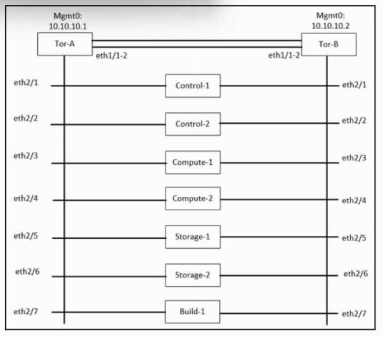
Refer to the exhibit. An engineer needs to configure ToR switches for a Cisco NFVI C-series pod. This configuration was performed on the ToR-A switch already:
feature vpc
feature lacp
interface Ethernet1/1-2
channel-group 110 mode active
interface port-channel110
Which command must be run on ToR-A to complete the port-channel configuration?
In a Cisco NFVI C-Series Pod, the Top-of-Rack (ToR) switches are almost always configured as a vPC pair. A vPC domain requires three mandatory components:
vPC domain ID
vPC peer-link
vPC peer-keepalive link ensures dual-active detection
In the exhibit:
The management interfaces are Tor-A Mgmt0: 10.10.10.1 and Tor-B Mgmt0: 10.10.10.2
These IPs are used commonly as the peer-keepalive endpoints
The physical uplinks to NFVI nodes form Port-Channel110
Since the configuration snippet already includes:
feature vpc
feature lacp
channel-group 110 mode active
The next required step in a Cisco NFVI + vPC configuration is to configure the peer-keepalive from ToR-A toward ToR-B:
vpc domain 1
peer-keepalive destination 10.10.10.2
This ensures:
vPC roles sync
Dual-active prevention
Stable operation for the NFVI C-Series rack
Why the Other Options Are Incorrect
A. vpc peer-link This is required but must be configured on the dedicated peer-link interfaces, not on the server-facing port-channel.
C. channel-group 110 mode on The correct mode is already configured: mode active for LACP. mode on disables LACP.
D. switchport mode access NFVI ToR links use trunking, not access mode, because servers carry multiple networks (control, compute, storage, management VLANs).
Refer to the exhibit.
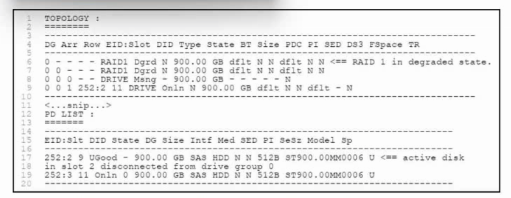
Refer to the exhibit. An engineer is troubleshooting a physical configuration issue in Cisco NFVI. Which two observations should be made? (Choose two.)
A. The node allows two disks to fail. B. One RAID 1 disk failed. C. The node is still functional. D. The node is no longer functional. E. Two RAID 1 disks failed.
From the RAID controller output:
The RAID1 virtual drive is shown as ''Dgrd'' (degraded) with a note: ''RAID 1 in degraded state.''
In the PD LIST, one disk (slot 2) is marked ''UGood -- active disk in slot 2 disconnected from drive group 0'', while the other (slot 3) is ''Onln 0'' (online and part of drive group 0).
This means:
In a RAID 1 mirror, only one disk may fail while the array remains available.
Here, one disk has failed/disconnected, the other is still online the array is degraded but operational.
Therefore:
- Select Question Types you want
- Set your Desired Pass Percentage
- Allocate Time (Hours : Minutes)
- Create Multiple Practice tests with Limited Questions
- Customer Support
John Wright
17 days agoBarbara Edwards
1 month agoRebecca Lee
2 months agoRachel Stewart
2 months agoMichael Perez
3 months agoRyan Walker
3 months agoWilliam Lee
4 months agoDaniel Peterson
4 months agoCarol Scott
5 months agoAnthony Lee
5 months agoJustin Mitchell
6 months agoJeffrey Allen
6 months agoAdam Johnson
6 months agoEric Rivera
5 months agoHeather Cook
5 months agoAshley Bailey
5 months agoDominic
6 months agoGabriele
7 months agoMarylin
7 months agoBernardo
7 months agoWillodean
7 months agoRolande
8 months agoWillie
8 months agoLucy
8 months agoCorazon
8 months agoJina
9 months agoCharlette
9 months agoEdda
9 months agoReena
9 months agoFlorinda
10 months agoGenevive
10 months agoSueann
10 months agoPearlie
10 months agoJuliana
11 months ago