
Free Preparation Discussions
 MENU
MENU
Cisco 300-445 Exam - Topic 4 Question 14 Discussion
Topic #: 4
The following exhibit shows the Capacity Planning results for a router interface connected to an ISP, which provides a 1Gbps connection. Based on the evidence, which action is most likely to fix the observed behavior?
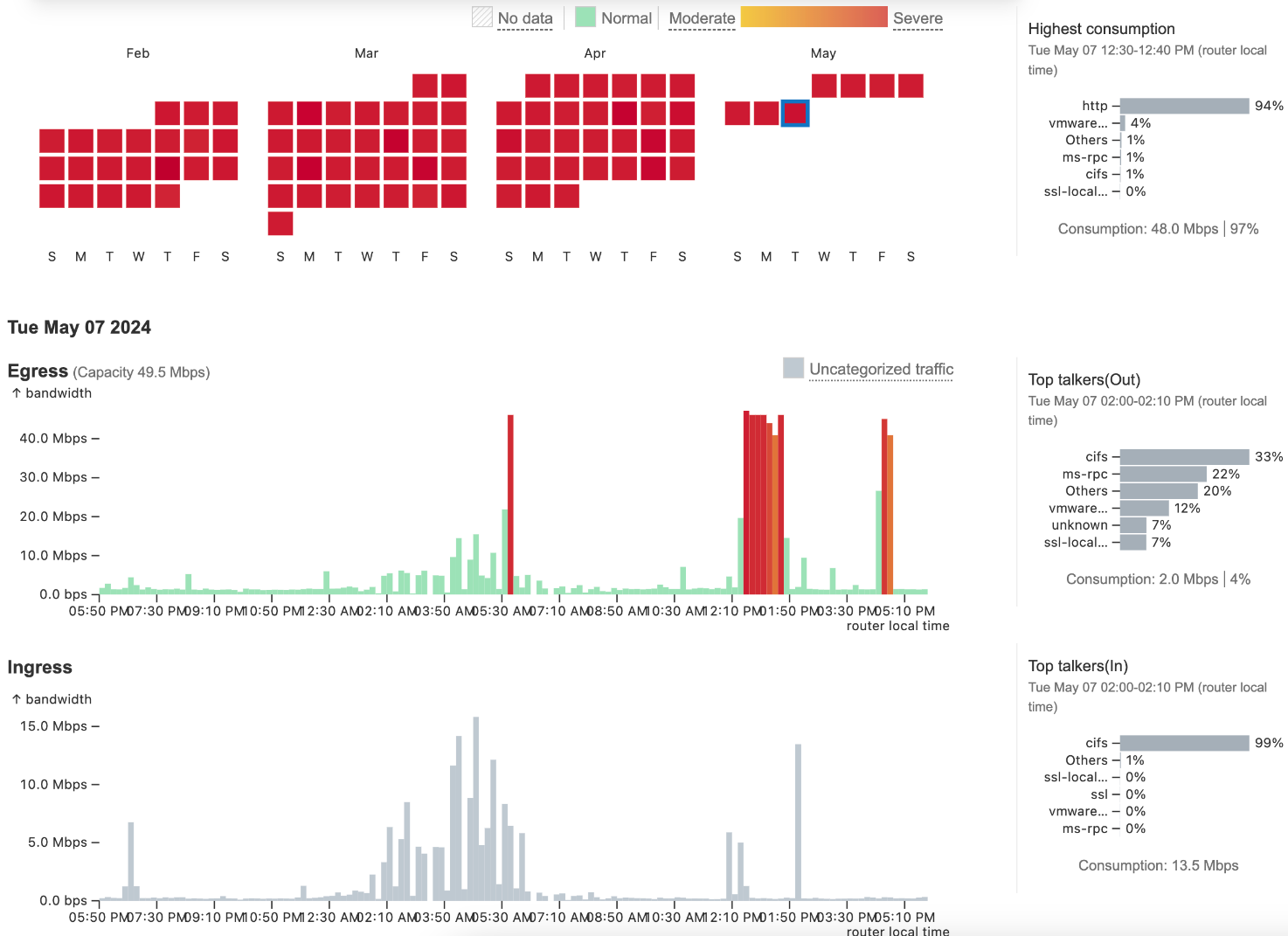
In the context of Designing and Implementing Enterprise Network Assurance (300-445 ENNA), capacity planning requires accurate baselining of interface bandwidth against its theoretical and provisioned limits. Analyzing Exhibit 4.5 Question 4 (image_79d4fc.jpg) reveals a significant discrepancy between the physical reality of the link and its configuration within the monitoring tool.
The exhibit displays a capacity planning dashboard with a calendar heatmap and traffic graphs. The heatmap for February through May shows a high frequency of 'Severe' (red) utilization blocks. Looking at the Egress graph for Tue May 07 2024, the traffic spikes clearly exceed 40.0 Mbps. Crucially, the dashboard indicates an 'Egress Capacity' of 49.5 Mbps and reports that the 'Highest consumption' was 48.0 Mbps, representing 97% of the available bandwidth.
However, the question states that the ISP provides a 1 Gbps (1000 Mbps) connection. Since the actual traffic being sent is less than 50 Mbps, the link is nowhere near physical saturation. The 'Severe' alerts and high utilization percentages are occurring only because the monitoring software (likely ThousandEyes or a similar NMS) is configured with a Maximum Capacity of only 49.5 Mbps for this interface. This misconfiguration causes the tool to calculate utilization based on a much smaller 'pipe' than what actually exists, leading to false-positive alerts.
Therefore, the most likely action to fix this observed behavior is to reconfigure maximum capacity for the interface (Option B) to match the 1 Gbps specification.
Option A is unnecessary because the current link is only being utilized at ~5% of its 1 Gbps potential.
Option C is a restrictive policy change that is not justified given the actual available headroom.
Option D might shift how data is displayed but will not fix the underlying mathematical error in utilization calculations.
Jame
20 hours agoRory
6 days agoTracey
11 days agoTeresita
16 days agoWalton
21 days agoElvis
27 days agoRenay
1 month agoErick
1 month agoUna
1 month agoKathrine
2 months agoDana
2 months ago