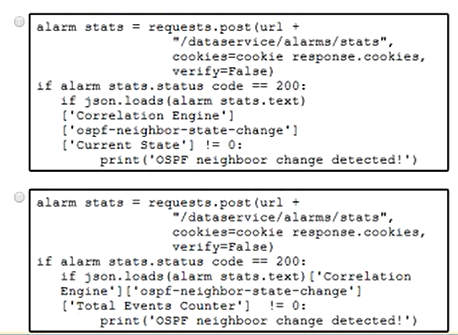
Refer to the exhibit. An API request must display an alert message if change in OSPF neighbors is detected. Which code snippet must be added to complete the requests?
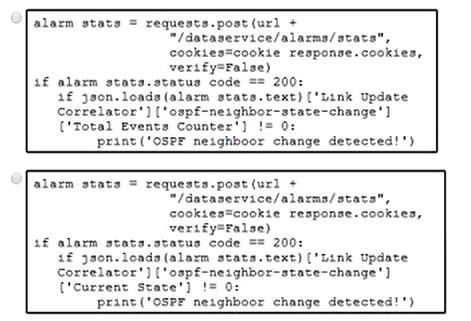
I’m a bit confused about whether we need to check for specific events or just any change. I think all options have some merit, but I’m leaning towards Option B.
I practiced a similar question where we had to set up alerts for network changes. I feel like Option C might be the right choice, but I can't recall the exact syntax.
I think I remember that we need to use a callback function for detecting changes in OSPF neighbors, but I'm not sure which option actually implements that correctly.
Okay, I think I've got this. The key is to identify where the OSPF neighbor change detection logic needs to be added. Let me take another look at the options.
This looks like a straightforward question about the objective of IT Service Management. I'm pretty confident I can answer this based on my understanding of the topic.
Okay, let me break this down. The SAS configuration directory needs to be protected, and the options mention things like metadata access controls, OS controls, and the SAS Management Console. I'm going to go with option B - operating system controls. That seems like the most comprehensive way to protect a local directory.
Signing an acceptable use guide seems like it might help, but I'm not convinced that alone would be the most effective method. We need a more proactive approach to really address the phishing problem.
upvoted 0
times
...
Log in to Pass4Success
Sign in:
Report Comment
Is the comment made by USERNAME spam or abusive?
Commenting
In order to participate in the comments you need to be logged-in.
You can sign-up or
login
Leigha
5 months agoMerlyn
5 months agoJohanna
6 months agoOliva
6 months agoChaya
6 months agoBeth
6 months agoAleta
6 months agoCraig
6 months agoDarrin
7 months agoBuddy
7 months agoLaurene
7 months agoClare
7 months agoJutta
7 months agoColby
7 months agoSusana
7 months agoMauricio
7 months agoKasandra
7 months ago