Deal of The Day! Hurry Up, Grab the Special Discount - Save 25% - Ends In 00:00:00 Coupon code: SAVE25
Welcome to Pass4Success

- Free Preparation Discussions

Cisco 300-420 Exam - Topic 3 Question 129 Discussion

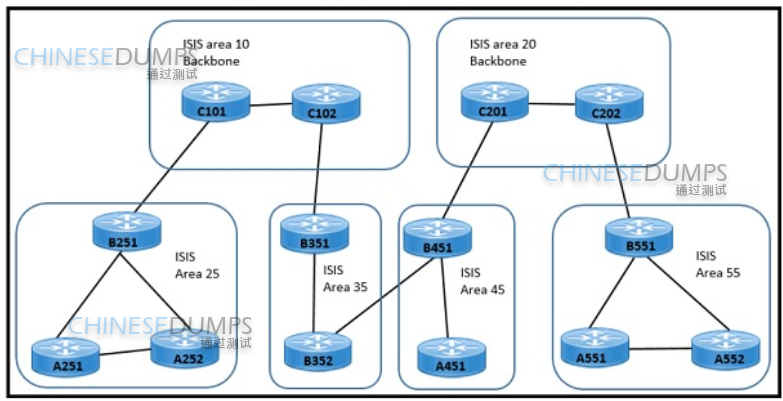
Refer to the exhibit.Refer to the exhibit An engineer is designing a hierarchical ISIS solution for an enterprise customer with these requirementsUsers in areas 25 and 55 send and receive traffic from both backbone areasLink flaps in areas 35 and 45 must not impact other areasRouters will double within the next 12 months in areas 35 and 45Which design must the engineer select?
C) A series routers Level 1. B series routers Level 1/2. and C series routers Level 2
A) A series routers Level 2, B series routers Level 2, and C series routers Level 1
B) A series routers Level 1/2 B series routers Level 2 and C series routers Level 2
D) A series routers Level 1.2 B series routers Level 1/2 and C series routers Level 1/2

Cisco 300-420 Exam - Topic 3 Question 129 Discussion

Actual exam question for Cisco's 300-420 exam
Question #: 129
Topic #: 3
[All 300-420 Questions]

Refer to the exhibit.

Refer to the exhibit An engineer is designing a hierarchical ISIS solution for an enterprise customer with these requirements

Users in areas 25 and 55 send and receive traffic from both backbone areas

Link flaps in areas 35 and 45 must not impact other areas

Routers will double within the next 12 months in areas 35 and 45

Which design must the engineer select?

Show Suggested Answer Hide Answer
Suggested Answer: C

The IS-IS hierarchy should place access or internal area routers at Level 1, boundary routers at Level 1/2, and backbone routers at Level 2. In this exhibit, users in areas 25 and 55 must send and receive traffic through both backbone areas, while link flaps in areas 35 and 45 must not affect other areas. Cisco IS-IS design uses Level 1 areas to contain local topology changes and Level 2 routing to interconnect areas through the backbone. Level 1/2 routers sit at the area boundary and leak or advertise reachability between the local Level 1 area and the Level 2 backbone. Option C matches that hierarchy by placing A-series routers as Level 1, B-series routers as Level 1/2, and C-series routers as Level 2. Making too many routers Level 1/2 would expand the impact of topology changes and reduce scaling benefits. Making backbone routers Level 1 would break interarea design. Reference topics: IS-IS hierarchy, Level 1, Level 2, Level 1/2 routers, failure-domain containment, enterprise scaling.


Contribute your Thoughts:

0/2000 characters
Ardella
3 days ago
But what about link flaps? We need stability.
upvoted 0 times
...
Tamala
8 days ago
Option C seems solid too. It supports scalability.
upvoted 0 times
...
Brynn
13 days ago
I think option B is the best choice. It balances the levels well.
upvoted 0 times
...
Jani
19 days ago
I agree! The hierarchical design is crucial here.
upvoted 0 times
...
Ardella
24 days ago
This question is tricky! I feel like it requires deep understanding.
upvoted 0 times
...
Niesha
29 days ago
The doubling of routers in areas 35 and 45 is a big factor to consider!
upvoted 0 times
...
Paul
1 month ago
A series routers Level 1/2 are definitely needed for scalability.
upvoted 0 times
...
Stephen
1 month ago
Surprised that link flaps won't affect other areas, isn't that risky?
upvoted 0 times
...
Ngoc
1 month ago
I disagree, option C seems more balanced for the requirements.
upvoted 0 times
...
Velda
2 months ago
I think option B is the best choice for this setup.
upvoted 0 times
...
Demetra
2 months ago
I vaguely recall that Level 1 routers are better for stability in certain areas. Maybe option C could be the right choice?
upvoted 0 times
...
Rashad
2 months ago
I’m a bit confused about the impact of doubling routers in areas 35 and 45. Does that mean we need more Level 2 routers?
upvoted 0 times
...
William
2 months ago
I think I practiced a similar question where the focus was on minimizing disruptions. I feel like Level 1/2 routers might be key here.
upvoted 0 times
...
Joaquin
2 months ago
I remember something about how Level 1 routers handle intra-area traffic, but I'm not sure which option best isolates the link flaps.
upvoted 0 times
...

Save Cancel