
Free Preparation Discussions
 MENU
MENU
Cisco 300-420 Exam Questions
- Cisco Certified Network Professional CCNP Certifications
- Cisco Certified Network Professional Enterprise CCNP Enterprise Certifications
- Topic 1: Select Appropriate Qos Strategies To Meet Customer Requirements (Diffserv, Intserv)/ Determine Ipv6 Migration Strategies
- Topic 2: Choose The Correct YANG Data Model Set Based On Requirements/ Advanced Addressing And Routing Solutions
- Topic 3: Differentiate Between IETF, Openconfig, And Cisco Native YANG Models/ Describe SD-Access Architecture
- Topic 4: Describe The Impact Of Model-Driven Telemetry On The Network/ Create Structured Addressing Plans For Ipv4 And Ipv6
- Topic 5: Describe SD-Access Fabric Design Considerations For Wired And Wireless Access/ Create Stable, Secure, And Scalable Routing Designs For IS-IS
- Topic 6: Describe Multicast Routing Concepts (Source Trees, Shared Trees, RPF, Rendezvous Points)/ Attributes For Path Preference
- Topic 7: Compare Dial-In And Dial-Out Approaches To Model-Driven Telemetry/ Create Stable, Secure, And Scalable Routing Designs For BGP
- Topic 8: Differentiate Between NETCONF And RESTCONF/ Create Stable, Secure, And Scalable Routing Designs For EIGRP
- Topic 9: Design High Availability For Enterprise WAN/ Create Stable, Secure, And Scalable Routing Designs For OSPF
- Topic 10: Design Multicast Services (SSM, PIM Bidirectional, MSDP)/ Advanced Enterprise Campus Networks
- Topic 11: Describe Cisco SD-WAN Design Considerations/ Design Campus Networks For High Availability
- Topic 12: Describe Cisco SD-WAN Architecture (Orchestration Plane, Management Plane, Control Plane, Data Plane, On-Boarding And Provisioning, Security)
- Topic 13: Design Multicampus Layer 3 Infrastructures/ Generic Routing Encapsulation (GRE)/ Group Encrypted Transport VPN (GET VPN)
- Topic 14: Compare WAN Connectivity Options/ Design Campus Layer 2 Infrastructures
- Topic 15: Design End-To-End Qos Policies/ WAN For Enterprise Networks/ Design Network Management Techniques
Free Cisco 300-420 Exam Actual Questions
Note: Premium Questions for 300-420 were last updated On Oct. 15, 2026 (see below)
Refer to the exhibit. A company is expanding and decides to use a DMVPN solution to connect the branches. The network uses the EIGRP routing protocol. All remote branch routers must be configured with the normal EIGRP area. Auto-summary is not allowed on the routers in the network. Which solution must the company implement on R1 to achieve this goal?
The company must configure a summary route on R1. The branch routers must remain normal EIGRP routers, and auto-summary is not allowed, so the scalable design choice is manual summarization at the hub. Cisco EIGRP documentation states that manual summarization can be configured on an interface using the ip summary-address eigrp command and can summarize routes on almost any bit boundary. In a DMVPN hub-and-spoke topology, a hub summary reduces the number of individual routes advertised to branches, limits routing-table growth, and helps contain EIGRP queries. It also keeps branch configuration simple because the branches do not need to be converted to stub routers to meet this specific requirement. Disabling split horizon is a common DMVPN Phase 2 consideration when the hub must advertise spoke routes back out the same multipoint tunnel interface, but it does not summarize HQ routes. A multipoint interface is already implied by DMVPN, and disabling the SIA timer is not a design solution. Reference topics: EIGRP manual summarization, DMVPN hub design, no auto-summary, query containment.
When vEdge router redundancy is designed, which FHRP is supported?
When Cisco SD-WAN edge router redundancy is designed, VRRP is the supported first-hop redundancy protocol in the SD-WAN edge context. VRRP provides a virtual default gateway for LAN-side devices, allowing one WAN Edge router to act as the active gateway while another can take over if the active router or tracked condition fails. Cisco SD-WAN designs use VRRP with tracking and policy alignment so branch LAN traffic can fail over to the appropriate edge router while the SD-WAN overlay handles transport and tunnel selection. HSRP and GLBP are traditional campus first-hop redundancy protocols, but they are not the supported FHRP answer for vEdge router redundancy in this design context. OMP is the SD-WAN control-plane routing protocol used between WAN Edge routers and vSmart controllers; it is not a first-hop redundancy protocol for LAN hosts. Therefore, the correct FHRP for vEdge router redundancy is VRRP. The design should also ensure that VRRP priorities, tracking, and SD-WAN routing preferences align so traffic exits the intended edge during normal and failure conditions.
Which feature is required for graceful restart to recover from a processor failure?
Graceful restart and nonstop forwarding designs depend on preserving forwarding continuity during a control-plane processor switchover. Cisco Stateful Switchover provides the mechanism for a standby route processor or supervisor to maintain synchronized state so it can assume control when the active processor fails. When SSO is combined with NSF or graceful restart capabilities in routing protocols, neighboring devices can continue forwarding traffic while the restarting device preserves or rebuilds control-plane adjacencies. Cisco Express Forwarding is required for fast data-plane forwarding, but CEF alone does not provide route processor state synchronization after processor failure. Virtual Switch System is a chassis or switching architecture that can provide high availability in certain campus designs, but it is not the required feature named by graceful restart recovery. Bidirectional Forwarding Detection is a failure-detection protocol used to detect path or neighbor failures quickly; it does not recover a failed processor. Therefore, the feature that must be incorporated for graceful restart recovery from processor failure is Stateful Switchover. In a resilient enterprise design, SSO, NSF, and protocol graceful restart are coordinated to reduce outage impact.
Refer to the exhibit.
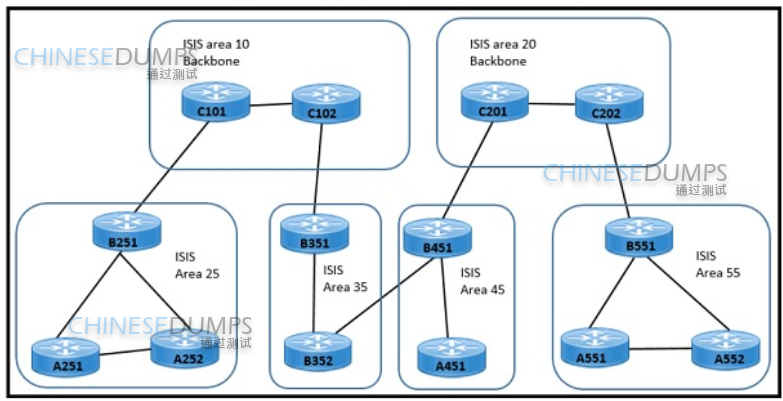
Refer to the exhibit An engineer is designing a hierarchical ISIS solution for an enterprise customer with these requirements
Users in areas 25 and 55 send and receive traffic from both backbone areas
Link flaps in areas 35 and 45 must not impact other areas
Routers will double within the next 12 months in areas 35 and 45
Which design must the engineer select?
The IS-IS hierarchy should place access or internal area routers at Level 1, boundary routers at Level 1/2, and backbone routers at Level 2. In this exhibit, users in areas 25 and 55 must send and receive traffic through both backbone areas, while link flaps in areas 35 and 45 must not affect other areas. Cisco IS-IS design uses Level 1 areas to contain local topology changes and Level 2 routing to interconnect areas through the backbone. Level 1/2 routers sit at the area boundary and leak or advertise reachability between the local Level 1 area and the Level 2 backbone. Option C matches that hierarchy by placing A-series routers as Level 1, B-series routers as Level 1/2, and C-series routers as Level 2. Making too many routers Level 1/2 would expand the impact of topology changes and reduce scaling benefits. Making backbone routers Level 1 would break interarea design. Reference topics: IS-IS hierarchy, Level 1, Level 2, Level 1/2 routers, failure-domain containment, enterprise scaling.
An engineer must configure EIGRP to ensure that all WAN routes are not advertised to the routers in a data center. Which action must be taken?
The action is to configure the EIGRP stub router in receive-only mode. Cisco EIGRP stub routing limits which routes a router advertises to neighbors, reducing query scope and improving stability in hub-and-spoke or WAN designs. The receive-only keyword is the most restrictive stub option: the router receives routes from neighbors but does not advertise any routes to them. That directly satisfies the requirement that WAN routes must not be advertised to the routers in the data center. Advertising only a default route still advertises routing information, so it does not meet the wording. Summarizing local subnets reduces the number of routes, but it still advertises reachability. The ''distributed mode'' option is not the correct EIGRP stub behavior for this requirement; redistributed stub mode would allow redistributed routes to be advertised. Receive-only is therefore the precise design control for stopping route advertisement from the stub router. Reference topics: EIGRP stub routing, receive-only mode, query scoping, route advertisement control, WAN-to-data-center design.
- Select Question Types you want
- Set your Desired Pass Percentage
- Allocate Time (Hours : Minutes)
- Create Multiple Practice tests with Limited Questions
- Customer Support
Tiffany Lopez
11 days agoDonald Walker
1 month agoLisa Hill
1 month agoBrenda Davis
2 months agoJoseph Walker
2 months agoJoseph Stewart
3 months agoRebecca Flores
3 months agoThomas Smith
4 months agoRonald Rodriguez
4 months agoJohn King
5 months agoAnthony Morris
6 months agoMaria Smith
6 months agoGeorge Harris
5 months agoSarah Davis
5 months agoLinda Hernandez
6 months agoBarbara Rivera
5 months agoAleshia
6 months agoHarley
7 months agoMalinda
7 months agoMelodie
7 months agoAleta
7 months agoAshley
8 months agoLatricia
8 months agoJoseph
8 months agoIlona
8 months agoVon
9 months agoMaurine
9 months agoMaryanne
9 months agoDiego
9 months agoTaryn
9 months agoTheodora
10 months agoGraciela
10 months agoLenna
10 months agoFiliberto
10 months agoNoel
11 months agoOlene
11 months agoVilma
11 months agoJoanna
12 months agoTrinidad
12 months agoChan
1 year agoDenna
1 year agoLashawn
1 year agoCecilia
1 year agoTammara
1 year agoMadelyn
1 year agoMitzie
1 year agoLorita
1 year agoVirgie
1 year agoPaola
1 year agoAdaline
1 year agoBerry
1 year agoNadine
1 year agoNichelle
2 years agoLakeesha
2 years agoDenny
2 years agoLorrine
2 years agoAja
2 years agoFrancine
2 years agoAntonio
2 years agoVivienne
2 years agoSherman
2 years agoGail
2 years agoQuinn
2 years agoDong
2 years agoRonald
2 years agoBeth
2 years agoClaribel
2 years agoTrinidad
2 years agoLatia
2 years agoVelda
2 years agoLynsey
2 years agoIlene
2 years agoFrance
2 years agoDianne
2 years agoMona
2 years agoTracie
2 years agoKrystal
2 years agoAmos
2 years agoStephen
2 years agoKeneth
2 years agoHelene
2 years agoHarrison
2 years agoGabriele
2 years agoErick
2 years agoGlory
2 years agoTyisha
2 years agoKristel
2 years agoLettie
2 years ago