
 MENU

Refer to the exhibit.
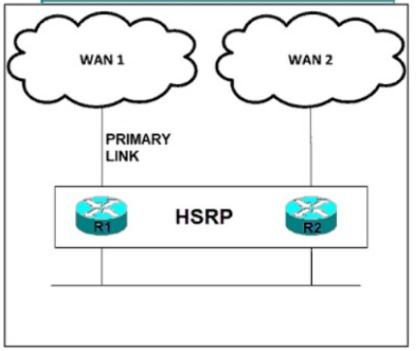
Refer to the exhibit. An engineer must design an automatic failover solution. The solution should allow HSRP to detect a WAN 1 failure and initiate an automatic failover, making router R2 the active HSRP router. Which two solutions should the engineer choose? (Choose two.)
The design should combine IP SLA with Enhanced Object Tracking on router R1. HSRP by itself tracks the health of the local interface and peer state, but it may not detect a remote WAN failure beyond the directly connected segment. IP SLA can actively probe a target through WAN 1, such as an upstream next hop or reachable service address. Enhanced Object Tracking then tracks the IP SLA result and adjusts the HSRP priority when the probe fails. If R1 loses WAN 1 reachability, its HSRP priority is decremented, allowing R2 to become the active default gateway. A floating static route can provide routing backup, but it does not directly trigger HSRP state change for gateway failover. Policy-based routing and IP source routing are not appropriate high-availability mechanisms for this requirement. The correct design pattern is therefore IP SLA plus object tracking integrated with HSRP. The architect should set preemption, decrement values, timers, and tracked destinations carefully to avoid false failovers during transient loss. Reference topics: HSRP, IP SLA, Enhanced Object Tracking, first-hop redundancy, WAN failure detection.