
 MENU

Refer to the exhibit.
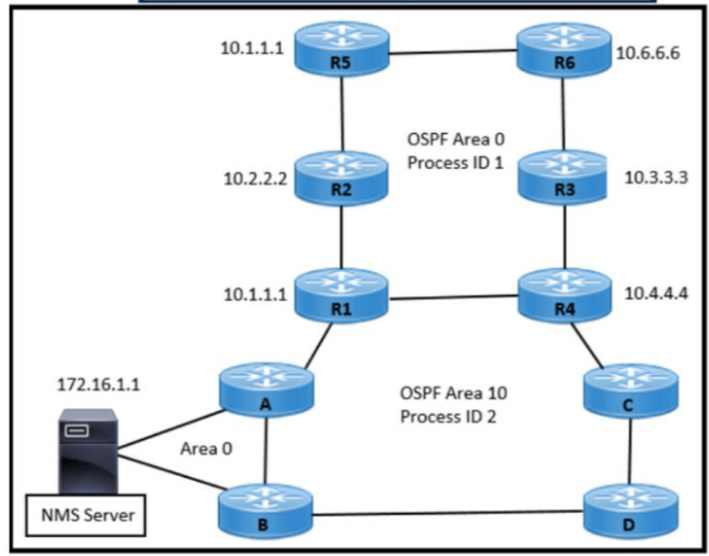
Refer to the exhibit An engineer is designing an OSPF solution with these requirements:
NMS server will manage R5 and R6.
Upon failure of R1. all NMS traffic should be routed through R4.
Upon failure of the link between R5 and R6. all traffic destined for 10.6.6.6 should be routed through R4
Which solution must the engineer choose?
Redistributing OSPF process 1 into process 2 on both R1 and R4 provides the required backup routing behavior between the management network and the target routers. The design requirements are failure driven: if R1 fails, NMS traffic must use R4, and if the link between R5 and R6 fails, traffic to 10.6.6.6 must still route through R4. When separate OSPF processes or domains exist, controlled redistribution at both exit points allows reachability to be maintained through either redistribution point. Advertising a single address into OSPF with high cost on R1 does not solve both failure cases. Static routes with IP SLA on R2 and R3 would be more manual and less aligned with the dynamic OSPF design. Default-information originate would provide a default path but would not accurately advertise the specific internal reachability required for the NMS destinations. The redistribution design must also include route filtering or tagging in production to prevent feedback loops. Reference topics: OSPF redistribution, redundant redistribution points, management reachability, route control, failure-path design.