
 MENU

Refer to the exhibit.
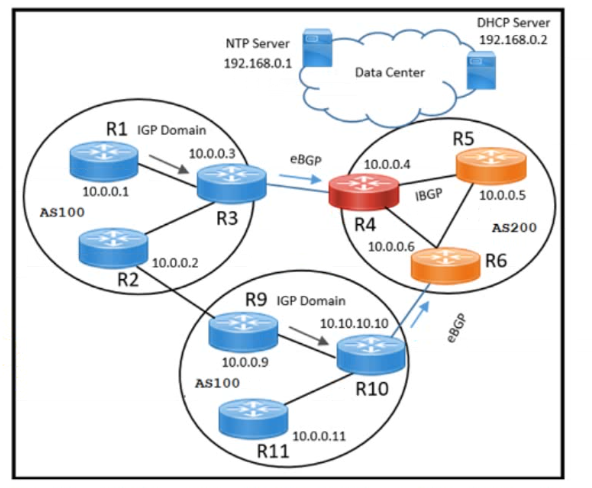
Refer to the exhibit. A network engineer working for a private service provider with an employee ID: 4670:71:451 must design a BGP solution based on:
All traffic originating from AS100 must pass through AS200 to reach the NTP and DHCP server
When a link failure occurs between R3 and R4, traffic must follow the R2-R9 link to reach the NTP and DHCP server.
Which solution must the design include?
Suggested Answer: D
Get Premium 300-420 Questions
as Interactive Web-Based Practice Test or PDF
Real Exam Format
Detailed Explanations
Instant Access
Get Your Practice Test
12 comments · newest first
EL
Elouise
3 months ago
I’m leaning towards option C. Lower local preference can help manage traffic better.
PA
Paris
3 months ago
I feel option A could work too. IGP metrics in BGP? Sounds solid.
CA
Cathern
3 months ago
This question is tricky! I think option D makes sense.
SA
Sarina
3 months ago
Local preference of 200 for R1, R2, R9, and R11 is a solid choice!
SA
Sang
4 months ago
I disagree, option C seems more effective for traffic management.
DI
Diane
4 months ago
Wait, can R3 really influence that many paths? Sounds tricky.
JE
Jettie
5 months ago
I think option D makes the most sense here.
CH
Chantell
6 months ago
AS100 traffic needs to go through AS200, that's key.
TY
Tyra
6 months ago
I think option A could work since it talks about IGP metrics and redistribution, but I’m not entirely confident about how that interacts with BGP.
SY
Sylvie
6 months ago
I’m a bit confused about the AS-PATH values. I thought they were more about inbound traffic control, not sure how they apply here.
WA
Wava
7 months ago
This question feels similar to one we did in class about BGP path selection. I think option D might be the best fit since it mentions local preference.
AL
Alfred
7 months ago
I remember something about local preference influencing outbound traffic, but I'm not sure if it's the right choice here.