
 MENU

Refer to the exhibit.
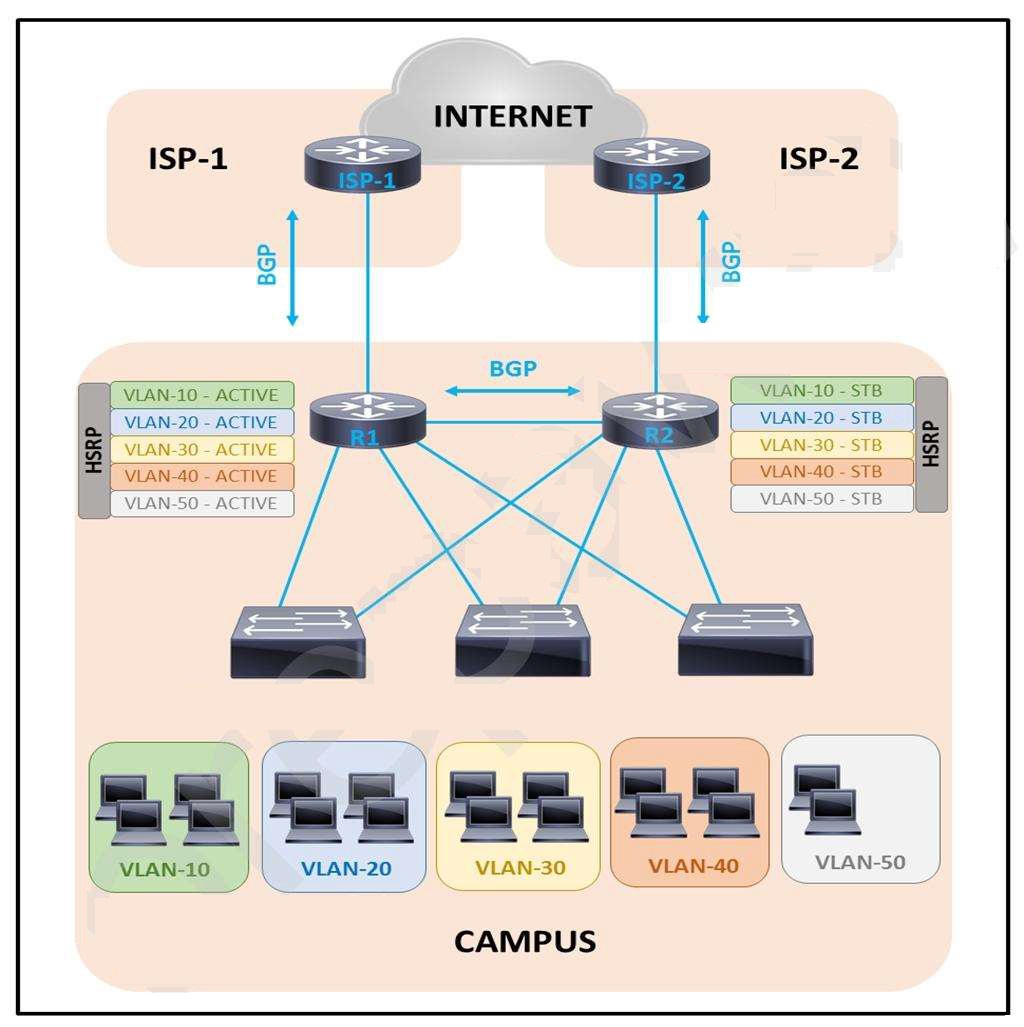
A customer is running HSRP on the core routers. Over time the company has grown and requires more
network capacity. In the current environment, some of the downstream interfaces are almost fully utilized, but
others are not. Which solution improves the situation?
Suggested Answer: A
Get Premium 300-420 Questions
as Interactive Web-Based Practice Test or PDF
Real Exam Format
Detailed Explanations
Instant Access
Get Your Practice Test
25 comments · newest first
LU
Luis
6 months ago
Not sure about D. RSTP is good, but doesn't really solve the capacity issue.
SH
Sherell
6 months ago
Option B seems solid. More interfaces mean more capacity.
HU
Hubert
6 months ago
I feel like option A could work too. Splitting VLANs might help.
NI
Nickole
6 months ago
I think option C is the best. Port channels balance the load.
DE
Dexter
6 months ago
Surprised that no one mentioned upgrading the core routers!
LA
Launa
7 months ago
Totally agree, port channeling seems like the way to go!
EV
Evangelina
7 months ago
Wait, why would we enable RSTP? That doesn't really solve the capacity issue.
SA
Sabina
7 months ago
I think configuring a port channel is the best option here.
WE
Werner
7 months ago
Adding more interfaces to R1 and R2 could help balance the load.
DO
Dorethea
7 months ago
A) Making R2 active for half the VLANs is an interesting idea, but it might introduce complexity.
JA
Jacinta
8 months ago
D) RSTP is for redundancy, not load balancing. That won't solve the problem.
SO
Sol
8 months ago
B) Adding more interfaces to R1 and R2 is a good idea, but it doesn't address the load imbalance issue.
CO
Coletta
8 months ago
C) Configure port channel toward downstream switches. This will improve load balancing and utilize all the available bandwidth.
AD
Adelle
8 months ago
Enabling RSTP seems like it could help with redundancy, but I don't see how it directly addresses the capacity issue.
MI
Mitsue
9 months ago
I'm leaning towards configuring a port channel since it can aggregate bandwidth, but I need to double-check if that's the best option here.
SH
Shonda
9 months ago
I think adding more interfaces to R1 and R2 could help, but it might not solve the issue of uneven utilization.
OL
Olene
9 months ago
I remember studying HSRP, but I'm not sure if making R2 active for half the VLANs would really balance the load effectively.
CH
Christiane
9 months ago
Making R2 active for half the VLANs could work, but that feels a bit hacky to me. I'd prefer a more elegant, scalable solution if possible. The port channel idea is probably the way to go.
DA
Dannette
9 months ago
I'm not totally sure about the RSTP option. Wouldn't that be more focused on redundancy and failover rather than load balancing? I'd want to double-check the details on that one before selecting it.
JI
Jina
10 months ago
Okay, I think I've got this. The key is to find a way to more evenly distribute the traffic across the available interfaces. Option C about configuring a port channel seems like the most straightforward solution to me.
MA
Maricela
10 months ago
I'm a bit confused by the wording of the question. Is it asking about improving the load balancing specifically, or just generally improving the network capacity? I'll need to read it carefully to make sure I understand the core issue.
KA
Kassandra
10 months ago
Hmm, this looks like a classic HSRP load balancing question. I'd start by considering the current utilization of the downstream interfaces and think about how to better distribute the load.
JA
Janessa
4 months ago
I lean towards option C, configuring a port channel seems efficient.
TI
Tish
5 months ago
But adding more interfaces, like in option B, might also work.
TR
Troy
6 months ago
I think option A could help balance the load better.