Deal of The Day! Hurry Up, Grab the Special Discount - Save 25% - Ends In 00:00:00 Coupon code: SAVE25

Welcome to Pass4Success

- Free Preparation Discussions

Cisco 300-410 Exam - Topic 4 Question 127 Discussion

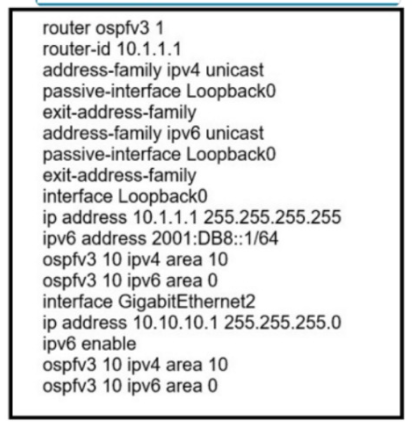
Refer to the exhibit.An administrator must configure the router with OSPF for IPv4 and IPv6 networks under a single process. The OSPF adjacencies are not established and did not meet the requirement. Which action resolves the issue?
C) Replace OSPF process 10 on the interface with OSPF process 1, and remove process 10 from the global configuration.
A) Replace OSPF process 10 on the interface with OSPF process 1, and configure an additional router ID with IPv6 address.
B) Replace OSPF process 10 on the interface with OSPF process 1, for the VPv6 addressma nd remove process route ID with IPv6 address.
D) Replace OSPF process 10 on the interface with OSPF process 1 for the IPv4 address, and remove process 10 from the global configuration.

Cisco 300-410 Exam - Topic 4 Question 127 Discussion

Actual exam question for Cisco's 300-410 exam
Question #: 127
Topic #: 4
[All 300-410 Questions]

Refer to the exhibit.

An administrator must configure the router with OSPF for IPv4 and IPv6 networks under a single process. The OSPF adjacencies are not established and did not meet the requirement. Which action resolves the issue?

Show Suggested Answer Hide Answer
Suggested Answer: C

Contribute your Thoughts:

0/2000 characters
Jessenia
3 days ago
I agree with Glory. We need to ensure both protocols are configured properly.
upvoted 0 times
...
Doyle
8 days ago
Option B confuses me. Why remove the router ID? That doesn’t seem right.
upvoted 0 times
...
Dominga
13 days ago
I’m leaning towards option C. Removing the conflicting process seems logical.
upvoted 0 times
...
Brett
19 days ago
I feel like option D could work too. Simplifying the process might help.
upvoted 0 times
...
Glory
24 days ago
I think option A is the best choice. It addresses both IPv4 and IPv6.
upvoted 0 times
...
Derick
29 days ago
Removing process 10 is key, so D is the way to go!
upvoted 0 times
...
Bulah
1 month ago
I think option A could work too, but not sure.
upvoted 0 times
...
Christene
1 month ago
Wait, can you really mix IPv4 and IPv6 like that?
upvoted 0 times
...
Rickie
1 month ago
Definitely option D, that makes the most sense!
upvoted 0 times
...
Janey
2 months ago
OSPF process IDs need to match for adjacencies.
upvoted 0 times
...
Emile
2 months ago
I vaguely remember that you can't have two OSPF processes running on the same interface, so I think we need to replace process 10, but I’m not sure about the specifics of the IPv6 address.
upvoted 0 times
...
Luisa
2 months ago
I feel like option D makes sense because it mentions removing process 10, but I'm not completely confident about the details of the global configuration.
upvoted 0 times
...
Krystal
2 months ago
I think we practiced a similar question where we had to change the OSPF process ID, but I can't recall if we needed to remove the old process or just replace it.
upvoted 0 times
...
Emerson
2 months ago
I remember something about OSPF process IDs needing to match on both ends for adjacencies to form, but I'm not sure which option actually resolves that.
upvoted 0 times
...

Save Cancel