Deal of The Day! Hurry Up, Grab the Special Discount - Save 25% - Ends In 00:00:00 Coupon code: SAVE25

Welcome to Pass4Success

- Free Preparation Discussions

Cisco 300-215 Exam - Topic 3 Question 82 Discussion

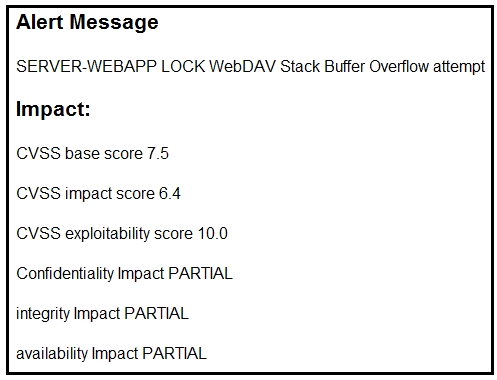
Refer to the exhibit.After a cyber attack, an engineer is analyzing an alert that was missed on the intrusion detection system. The attack exploited a vulnerability in a business critical, web-based application and violated its availability. Which two migration techniques should the engineer recommend? (Choose two.)
C) address space randomization and E) data execution prevention
A) encapsulation
B) NOP sled technique
D) heap-based security

Cisco 300-215 Exam - Topic 3 Question 82 Discussion

Actual exam question for Cisco's 300-215 exam
Question #: 82
Topic #: 3
[All 300-215 Questions]

Refer to the exhibit.

After a cyber attack, an engineer is analyzing an alert that was missed on the intrusion detection system. The attack exploited a vulnerability in a business critical, web-based application and violated its availability. Which two migration techniques should the engineer recommend? (Choose two.)

Show Suggested Answer Hide Answer
Suggested Answer: C, E

Contribute your Thoughts:

0/2000 characters
Gene
9 months ago
Encapsulation could help, but is it really effective against all attacks?
upvoted 0 times
...
Dorsey
9 months ago
I’m surprised they didn’t mention heap-based security!
upvoted 0 times
...
Shawnda
10 months ago
NOP sled technique? Really? That seems outdated.
upvoted 0 times
...
Jaime
10 months ago
Definitely agree, data execution prevention is a must too!
upvoted 0 times
...
Toshia
10 months ago
I think address space randomization is a solid choice.
upvoted 0 times
...
Ashton
10 months ago
I'm a bit confused about heap-based security. I recall it being important, but I can't remember how it directly relates to availability issues.
upvoted 0 times
...
Ronna
11 months ago
I practiced a similar question where data execution prevention was highlighted as a key technique. I feel confident about that one!
upvoted 0 times
...
Glennis
11 months ago
I think address space randomization could be a good option since it helps prevent certain types of attacks, but I need to double-check its effectiveness in this context.
upvoted 0 times
...
Jenifer
11 months ago
I remember studying about encapsulation and its role in securing applications, but I'm not entirely sure if it's the best choice here.
upvoted 0 times
...
Bok
11 months ago
I'm a bit confused by the options. Encapsulation and NOP sled technique don't seem directly relevant to the issue of a web app vulnerability. I'll need to review my notes on security migration techniques to make sure I pick the best two for this scenario.
upvoted 0 times
...
Domitila
11 months ago
Okay, let's see. Address space randomization and data execution prevention seem like good options to improve security and prevent similar attacks in the future. I'll go with those two.
upvoted 0 times
...
Viva
11 months ago
Hmm, I'm a bit unsure about this one. There are a lot of options and I'm not totally familiar with all the migration techniques. I'll need to think carefully about which two would be most relevant to the scenario.
upvoted 0 times
...
Cecily
11 months ago
This question seems pretty straightforward. I'll focus on the key details - the attack exploited a vulnerability in a web-based application and violated its availability. That suggests I should look for migration techniques that improve application security and availability.
upvoted 0 times
...
Nickie
11 months ago
The control plane running in the HPE cloud is an interesting point, that could provide the scalability needed for IoT. I'll have to weigh the pros and cons of each option.
upvoted 0 times
...
Gregoria
2 years ago
I believe data execution prevention could also be a good migration technique to recommend.
upvoted 0 times
...
Tyra
2 years ago
I agree with Michael, address space randomization can help prevent similar attacks in the future.
upvoted 0 times
...
Kristian
2 years ago
I'm going with C and E. Anything to keep those pesky hackers at bay, am I right? Though I do wonder if the engineer's sense of humor needs a little work.
upvoted 0 times
Chandra
2 years ago
Definitely, can't be too careful when it comes to cybersecurity.
upvoted 0 times
...
Markus
2 years ago
I think C and E are good choices. Better safe than sorry.
upvoted 0 times
...
...
Shawn
2 years ago
Definitely C and E. Heap-based security? Really? That's like trying to put out a fire with a garden hose.
upvoted 0 times
...
Zachary
2 years ago
C'mon, address space randomization? That's a no-brainer! The real question is, who thought NOP sled technique was a viable option here?
upvoted 0 times
Isaiah
2 years ago
Maybe they were trying to think outside the box, but it doesn't seem like the best option here.
upvoted 0 times
...
Ammie
2 years ago
I know right, NOP sled technique seems like a strange choice for this scenario.
upvoted 0 times
...
Stevie
2 years ago
I agree, address space randomization is a must in this situation.
upvoted 0 times
...
...
Michael
2 years ago
I think we should consider address space randomization for migration.
upvoted 0 times
...

Save Cancel