
Deal of The Day! Hurry Up, Grab the Special Discount - Save 25% - Ends In 00:00:00 Coupon code: SAVE25
Welcome to Pass4Success

- Free Preparation Discussions

CFA Institute CFA-Level-II Exam - Topic 3 Question 68 Discussion

Actual exam question for CFA Institute's CFA-Level-II exam
Question #: 68
Topic #: 3
[All CFA-Level-II Questions]

Ryan Hendricks serves as a security analyst for Investment Management, Inc. (IMI), which employs the Treynor-Black model to evaluate securities and to make portfolio recommendations. IMI uses the capital asset pricing model (CAPM) to determine the degree to which securities may be mispriced relative to IMFs forecasts.

Hendricks evaluates the common shares of Computer Software Associates (CSA), a small company specializing in a unique computer software market niche. Hendricks obtains the following market model results for CSA, using monthly returns for the past 60 months:

Hendricks uses the adjusted beta method to derive his forecasts for companies' future betas. In deriving his forecast for any company beta, Hendricks uses the following first-order autoregressive formula:

forecast beta = 0.33 + 0.67 x (historical beta) (2)

Hendricks derives required returns for individual securities using the CAPM after making appropriate adjustments using his adjusted beta formula in equation (2).

IMI provides Hendricks with the following capital market forecasts to use as inputs for the CAPM.

IMI asks Hendricks to make decisions to take long and short positions in individual securities for IMl's actively managed portfolio, IMI-Active. Specifically, Hendricks is asked to examine CSA and Millennium Drilling (MD), an oil and gas drilling company specializing in deep sea drilling. After a thorough examination of the prospects for each company, Hendricks derives the following alpha forecasts for CSA and MD.

Hendricks forecasts that the unsystematic variance (the variance of the market model regression error) for MD will be more than double that of CSA .

After determining the appropriate allocations across securities within the IMI-Active portfolio, Hendricks derives the portfolio predictions shown in Exhibit 3.

IMI forecasts that the total standard deviation for the S&P500 returns will equal 20%. After examining the historical forecasting abilities of Hendricks, IMI determines that Hendricks has demonstrated perfect forecasting ability in regards to CSA stock, but imperfect forecasting abilities in regards to MD stock. IMI finds that the correlation between the realized alphas for MD and the forecast MD alphas provided by Hendricks equals 0.50.

Referring to the Treynor-Black model, Hendricks makes the following statements:

Statement 1: All else equal, the Treynor-Black model increases the weight to the active portfolio as its unsystematic risk increases.

Statement 2: The Treynor-Black model is based on the premise that only a limited number of stocks should be included in the actively managed portfolio.

Hendricks' forecasts for the CSA beta and future return are closest to:

Show Suggested Answer Hide Answer
Suggested Answer: A

At the initiation of GlobeCorp's fixed rate payer swap, the value was zero and the fixed rate was set at 2.75%. To determine the change in the value of the swap, we must determine the fixed rate on comparable swaps available today using the LIBOR curve. Since a year has passed since the initiation of the swap, a comparable swap as of today would be a 2-year swap with semiannual payments. First calculate the discount factors for the 180-, 360-, 540-, and 720-day LIBOR interest rates as follows:
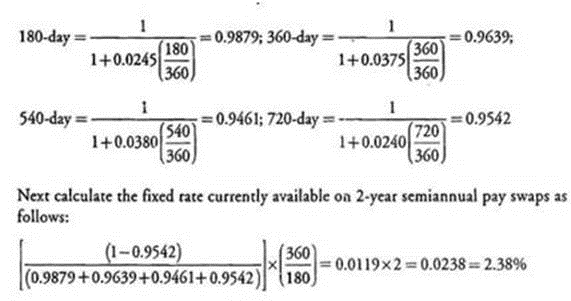
GlobcCorp could enter into an equivalent swap today at an annualized fixed rate of 2.38% versus the fixed rate of 2.75% that it is currently paying on the existing swap. Therefore, the existing swap has negative value to GlobeCorp and has thus decreased from an initial value of zero. Current credit risk is greater for NVS Bank since the negative value of the swap to GlobcCorp increases the chance that the company will default on the obligation and fail to make the required payments to NVS. (Study Session 17, LOS 6l.c,i)


Contribute your Thoughts:

0/2000 characters
Nieves
5 months ago
I’d go with option B for the CSA beta and return. Looks solid!
upvoted 0 times
...
Lon
5 months ago
The unsystematic risk increasing the active portfolio weight seems off to me.
upvoted 0 times
...
Garry
5 months ago
Surprised that Hendricks has perfect forecasting for CSA! That’s impressive.
upvoted 0 times
...
Veronique
6 months ago
Totally agree, but I’m not sure about the limited stock inclusion part.
upvoted 0 times
...
Rachael
6 months ago
I think the Treynor-Black model really helps with risk management.
upvoted 0 times
...
Talia
6 months ago
I think the beta for CSA should be around 1.33 based on the historical data, but I'm unsure about the return estimate.
upvoted 0 times
...
Ellsworth
6 months ago
I feel like I might confuse the weights in the Treynor-Black model. Does higher unsystematic risk really lead to increased weights in the active portfolio?
upvoted 0 times
...
Kizzy
6 months ago
This question reminds me of a practice problem where we had to calculate expected returns using CAPM. I think I need to focus on the inputs carefully.
upvoted 0 times
...
Jani
6 months ago
I remember the adjusted beta formula, but I'm not entirely sure how to apply it to derive the beta for CSA.
upvoted 0 times
...
Melvin
6 months ago
I'm feeling pretty confident about this one. The solution of using a Site-to-Site VPN and virtual network peering seems like it should meet the goal.
upvoted 0 times
...
Noble
6 months ago
This seems straightforward enough. We just need to check if the sum of sales is greater than $200,000, so option A looks like the correct choice to me. I feel pretty good about this one.
upvoted 0 times
...
Jenise
6 months ago
I'm a bit confused about the zone status and what it means. Does the "incomplete/zone/zone1solaris10 excl" status indicate something specific I need to address?
upvoted 0 times
...
Dean
11 months ago
Wow, perfect forecasting ability for CSA stock? Hendricks must be some kind of wizard. I wonder if he can predict the winning lottery numbers too.
upvoted 0 times
...
Ruth
11 months ago
Unsystematic risk? More like 'unsystematic headache' for Hendricks. I hope he's got a good crystal ball to see the future.
upvoted 0 times
Annice
10 months ago
Hendricks better hope his crystal ball is accurate for those predictions.
upvoted 0 times
...
Pilar
10 months ago
I know, forecasting future betas and returns can be tricky.
upvoted 0 times
...
Mariko
11 months ago
Hendricks must be stressed with all that unsystematic risk analysis.
upvoted 0 times
...
...
Paola
11 months ago
1.17 beta and 12% return? That's a bit too conservative for my liking. I'm feeling bold, let's go with 1.50 beta and 20% return!
upvoted 0 times
Glenn
11 months ago
User 2
upvoted 0 times
...
Thurman
11 months ago
User 1
upvoted 0 times
...
...
Annelle
12 months ago
Wait, they're using the Treynor-Black model? That's like trying to predict the weather with a crystal ball. Let's see if Hendricks can work his magic.
upvoted 0 times
Van
9 months ago
We'll have to wait and see how it all plays out.
upvoted 0 times
...
Theodora
9 months ago
I wonder if his predictions for CSA and MD will be accurate.
upvoted 0 times
...
Titus
10 months ago
Hendricks must be confident in his forecasting abilities to use it.
upvoted 0 times
...
Ressie
10 months ago
I agree, the Treynor-Black model seems like a risky choice.
upvoted 0 times
...
Clarinda
10 months ago
Let's see if his predictions are accurate this time.
upvoted 0 times
...
Filiberto
10 months ago
I think he will go with option B) 1.33 beta and 16% return.
upvoted 0 times
...
Jaime
11 months ago
Hendricks seems confident in his forecasting abilities though.
upvoted 0 times
...
Estrella
11 months ago
I agree, the Treynor-Black model can be tricky to use.
upvoted 0 times
...
...
Amie
12 months ago
I'm not sure, but I think the Treynor-Black model increases weight to the active portfolio as unsystematic risk increases.
upvoted 0 times
...
Ty
1 year ago
I agree with Mitsue, the adjusted beta method is used to derive future betas.
upvoted 0 times
...
Mitsue
1 year ago
I think the answer is B) 1.33 beta and 16% return.
upvoted 0 times
...

Save Cancel