
 MENU
MENU
Charles Mabry manages a portfolio of equity investments heavily concentrated in the biotech industry. He just returned from an annual meeting among leading biotech analysts in San Francisco. Mabry and other industry experts agree that the latest industry volatility is a result of questionable product safety testing methodologies. While no firms in the industry have escaped the public attention brought on by the questionable safety testing, one company in particular is expected to receive further attention---Biological Instruments Corporation (BIC), one of several long biotech positions in Mabry's portfolio. Several regulatory agencies as well as public interest groups have heavily criticized the rigor of BIC's product safety testing.
In an effort to manage the risk associated with BIC, Mabry has decided to allocate a portion of his portfolio to options on BIC's common stock. After surveying the derivatives market, Mabry has identified the following European options on BIC common stock:
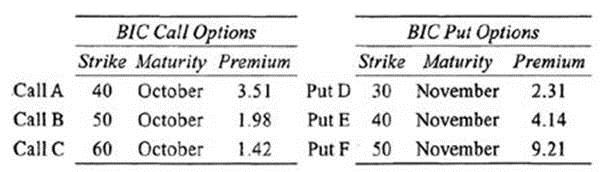
Mabry wants to hedge the large BIC equity position in his portfolio, which closed yesterday (June 1) at $42 per share. Since Mabry is relatively inexperienced with utilizing derivatives in his portfolios, Mabry enlists the help of an analyst from another firm, James Grimell.
Mabry and Grimell arrange a meeting in Boston where Mabry discusses his expectations regarding the future returns of BIC's equity. Mabry expects BIC equity to make a recovery from the intense market scrutiny but wants to provide his portfolio with a hedge in case BIC has a negative surprise. Grimell makes the following suggestion:
"If you want to avoid selling the BIC position and are willing to earn only the risk-free rate of return, you should sell calls and buy puts on BIC stock with the same market premium. Alternatively, you could buy put options to manage the risk of your portfolio. I recommend waiting until the vega on the options rises, making them less attractive and cheaper to purchase."
If the gamma of Put E is equal to 0.081, which of the following correctly interprets the option's gamma?
An option's gamma measures the change in the delta for a change in the price of the underlying asset. The gamma of an option is highest when an option is at-the-money since the probability of moving in or out of the money is high. Put E is close to being at-the-money and because it has a gamma of greater than zero, the sensitivity of Put Es price to changes in BlC's stock price (i.e., the delta) is likely to change. The higher the gamma, the greater the change in delta given a change in stock price. (Study Session 17, LOS 60. f)