Deal of The Day! Hurry Up, Grab the Special Discount - Save 25% - Ends In 00:00:00 Coupon code: SAVE25
Welcome to Pass4Success

- Free Preparation Discussions

CFA Institute CFA-Level-II Exam - Topic 1 Question 118 Discussion

Posted by Celeste on May 16, 2026 at 03:09 PM

Jerry Sanders, CFA, has been asked to analyze the 20-year bonds of Marietta Tech, Inc., which are currently being held in a corporate bond portfolio managed by a colleague, and to recommend whether the bonds should be sold or held. The bonds currently have a yield spread of 1.55% over Treasuries.

Marietta Tech, Inc. designs, manufactures, and markets specialty trucks and truck bodies mounted on new truck chassis produced by others, including concrete mixers, refuse bodies, fire and emergency vehicles, defense trucks, cut-away and dry freight van bodies, refrigerated units, stake bodies, and other specialized trucks. Marietta also manufactures fiberglass wind deflectors, armored trucks, shuttle buses, and cargo vans. Marietta's customers are located in the United States and Canada.

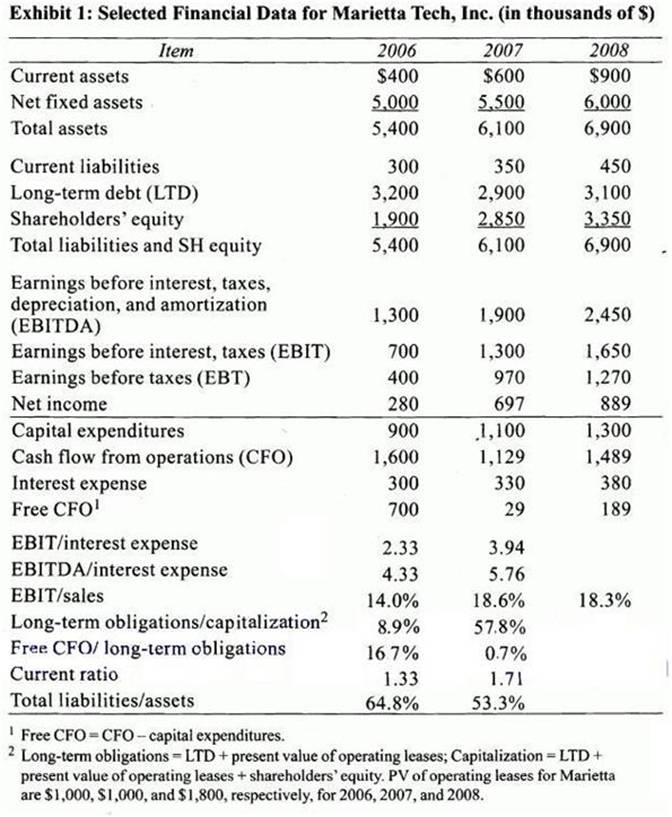
Exhibit 1: Selected Financial Data for Marietta Tech, Inc. (in thousands of $)
At lunch Sanders discusses the credit analysis of various types of bonds with Elizabeth Yan, who was just hired as a bond analyst. Yan makes the following statements:

Statement 1: An analysis of the issuer's business and operating risks is important to the analysis of corporate bond credit risk but not important for the credit analysis of asset backed securities (ABS).

Statement 2: The unique bond covenants in a municipal bond's trust indenture require an additional level of credit analysis not necessary in a corporate credit analysis.

After lunch Sanders asks Tatiana Petrovich in the municipal bond department for her opinion on the most important factors in the risk assessment of tax-backed municipal debt. Petrovich identifies three factors:

1. Ameasure of debt burden, such as debt-per-capita in the tax jurisdiction.

2. An evaluation of tax collection rates and intergovernmental revenue ability.

3. Analysis of the municipality's budgetary policies as an indication of financial discipline.

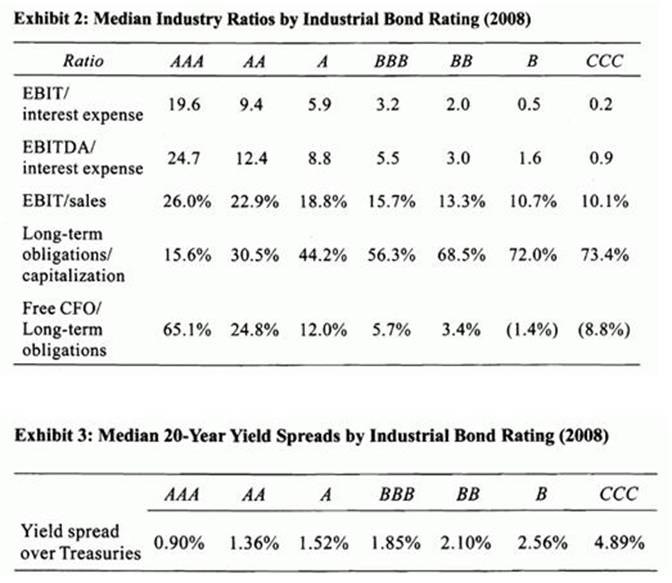
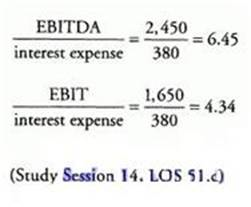
Sanders first analyzes Marietta's 2008 EBIT-to-interest expense and EBITDA-to-interest expense and compares them to the median ratios from Exhibit 2. Relative to the BBB medians for the respective ratios:

Suggested Answer: A

Both the 2008 EBITDA/interest and the EBIT/interest ratios for Marietta are greater than their comparable indusuy medians of 5.5 and 3.2, icspcctivcly.

Get Premium CFA-Level-II Questions as Interactive Web-Based Practice Test or PDF Real Exam Format Detailed Explanations Instant Access Get Your Practice Test
21 comments · newest first
AH
Ahmad 4 days ago
I think Marietta's ratios are strong. They should hold the bonds.
JE
Jennie 10 days ago
I agree, holding seems safer right now.
SK
Skye 15 days ago
I feel like we should hold.
AM
Amalia 20 days ago
True, but the yield spread is decent.
MI
Mitzie 25 days ago
But what if the market changes?
DI
Dick 1 month ago
Definitely, I lean towards option A.
GE
German 1 month ago
I think Marietta's ratios are strong.
CL
Clement 1 month ago
Totally agree, the debt burden factor is crucial for municipalities.
SH
Shawna 2 months ago
Both ratios being below BBB median? That's a red flag.
HE
Herminia 2 months ago
Surprised that municipal bonds need more analysis than corporate ones!
LE
Leslie 2 months ago
I think Statement 1 is off; ABS still need business risk analysis.
SH
Sharmaine 2 months ago
Marietta's yield spread is pretty decent at 1.55%.
ER
Eric 2 months ago
The unique covenants in municipal bonds do need extra analysis, for sure!
IS
Isabelle 2 months ago
Wait, are we really trusting those ratios? Seems risky.
DE
Delisa 3 months ago
Not sure about that, I’d sell if the ratios are below BBB medians.
VA
Valentin 3 months ago
I think holding the bonds makes sense given the current spread.
AR
Art 3 months ago
Marietta's yield spread is pretty solid at 1.55%.
YO
Yoko 3 months ago
I vaguely remember that if one ratio is greater than the median and the other is not, it could suggest mixed signals about the company's credit risk. I hope I can apply that here.
SA
Salena 3 months ago
I feel like I might be mixing up the definitions of EBIT and EBITDA. I hope I remember correctly that higher ratios generally indicate better coverage of interest expenses.
CH
Chau 3 months ago
I think I practiced a question similar to this where we had to compare ratios to medians. If I recall correctly, it was crucial to see if both ratios exceeded the median to indicate stronger creditworthiness.
DA
Dannie 5 months ago
I remember studying the importance of EBIT and EBITDA ratios in assessing credit risk, but I'm not entirely sure how Marietta's numbers stack up against the BBB medians.
0/2000 characters

Save Cancel