Deal of The Day! Hurry Up, Grab the Special Discount - Save 25% - Ends In 00:00:00 Coupon code: SAVE25
Welcome to Pass4Success

- Free Preparation Discussions

AutoDesk RVT_ELEC_01101 Exam - Topic 5 Question 15 Discussion

Refer to exhibits.What is the demand load on Panel B?
B) 55kVA
A) 65kVA
C) 30kVA
D) 40kVA

AutoDesk RVT_ELEC_01101 Exam - Topic 5 Question 15 Discussion

Actual exam question for AutoDesk's RVT_ELEC_01101 exam
Question #: 15
Topic #: 5
[All RVT_ELEC_01101 Questions]

Refer to exhibits.

What is the demand load on Panel B?

Show Suggested Answer Hide Answer
Suggested Answer: B

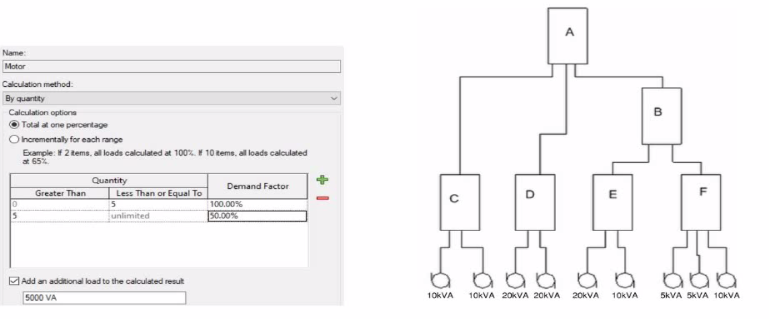
In Revit Electrical, Demand Factors are applied through Load Classifications to compute an Estimated Demand Load rather than simply summing connected loads. The documentation states: ''You use demand factors to adjust the rating of the main service... Demand factors are assigned to load classifications, and load classifications are assigned to device connectors. The estimated load for a device is calculated by multiplying the load by the demand factor. ... The panel schedule can also display the load for each load classification.''

In the exhibit's Demand Factor definition (for the Motor classification), the Calculation method is By quantity with Total at one percentage selected. Two quantity ranges are defined: 0--5 items at 100% and 5--unlimited at 50%. An additional checkbox adds an extra fixed load of 5000 VA to the calculated result. (This follows Revit's behavior of applying the selected demand factor to the connected load and then adding any specified additional load to the result for that classification.)

Panel B feeds only panels E and F. The connected motor loads downstream are:

Panel E: 20 kVA + 10 kVA = 30 kVA

Panel F: 5 kVA + 5 kVA + 10 kVA = 20 kVA

Total connected motor load on B = 30 + 20 = 50 kVA (five items).

Because five items fall in the 0--5 range at 100%, the demand factor is 100% 50 kVA. Per the definition, add an additional load of 5000 VA (5 kVA) to the calculated result:

Demand Load on Panel B = 50 kVA 100% + 5 kVA = 55 kVA.

Therefore, the correct choice is 55 kVA.

References: Revit MEP Electrical documentation -- Demand Factors (assignment to load classifications, multiplication to compute estimated load, and display in panel schedules).


Contribute your Thoughts:

0/2000 characters
Caprice
3 days ago
C) 30kVA feels too low for Panel B. What do you think?
upvoted 0 times
...
Shaunna
8 days ago
I'm leaning towards B) 55kVA. Seems more balanced.
upvoted 0 times
...
Laurene
14 days ago
I think it's A) 65kVA. Looks like a heavy load.
upvoted 0 times
...
Alysa
19 days ago
Not sure about that, could be 55kVA too.
upvoted 0 times
...
Hui
24 days ago
I agree, 30kVA doesn't make sense here.
upvoted 0 times
...
Kimi
29 days ago
Wait, is it really 40kVA? That seems low.
upvoted 0 times
...
Lorean
1 month ago
Definitely 65kVA, no doubt about it.
upvoted 0 times
...
Arlette
1 month ago
I think the demand load is 55kVA.
upvoted 0 times
...
Charlesetta
1 month ago
I practiced a question like this last week, and I think the answer was 30kVA, but I could be mixing it up with another problem.
upvoted 0 times
...
Barb
2 months ago
I’m a bit confused about how to interpret the exhibits. I thought demand loads were usually higher, so maybe 65kVA?
upvoted 0 times
...
Na
2 months ago
I remember a similar question where we had to determine the load based on panel specifications. I feel like 40kVA could be the right answer.
upvoted 0 times
...
Rodrigo
2 months ago
I think the demand load might be around 55kVA, but I'm not entirely sure how to calculate it from the exhibits.
upvoted 0 times
...

Save Cancel