Free Preparation Discussions
 MENU
MENU
Free Arcitura Education S90.20 Exam Dumps August 2026
Here you can find all the free questions related with Arcitura Education SOA Security Lab (S90.20) exam. You can also find on this page links to recently updated premium files with which you can practice for actual Arcitura Education SOA Security Lab Exam. These premium versions are provided as S90.20 exam practice tests, both as desktop software and browser based application, you can use whatever suits your style. Feel free to try the SOA Security Lab Exam premium files for free, Good luck with your Arcitura Education SOA Security Lab Exam.MultipleChoice
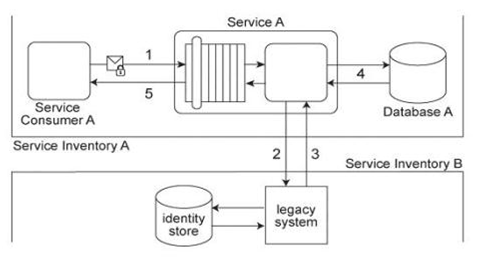
Service Consumer A submits a request message with security credentials to Service A (1). The identity store that Service A needs to use in order to authenticate the security credentials can only be accessed via a legacy system that resides in a different service inventory. Therefore, to authenticate Service Consumer A, Service A must first forward the security credentials to the legacy system (2). The legacy system then returns the requested identity to Service A (3). Service A authenticates Service Consumer A against the identity received from the legacy system. If the authentication is successful, Service A retrieves the requested data from Database A (4), and returns the data in a response message sent back to Service Consumer A (5). Service A belongs to Service Inventory A which further belongs to Security Domain A and the legacy system belongs to Service Inventory B which further belongs to Security Domain B .(The legacy system is encapsulated by other services within Service Inventory B, which are not shown in the diagram.) These two security domains trust each other. Communication between Service A and the legacy system is kept confidential using transport-layer security. It was recently discovered that a malicious attacker, posing as Service Consumer A, has been accessing Service A .An investigation revealed that these attacks occurred because security credentials supplied by Service Consumer A were transmitted in plaintext. Furthermore, vulnerabilities to replay attacks and malicious intermediaries have been detected. Which of the following statements describes a solution that can counter these types of attacks?
Also, list the industry standards required by the proposed solution.
MultipleChoice
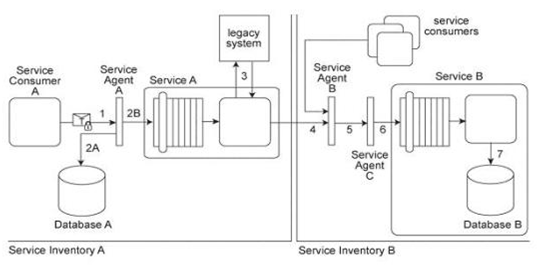
Service Consumer A sends a request message with an authentication token to Service A, but before the message reaches Service A, it is intercepted by Service Agent A (1). Service Agent A validates the security credentials and also validates whether the message is compliant with Security Policy A .If either validation fails, Service Agent A rejects the request message and writes an error log to Database A (2A). If both validations succeed, the request message is sent to Service A (2B). Service A retrieves additional data from a legacy system (3) and then submits a request message to Service B Before arriving at Service B, the request message is intercepted by Service Agent B (4) which validates its compliance with Security Policy SIB then Service Agent C (5) which validates its compliance with Security Policy B .If either of these validations fails, an error message is sent back to Service A .that then forwards it to Service Agent A so that it the error can be logged in Database A (2A). If both validations succeed, the request message is sent to Service B (6). Service B subsequently stores the data from the message in Database B (7). Service A and Service Agent A reside in Service Inventory A .Service B and Service Agents B and C reside in Service Inventory B .Security Policy SIB is used by all services that reside in Service Inventory B .Service B can also be invoked by other service consumers from Service Inventory B .Request messages sent by these service consumers must also be compliant with Security Policies SIB and B .Access to the legacy system in Service Inventory A is currently only possible via Service A, which means messages must be validated for compliance with Security Policy A .A new requirement has emerged to allow services from Service Inventory B to access the legacy system via a new perimeter service that will be dedicated to processing request messages from services residing in Service Inventory B .Because the legacy system has no security features, all security processing will need to be carried out by the perimeter service. However, there are parts of Security Policy A that are specific to Service A and do not apply to the legacy system or the perimeter service. Furthermore, response messages sent by the perimeter service to services from Service Inventory B will still need to be validated for compliance to Security Policy B and Security Policy SIB .How can the Policy Centralization pattern be correctly applied without compromising the policy compliance requirements of services in both service inventories?
MultipleChoice
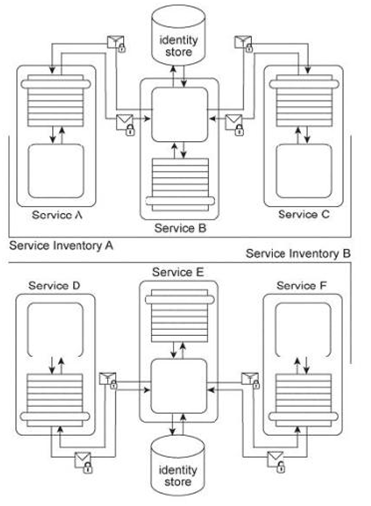
Services A, B, and C reside in Service Inventory A and Services D, E, and F reside in Service Inventory B .Service B is an authentication broker that issues WS-Trust based SAML tokens to Services A and C upon receiving security credentials from Services A and C .Service E is an authentication broker that issues WS-Trust based SAML tokens to Services D and F upon receiving security credentials from Services D and E .Service B uses the Service Inventory A identify store to validate the security credentials of Services A and C .Service E uses the Service Inventory B identity store to validate the security credentials of Services D and F .To date, the two service inventories have existed independently from each other. However, a requirement has emerged that the services in Service Inventory A need to be able to use the services in Service Inventory B, and vice versa. How can cross-service inventory message exchanges be enabled with minimal changes to the existing service inventory architectures and without introducing new security mechanisms?
MultipleChoice
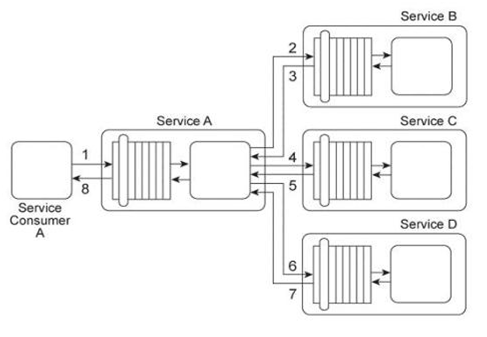
Service A provides a data retrieval capability that can be used by a range of service consumers, including Service Consumer A .In order to retrieve the necessary data, Service Consumer A first sends a request message to Service A (1). Service A then exchanges request and response messages with Service B (2, 3), Service C (4, 5), and Service D (6. 7). After receiving all three response messages from Services B .C .and D, Service A assembles the collected data into a response message that it returns to Service Consumer A (8). The owner of Service A charges service consumers for each usage of the data retrieval capability. Recently, the owner of Service Consumer A has complained that the data returned by Service A is incorrect, incomplete, and from invalid sources. As evidence, the Service Consumer A owner has presented the owner of Service A with sample messages containing the incorrect and incomplete contents. As a result, the Service Consumer A owner has refused to pay the usage fees. Subsequent to an internal investigation, the owner of Service A determines that the data returned by Service A is consistently correct and complete. There are suspicions that the Service Consumer A owner is altering the original messages and issuing these complaints fraudulently in order to avoid paying the usage fees. How can the owner of Service A prove that Service A is returning correct and complete data and that this data originated from the correct sources?
MultipleChoice
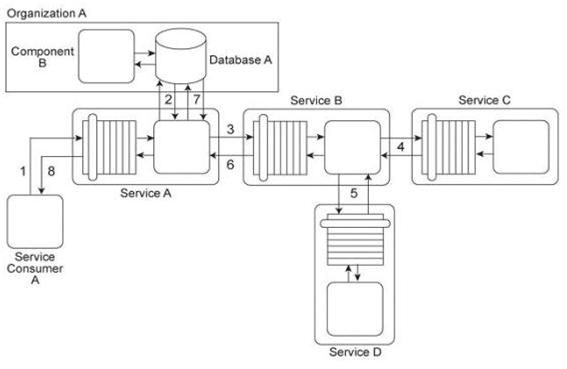
Service Consumer A sends a request message to Service A (1) after which Service A retrieves financial data from Database A (2). Service A then sends a request message with the retrieved data to Service B (3). Service B exchanges messages with Service C (4) and Service D (5), which perform a series of calculations on the data and return the results to Service A .Service A uses these results to update Database A (7) and finally sends a response message to Service Consumer A (8). Component B has direct, independent access to Database A and is fully trusted by Database A .Both Component B and Database A reside within Organization A .Service Consumer A and Services A, B, C, and D are external to the organizational boundary of Organization A .Service A has recently experienced an increase in the number of requests from Service Consumer A .However, the owner of Service Consumer A has denied that Service Consumer A actually sent these requests. Upon further investigation it was determined that several of these disclaimed requests resulted in a strange behavior in Database A, including the retrieval of confidential data. The database product used for Database A has no feature that enables authentication of consumers. Furthermore, the external service composition (Services A, B, C, D) must continue to operate at a high level of runtime performance. How can this architecture be improved to avoid unauthenticated access to Database A while minimizing the performance impact on the external service composition?
MultipleChoice
Services A, B, and C reside in Service Inventory A and Services D, E, and F reside in Service Inventory B .Service B is an authentication broker that issues WS-Trust based SAML tokens to Services A and C upon receiving security credentials from Services A and C .Service E is an authentication broker that issues WS-Trust based SAML tokens to Services D and F upon receiving security credentials from Services D and E .Service B uses the Service Inventory A identify store to validate the security credentials of Services A and C .Service E uses the Service Inventory B identity store to validate the security credentials of Services D and F .It is decided to use Service E as the sole authentication broker for all services in Service Inventories A and B .Service B is kept as a secondary authentication broker for load balancing purposes. Specifically, it is to be used for situations where authentication requests are expected to be extra time consuming in order to limit the performance burden on Service E .Even though Service B has all the necessary functionality to fulfill this new responsibility, only Service E can issue SAML tokens to other services. How can these architectures be modified to support these new requirements?

MultipleChoice
Service Consumer A sends a request message to Service A (1), after which Service A sends a request message to Service B (2). Service B forwards the message to have its contents calculated by Service C (3). After receiving the results of the calculations via a response message from Service C (4), Service B then requests additional data by sending a request message to Service D (5). Service D retrieves the necessary data from Database A (6), formats it into an XML document, and sends the response message containing the XML-formatted data to Service B (7). Service B appends this XML document with the calculation results received from Service C, and then records the entire contents of the XML document into Database B (8). Finally, Service B sends a response message to Service A (9) and Service A sends a response message to Service Consumer A (10). Services A, B and D are agnostic services that belong to Organization A and are also being reused in other service compositions. Service C is a publicly accessible calculation service that resides outside of the organizational boundary. Database A is a shared database used by other systems within Organization A and Database B is dedicated to exclusive access by Service B .Service B has recently been experiencing a large increase in the volume of incoming request messages. It has been determined that most of these request messages were auto-generated and not legitimate. As a result, there is a strong suspicion that the request messages originated from an attacker attempting to carry out denial-of-service attacks on Service B .Additionally, several of the response messages that have been sent to Service A from Service B contained URI references to external XML schemas that would need to be downloaded in order to parse the message data. It has been confirmed that these external URI references originated with data sent to Service B by Service C .The XML parser currently being used by Service A is configured to download any required XML schemas by default. This configuration cannot be changed. What steps can be taken to improve the service composition architecture in order to avoid future denial-of-service attacks against Service B and to further protect Service A from data access-oriented attacks?

MultipleChoice
Service Consumer A sends a request message to Service A (1) after which Service A retrieves financial data from Database A (2). Service A then sends a request message with the retrieved data to Service B (3). Service B exchanges messages with Service C (4) and Service D (5), which perform a series of calculations on the data and return the results to Service A .Service A uses these results to update Database A (7) and finally sends a response message to Service Consumer A (8). Component B has direct, independent access to Database A and is fully trusted by Database A .Both Component B and Database A reside within Organization A .Service Consumer A and Services A, B, C, and D are external to the organizational boundary of Organization A .

Component B is considered a mission critical program that requires guaranteed access to and fast response from Database A .Service A was recently the victim of a denial of service attack, which resulted in Database A becoming unavailable for extended periods of time (which further compromised Component B). Additionally, Services B, C, and D have repeatedly been victims of malicious intermediary attacks, which have further destabilized the performance of Service A .How can this architecture be improved to prevent these attacks?
Options