
Deal of The Day! Hurry Up, Grab the Special Discount - Save 25% - Ends In 00:00:00 Coupon code: SAVE25
Welcome to Pass4Success

- Free Preparation Discussions

Arcitura Education C90.06 Exam - Topic 1 Question 2 Discussion

Physical Server A hosts Hypervisor A which hosts Virtual Server A, Virtual Server B and an active cluster comprised of three virtual servers. Virtual Server A hosts Ready-Made Environment A. Ready-Made Environment A uses Cloud Storage Device A to store data related to the ready-made environment and its users. Cloud Service A is hosted by a high-availability (HA) virtual server cluster. Hypervisor A is a cluster-enabled hypervisor.Developers access Ready-Made Environment A to work on the development of a new solution (1).During this usage. Ready-Made Environment A regularly reads and writes data to Cloud Storage Device A (2). Cloud Service Consumer B accesses Cloud Service A (3). Cloud Service A queries data residing in Cloud Storage Device A in response to processing requests from Cloud Service Consumer B (4).Hypervisor A is made part of a cluster of hypetvisors. Ready-Made Environment A, which is still hosted by Virtual Server Aon Hypervisor A, subsequently becomes unexpectedly unavailable. It then takes twenty minutes to pass before Virtual Server A and Ready-Made Environment A become available again on Hypervisor B (a hypervisor that is also part of the hypervisor cluster). This delay is considered unacceptable by Cloud Consumer A. Furthermore, after being relocatedto Hypervisor B, Virtual Server A is unable to connect to the network. By the time the cloud provider rectifies this second problem, Cloud Consumer A experiences a total of two hours of downtime.Which of the following statements describes a solution that can minimize or entirely avoid a delay for the runtime relocation of Ready-Made Environment A?
C) The Non-Disruptive Service Relocation pattern can be applied to place a secondary copy of Ready-Made Environment A on Hypervisor B. The Persistent Virtual Network Configuration pattern can be applied so that virtual servers retain network configurations when moving to other hypervisors.
A) The Load Balanced Virtual Server Instances pattern can be applied in combination with the Elastic Network Capacity pattern in order to establish a system whereby Ready-Made Environment A can be smoothly transitioned between hypervisors in the same cluster, while its underlying virtual server maintains the network connection.
B) The Hypervisor Clustering pattern was incorrectly applied and therefore needs to be re-applied correctly in order to establish a native system capable of instantly relocating virtual servers between hypervisors within the same cluster. The Direct I/O Access pattern can then also be applied so that the virtual servers retain their network configurations regardless of which hypervisor within the cluster they reside on.
D) The Load Balanced Virtual Server Instances and Persistent Virtual Network Configuration patterns can be applied together to ensure that the virtual servers retain their network configurations when moving to another hypervisor. The Redundant Storage pattern can further be applied to move the ready-made environment to another hypervisor without service impact.

Arcitura Education C90.06 Exam - Topic 1 Question 2 Discussion

Actual exam question for Arcitura Education's C90.06 exam
Question #: 2
Topic #: 1
[All C90.06 Questions]

Physical Server A hosts Hypervisor A which hosts Virtual Server A, Virtual Server B and an active cluster comprised of three virtual servers. Virtual Server A hosts Ready-Made Environment A. Ready-Made Environment A uses Cloud Storage Device A to store data related to the ready-made environment and its users. Cloud Service A is hosted by a high-availability (HA) virtual server cluster. Hypervisor A is a cluster-enabled hypervisor.
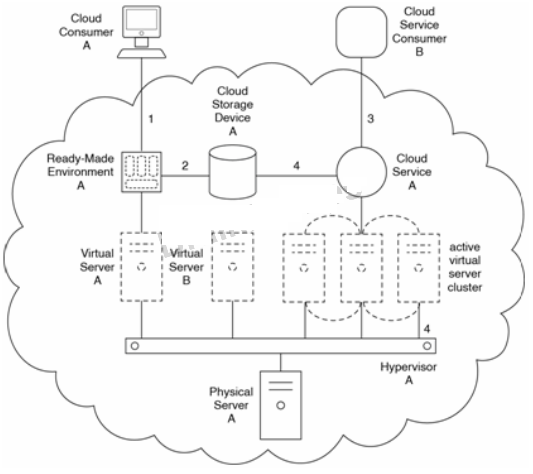
Developers access Ready-Made Environment A to work on the development of a new solution (1).

During this usage. Ready-Made Environment A regularly reads and writes data to Cloud Storage Device A (2). Cloud Service Consumer B accesses Cloud Service A (3). Cloud Service A queries data residing in Cloud Storage Device A in response to processing requests from Cloud Service Consumer B (4).

Hypervisor A is made part of a cluster of hypetvisors. Ready-Made Environment A, which is still hosted by Virtual Server Aon Hypervisor A, subsequently becomes unexpectedly unavailable. It then takes twenty minutes to pass before Virtual Server A and Ready-Made Environment A become available again on Hypervisor B (a hypervisor that is also part of the hypervisor cluster). This delay is considered unacceptable by Cloud Consumer A. Furthermore, after being relocated

to Hypervisor B, Virtual Server A is unable to connect to the network. By the time the cloud provider rectifies this second problem, Cloud Consumer A experiences a total of two hours of downtime.

Which of the following statements describes a solution that can minimize or entirely avoid a delay for the runtime relocation of Ready-Made Environment A?

Show Suggested Answer Hide Answer
Suggested Answer: C

Contribute your Thoughts:

0/2000 characters
Carlene
7 months ago
Not sure about option C, seems a bit complicated for a simple fix.
upvoted 0 times
...
Paulina
7 months ago
The Load Balanced pattern sounds like a solid approach too.
upvoted 0 times
...
Leota
8 months ago
Wait, how did they not keep the network connection? That's surprising!
upvoted 0 times
...
Grover
8 months ago
I think option B makes the most sense here.
upvoted 0 times
...
Yvonne
8 months ago
Hypervisor A is cluster-enabled, so it should handle relocations better.
upvoted 0 times
...
Mireya
8 months ago
This seems like a straightforward question. I'd use a record-triggered flow to handle the status change and make the necessary callouts to the external systems.
upvoted 0 times
...
Eden
8 months ago
This question looks straightforward. I'll just select the authentication methods I know Splunk supports - LDAP, SAML, and RADIUS.
upvoted 0 times
...

Save Cancel