Arcitura Education C90.03 Exam - Topic 7 Question 2 Discussion
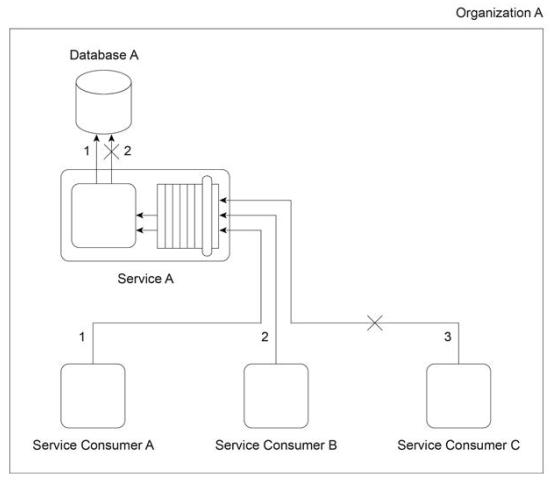
Organization A has been expanding and, as a result, is outgrowing the processing capacity of its on-premise Service A implementation. It is determined that this is due to usage thresholds of Service A and complex data processing limitations in Database A . The diagram depicts Organization A's current on-premise environment, where Service Consumers A . B and C attempt to access Service A at the same time. Service Consumer A successfully accesses Service A, which then successfully retrieves the requested data (1). Service Consumer B successfully accesses Service A, but due to the complex data structure, the request for the data times out and fails (2). Finally, Service Consumer C attempts to access Service A, but is rejected because Service A is unable to accept more concurrent requests.Organization A is required to continue using its on-premise Service A implementation, with the exception of Database A, which does not need to remain on-premise. Database A is dedicated to Service A and is comprised of relational data. Which of the following statements provides a solution that uses cloud-based IT resources to solve the performance limitations of Service A and Database A?
A) The virtual server and resource replication mechanisms can be implemented to replicate Service A and Database A across both on-premise and cloud environments. This enables on-demand usage in that requests sent by Service Consumers A, B and C will automatically be redirected to the replicated service and/or database. As a result, Service A' s usage thresholds will no longer result in rejected requests and Database A' s processing limitations will no longer result in failed data access attempts.
B) A cloud balancing solution can be implemented within the public cloud, whereby a redundant Cloud Service A implementation is established. Cloud Service A becomes the first point of contact for Service Consumers A, B and C (thereby turning them into Cloud Service Consumers A. B and C). Upon reaching its usage threshold (which will be higher than the on-premise Service A), Cloud Service A automatically routes usage requests to Service A . The resource replication mechanism is implemented within the cloud to establish a replicated Database A that can further be used to load balance data access requests from Cloud Service A or Service A .
C) Automated scaling listener mechanisms can be implemented in both the on-premise and cloud environments. Using built-in resiliency features, these service agents can be configured to coordinate the routing of messages between the on-premise Service A implementation and a redundant Cloud Service A implementation. This dynamic functionality can avoid service usage thresholds in both Service A and Cloud Service A .

 MENU
MENU
Jettie
10 months agoJanessa
10 months agoStevie
11 months agoCherelle
11 months agoStevie
11 months agoTheodora
11 months agoJunita
11 months agoDawne
11 months ago