
Free Preparation Discussions
 MENU
MENU
APA FPC-Remote Exam Questions
- Topic 1: Core Payroll Concepts: This section of the exam measures the skills of Payroll Specialists and covers fundamental payroll principles, including worker classification, Fair Labor Standards Act (FLSA) requirements, and employment tax regulations. Candidates must understand employee benefits, employer and employee tax forms, and their professional responsibilities in payroll administration. Additionally, they must be familiar with various methods and timing of payroll processing to ensure compliance with industry standards.
- Topic 2: Compliance / Research and Resources: This section of the exam measures the skills of Compliance Analysts and covers the essential legal and regulatory requirements that impact payroll operations. Candidates must understand escheatment laws, reporting obligations, and record retention policies to ensure proper documentation and compliance. They are also required to be familiar with penalties for non-compliance and navigate global payroll regulations as businesses expand across international markets.
- Topic 3: Calculation of the Paycheck: This section of the exam measures the skills of Payroll Coordinators and covers the accurate computation of employee compensation, benefits, and deductions. Candidates must demonstrate proficiency in processing involuntary and voluntary deductions, employer tax contributions, and fringe benefits. A strong understanding of total payroll calculations, including withholding taxes and compliance with payroll tax regulations, is essential for success in this domain.
- Topic 4: Payroll Process and Supporting Systems and Administration: This section of the exam measures the skills of Payroll Administrators and covers the key components of payroll systems and administration. Candidates must be able to maintain accurate payroll master files, understand core payroll functionalities, and ensure payroll systems support seamless processing. Knowledge of business continuity planning is also critical to safeguard payroll operations in case of disruptions.
- Topic 5: Payroll Administration and Management: This section of the exam measures the skills of Payroll Managers and covers essential administrative processes, policies, and communication strategies necessary for effective payroll management. Candidates must be familiar with intradepartmental agreements that define payroll responsibilities and procedures. Additionally, strong customer service and communication skills are required to address payroll-related inquiries and ensure a smooth payroll experience for employees.
- Topic 6: Audits: This section of the exam measures the skills of Internal Auditors and covers the essential controls and procedures required to ensure payroll accuracy and compliance. Candidates must understand internal controls, payroll system controls, and accounting system controls to detect and prevent errors. They must also be well-versed in payroll audit policies and procedures to maintain compliance with industry and regulatory standards.
- Topic 7: Accounting: This section of the exam measures the skills of Payroll Accountants and covers the financial aspects of payroll processing. Candidates must understand payroll journal entries, financial reporting principles, and account reconciliation processes. A solid grasp of payroll-related accounting principles is crucial for ensuring accurate financial records and regulatory compliance.FPC-Remote
Free APA FPC-Remote Exam Actual Questions
Note: Premium Questions for FPC-Remote were last updated On Sep. 22, 2026 (see below)
Exempt employee master file data should include all of the following elements EXCEPT:
Comprehensive and Detailed Explanation:
The employee master file for an exempt employee should include:
Payment Dates (B) -- To ensure timely payroll processing.
Work Location (C) -- For tax and compliance purposes.
Rate of Pay (D) -- Required for salary calculations.
Option A (Minimum Wage) is incorrect because exempt employees are not subject to minimum wage laws under FLSA.
Fair Labor Standards Act (FLSA) -- Exempt Employee Requirements
Payroll.org -- Employee Master File Best Practices
Using the following information from a payroll journal, calculate the total Social Security tax liability for the first payroll of the year:
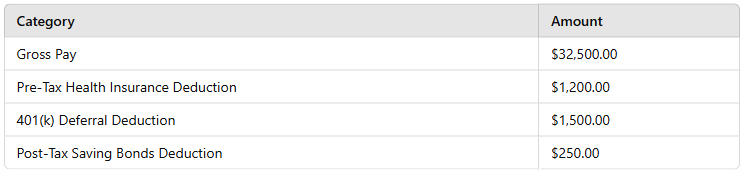
Comprehensive and Detailed Explanation:
Social Security tax is 6.2% for both the employer and employee, so total liability is 12.4% of Social Security taxable wages.
Calculate Social Security taxable wages:
Gross pay: $32,500.00
Less pre-tax deductions (Health Insurance & 401k do NOT reduce Social Security taxable wages):
Taxable Wages = $32,500.00 - $1,200.00 = $31,300.00
Calculate Social Security tax (12.4% total for employer & employee):
$31,300 12.4% = $3,881.20
Thus, the correct answer is C. $3,881.20.
IRS Publication 15 -- Employer's Tax Guide
Payroll.org -- Social Security and Medicare Tax Rules
The types of accounts used by businesses to classify transactions are:
Comprehensive and Detailed Explanation:
Business transactions are classified using five main types of accounts:
Asset -- Resources owned (e.g., cash, equipment, accounts receivable).
Liability -- Amounts owed (e.g., payroll taxes, loans).
Expense -- Costs incurred to operate the business (e.g., payroll expenses).
Revenue -- Income earned (e.g., sales, service fees).
Equity -- Owner's interest in the business (e.g., retained earnings).
Option A is incorrect because 'Inventory' is a type of asset, not a separate category.
Option C is incorrect because 'Cash' is a subcategory of assets, not a primary account type.
Option D is incorrect because 'Net Income' is the result of revenues minus expenses, not a separate account category.
GAAP Accounting Principles -- Types of Accounts
Payroll.org -- Payroll Accounting Classification
All of the following workflow mapping descriptions are correct EXCEPT:
Comprehensive and Detailed Explanation:
Workflow mapping is a visual representation of payroll processes to ensure efficiency and accuracy.
Option A (Logical thought processes) ensures clarity and eliminates assumptions.
Option B (Depictions of sequences) accurately describes workflow design.
Option C (Steps follow without delay) ensures process efficiency.
Option D is incorrect because it describes Service Level Agreements (SLA), not workflow mapping.
Payroll.org -- Payroll Workflow Mapping Guide
Process Improvement Standards -- Payroll System Optimization
Where should a firm's business transactions FIRST be recorded?
Comprehensive and Detailed Explanation:
A Journal (Option C) is the first place where transactions are recorded chronologically, before being posted to the General Ledger.
Option A (Balance Sheet) is incorrect because it is a financial statement, not a transaction log.
Option B (General Ledger) is incorrect because transactions must first be recorded in a journal before being posted.
Option D (Trial Balance) is incorrect because it is a summary of ledger balances used for reconciliation.
GAAP Accounting Principles -- Transaction Recording
Payroll.org -- Payroll Accounting Workflow
- Select Question Types you want
- Set your Desired Pass Percentage
- Allocate Time (Hours : Minutes)
- Create Multiple Practice tests with Limited Questions
- Customer Support
Sharon Rogers
2 days agoTiffany Nguyen
17 days agoLisa Stewart
1 month agoCynthia Lopez
2 months agoEmily Harris
2 months agoTimothy Bell
3 months agoDennis Allen
3 months agoMargaret Stewart
4 months agoEdward Scott
4 months agoJeffrey Howard
5 months agoMatthew Sanchez
5 months agoJohn Anderson
5 months agoBetty Howard
5 months agoCynthia Miller
5 months agoDonald Morris
5 months agoLisa Taylor
5 months agoCarlton
6 months agoNoel
6 months agoSabrina
6 months agoJerilyn
7 months agoValda
7 months agoLyndia
7 months agoSanda
7 months agoLai
8 months agoLea
8 months agoHillary
8 months agoLanie
8 months agoKimberely
9 months agoMalcolm
9 months agoLucia
9 months agoMa
9 months agoMarilynn
10 months agoBelen
10 months agoMarylou
10 months agoJettie
10 months agoDwight
11 months agoArlette
11 months agoMarylin
11 months agoRickie
11 months agoTijuana
12 months agoSalley
12 months agoMayra
12 months agoClaribel
1 year agoThaddeus
1 year agoArlette
1 year agoAngelyn
1 year agoRodrigo
1 year agoKendra
1 year agoLaquita
1 year agoLemuel
1 year agoCathrine
1 year agoGeorgeanna
1 year agoThersa
1 year agoMelynda
1 year agoOliva
1 year agoArlyne
1 year agoSina
2 years agoGlory
2 years ago