
Free Preparation Discussions
 MENU
MENU
The Open Group OGA-031 Exam Questions
- Topic 1: Language Structure of The Open Group ArchiMate: This The Open Group OGA-031 exam topic gives an understanding of the basic components and syntax of ArchiMate language.
- Topic 2: Generic Metamodel of The Open Group ArchiMate: By covering the topic, The Open Group enterprise architects get familiarity with the overarching metamodel that defines the relationships and elements within ArchiMate.
- Topic 3: Relationships in The Open Group ArchiMate: This topic of the ArchiMate 3 Part 1 exam gives knowledge of the various types of relationships that can exist between different elements in The Open Group ArchiMate.
- Topic 4: Motivation Elements of The Open Group ArchiMate: In this topic, aspiring The Open Group enterprise architects get comprehensive understanding of the motivation aspects within the ArchiMate framework, including stakeholders, drivers, and goals.
Free The Open Group OGA-031 Exam Actual Questions
Note: Premium Questions for OGA-031 were last updated On Sep. 15, 2026 (see below)
What is an external active structure element that represents a point of access where one or more services are provided to the environment?
Comprehensive and Detailed in Depth
An Interface in ArchiMate represents an access point through which elements interact with services. It can be a Business Interface, Application Interface, or Technology Interface.
Interfaces serve as a boundary between internal and external systems, allowing controlled interactions. The ArchiMate 3.2 Specification explicitly states that interfaces expose services to the environment.
Archi User Guide
Consider the diagram which has color removed from it:

(A diagram showing two stacked horizontal bars labeled X and Y, connected by an arrow, and a circle with lines (Z) positioned between them.)
What is the correct description of this diagram?
Comprehensive and Detailed In-Depth
This ArchiMate Implementation & Migration Layer diagram represents an architecture evolution model, specifically showing two plateaus (X and Y) with a Gap (Z) in between them.
Plateaus in ArchiMate represent states of an enterprise architecture at different points in time.
Gaps represent the difference or missing elements between two architectural states, indicating what needs to change.
The circle with lines (Z) represents a Gap, which identifies what is missing or needs to be addressed when transitioning from Plateau X to Plateau Y.
Analysis of Answer Choices:
A. Two plateaus (X and Y) with a transition architecture (Z). Incorrect
A transition architecture is different from a gap.
A Transition Architecture provides an intermediate step between two plateaus, whereas this diagram is identifying a Gap between them.
ArchiMate 3.2 Specification, Section 7.4.3, defines Gaps as structural differences, not transition states.
B. A gap (Z) associated with two plateaus (X and Y). Correct Answer
The circle with lines (Z) is the correct representation of a Gap in ArchiMate.
Plateau X represents the 'Before' state, and Plateau Y represents the 'Target' state.
Z (Gap) represents what is missing or what must be addressed to move from X to Y.
ArchiMate 3.2 Specification, Section 7.4.3, states that Gaps are used in architecture migration to analyze missing capabilities or elements.
C. A deliverable (Z) exchanged between two projects (X and Y). Incorrect
A deliverable is typically represented as a document or artifact in ArchiMate, not as a Gap.
Z represents a missing element between states, not an exchanged deliverable.
D. Two nodes (X and Y) connected by a communication path (Z). Incorrect
Nodes and Communication Paths belong to the Technology Layer, but this diagram represents the Implementation & Migration Layer.
X and Y are plateaus, not technology nodes.
Final Answer: B. A gap (Z) associated with two plateaus (X and Y).
ArchiMate 3.2 Specification: Sections 7.4.1 (Plateau) and 7.4.3 (Gap).
Archi User Guide: Modeling architecture migration using Gaps and Plateaus.
Consider the diagram:
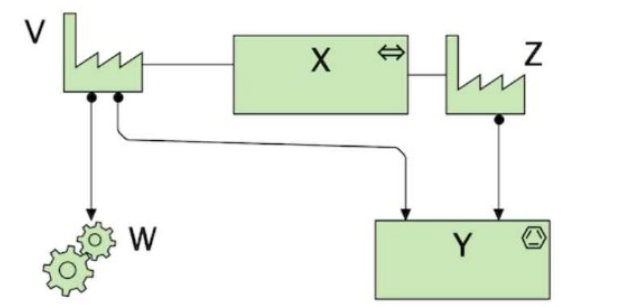
(A diagram showing V, W, X, and Y where:
V has a factory-like symbol.
W has a gear-like symbol.
X is connected to Y, which has a transportation-related symbol.)
What are elements V, W, and X?
Comprehensive and Detailed In-Depth
This ArchiMate Physical Layer diagram represents logistics and supply chain operations. The elements in the diagram align with physical infrastructure concepts used in ArchiMate 3.2.
Understanding the Diagram Elements:
V (Factory symbol) Represents a Factory or Production Facility, where goods are manufactured.
W (Gear symbol) Represents Raw Material or Equipment that is used in production.
X (Network or Transportation symbol) Represents Transportation or a Distribution network for moving goods.
Y (End-point receiving goods) Represents a logistics center, warehouse, or transportation endpoint.
This matches option D, where:
V = Factory The starting point of manufacturing.
W = Raw material Essential input for production.
X = Transportation Moving products to distribution centers.
Analysis of Answer Choices:
A. V = Production process, W = Finished Material, X = Transport network Incorrect
V is not a process; it is a physical location (Factory).
W represents raw material, not finished material.
X represents transportation, but V is wrongly classified as a process.
B. V = Equipment, W = Facility, X = Distribution channel Incorrect
V represents a Facility (Factory), not just Equipment.
W represents raw material, not a Facility.
X is more of a transportation network rather than a distribution channel.
C. V = Facility, W = Equipment, X = Distribution network Incorrect
W represents raw material, not just Equipment.
X represents Transportation, not strictly a distribution network.
D. V = Factory, W = Raw material, X = Transportation Correct Answer
This is the best match with the diagram's physical elements.
V (Factory) is the production source.
W (Raw material) is used in production.
X (Transportation) is the means of moving goods.
ArchiMate 3.2 Specification, Section 7.7, defines Facilities, Materials, and Transportation as part of the Physical Layer modeling concepts.
Final Answer: D. V = Factory, W = Raw material, X = Transportation.
ArchiMate 3.2 Specification: Sections 7.7 (Facilities & Physical Elements), 7.8 (Material Flow), and 7.9 (Distribution & Logistics).
Consider the diagram:

(A diagram showing "Acquire Insurance Product" decomposed into Develop Products, Market and Sell Products, Manage Policies and Claims, and Serve Customers.)
Which of the following describes the diagram?
Comprehensive and Detailed In-Depth
This diagram represents a value stream, which is a key concept in ArchiMate 3.2. A value stream describes how value is created and delivered across a sequence of activities. It is used to represent high-level business activities that contribute to the value creation for a stakeholder or customer.
The Acquire Insurance Product at the top level represents an end-to-end flow.
The sub-elements (Develop Products, Market and Sell Products, Manage Policies and Claims, and Serve Customers) depict how value is progressively built through different stages.
The dashed arrows indicate a flow of value from one stage to the next, typical in value streams.
Analysis of Answer Choices:
A. A set of processes for acquiring insurance products Incorrect.
Processes are typically lower-level activities depicted using process modeling, such as BPMN or a process flow diagram.
ArchiMate 3.2 Specification, Section 6.3.2, differentiates business processes from value streams.
B. A sequence of capabilities for acquiring insurance products Incorrect.
Capabilities represent the organization's abilities rather than sequential activities.
In ArchiMate, capabilities are more static, focusing on what the organization can do, rather than how value is delivered over time.
ArchiMate 3.2 Specification, Section 7.3, explains the distinction between capabilities and value streams.
C. A value stream for acquiring insurance products Correct Answer
A value stream represents a series of high-level activities that create value for a customer or stakeholder.
ArchiMate 3.2 Specification, Section 8.2.4, defines value streams as sequences that deliver value incrementally.
This exact pattern (top-level action decomposed into a structured sequence of stages) is a value stream.
D. A decomposition of the course of action for acquiring insurance products Incorrect.
Course of action is a concept in Strategy Layer of ArchiMate, referring to guidelines, policies, or directions rather than a flow of activities.
This is not a strategic breakdown, but rather a flow of value creation.
ArchiMate 3.2 Specification, Section 7.5, states that course of action is different from a structured value creation sequence.
Final Answer: C. A value stream for acquiring insurance products.
ArchiMate 3.2 Specification: Sections 6.3.2 (Business Process), 7.3 (Capabilities), 8.2.4 (Value Streams), and 7.5 (Course of Action).
What element types are defined in the top-level hierarchical structure of the language?
Comprehensive and Detailed in Depth
The ArchiMate Core Framework categorizes elements into three primary types:
Active Structure Elements -- Represent entities that perform behavior (e.g., business actors, applications).
Behavior Elements -- Represent functions, processes, or services.
Passive Structure Elements -- Represent objects or information (e.g., data objects, artifacts).
The ArchiMate 3.2 Specification explicitly defines these three primary element types.
Archi User Guide
- Select Question Types you want
- Set your Desired Pass Percentage
- Allocate Time (Hours : Minutes)
- Create Multiple Practice tests with Limited Questions
- Customer Support
Olivia Hall
15 days agoMohit Sharma
28 days agoEdward Hill
2 months agoAhmed Malik
2 months agoElizabeth Sanchez
3 months agoPooja Bhat
3 months agoCharles Taylor
4 months agoSarah Carter
5 months agoSharon White
5 months agoSteven Taylor
5 months agoEric Rogers
5 months agoEmily Bell
5 months agoDeborah Sanchez
5 months agoRichard Rodriguez
4 months agoLemuel
6 months agoMireya
6 months agoCasie
6 months agoMyra
6 months agoTommy
7 months agoBarrett
7 months agoGabriele
7 months agoLindsey
7 months agoLaurel
8 months agoVernell
8 months agoEarleen
8 months agoEna
8 months agoPearly
9 months agoFanny
9 months agoRessie
9 months agoJose
9 months agoCarmela
10 months agoClaudio
10 months agoLili
10 months agoCasie
10 months agoAlverta
11 months agoTamekia
11 months agoCheryl
11 months agoReena
11 months agoTracey
12 months agoChaya
12 months agoHolley
1 year agoGertude
1 year agoJoanna
1 year agoJanessa
1 year agoElvera
1 year agoLuis
1 year agoMyra
1 year agoLakeesha
1 year agoArlene
1 year agoShenika
1 year agoSabra
1 year agoTayna
1 year agoHana
2 years agoMona
2 years agoKarol
2 years agoRozella
2 years agoWava
2 years agoLatrice
2 years agoCiara
2 years agoShaun
2 years agoLatrice
2 years agoAmira
2 years agoAngelica
2 years agoKimberlie
2 years agoRodrigo
2 years agoLenna
2 years agoReed
2 years agoFannie
2 years agoShawna
2 years agoClay
2 years agoRhea
2 years agoCristina
2 years agoEllsworth
2 years agoLera
2 years agoCatina
2 years agoNada
2 years agoMaynard
2 years agoSharita
2 years agoLaura
2 years agoKasandra
2 years agoKassandra
2 years agoLynsey
2 years agoMerrilee
3 years ago