New Year Sale 2026! Hurry Up, Grab the Special Discount - Save 25% - Ends In 00:00:00 Coupon code: SAVE25

Welcome to Pass4Success

- Free Preparation Discussions

SAS A00-240 Exam - Topic 9 Question 42 Discussion

Actual exam question for SAS's A00-240 exam
Question #: 42
Topic #: 9
[All A00-240 Questions]

Given the following SAS data set TEST:
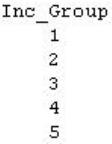
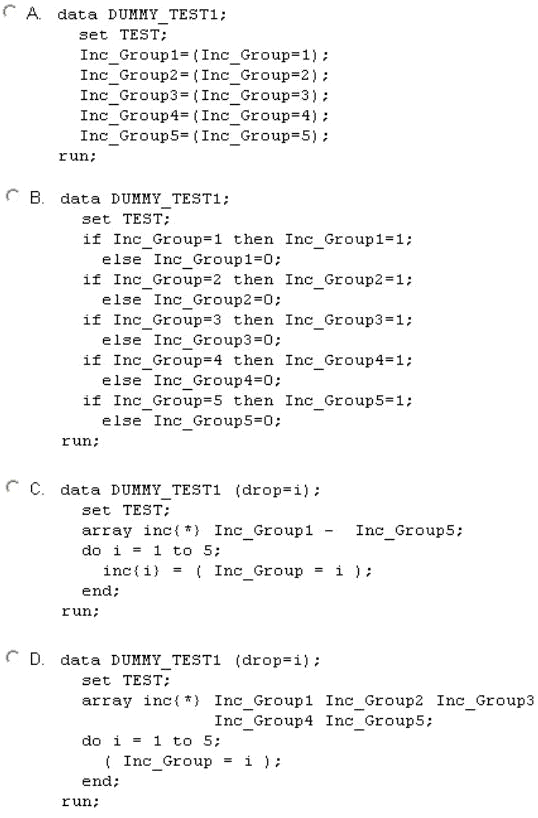
Which SAS program is NOT a correct way to create dummy variables?
Show Suggested Answer Hide Answer
Suggested Answer: D

Contribute your Thoughts:

0/2000 characters
Gilberto
4 months ago
Just to clarify, A and D are valid methods for dummy variables.
upvoted 0 times
...
Olive
4 months ago
Wait, are we sure about C? Seems off to me.
upvoted 0 times
...
Zona
4 months ago
I thought B was the odd one out, but I see the point.
upvoted 0 times
...
Dorothy
4 months ago
Totally agree, C is definitely wrong!
upvoted 0 times
...
Lashunda
5 months ago
Option C is the one that doesn't create dummy variables.
upvoted 0 times
...
Denny
5 months ago
I’m a bit confused about the differences between the options. I wish I had reviewed more examples before the exam.
upvoted 0 times
...
Dong
5 months ago
I recall a similar question where we had to identify the wrong syntax for dummy variables. I hope I can apply that knowledge here.
upvoted 0 times
...
Janna
5 months ago
I remember we practiced creating dummy variables, but I’m not sure which option is incorrect here.
upvoted 0 times
...
Ben
5 months ago
I think Option C might be the one that doesn’t follow the standard method we learned. It seems off somehow.
upvoted 0 times
...
Beckie
5 months ago
I'm leaning towards D - the present value of the positive cash flows. That seems to capture the essence of what we're trying to measure with expected value. But I'll double-check my notes just to be sure.
upvoted 0 times
...
Octavio
5 months ago
Okay, I think I've got this. With the protected LSP path being R1-R2-R3, and all links being equal cost, the detour LSP path for one-to-one link or node protection should be R1-R4-R5-R3. I'll select options B and D.
upvoted 0 times
...
Jettie
5 months ago
This looks straightforward, I think I can find the answer in the image.
upvoted 0 times
...

Save Cancel