
Free Preparation Discussions
 MENU
MENU
OMG-OCUP2-FOUND100 Exam - Topic 6 Question 47 Discussion
Topic #: 6
Choose the correct answer:
Consider the following class diagram:
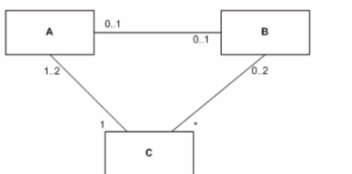
Which object diagram corresponds to it?
A)
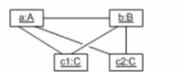
B)
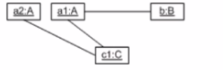
C)
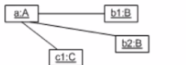
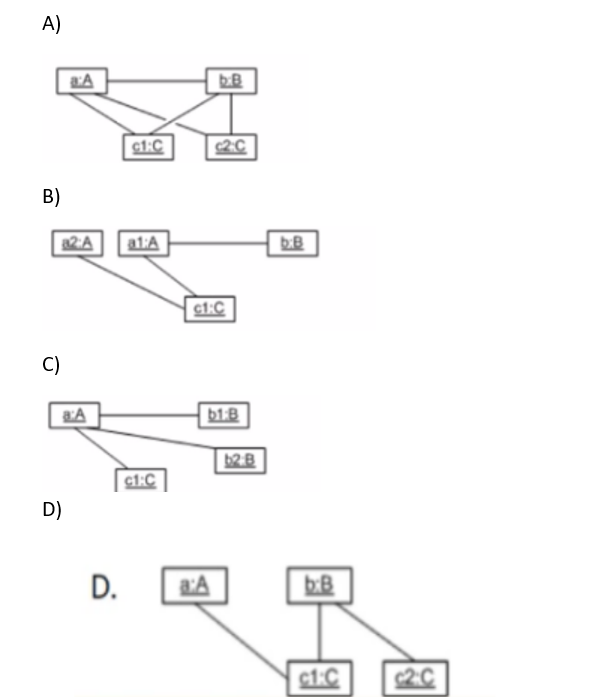
The question asks to identify which object diagram corresponds to the provided class diagram. In order to verify which object diagram is correct, we must look at the class diagram to understand the relationships and multiplicities between the classes, and then match these with the objects and links in the object diagrams.
The class diagram (not visible in your query but implied to be the reference for the object diagrams provided) must contain three classes, A, B, and C, with specific multiplicity relationships among them. Here's how we deduce the correct object diagram:
Multiplicity between A and C is '1..2', which means that for each instance of A there must be one or two links to instances of C.
Multiplicity between B and C is '0..2', which means that for each instance of B there are zero, one, or two links to instances of C.
Multiplicity between A and B is '0..1', which indicates that for each instance of A there can be zero or one link to an instance of B.
With these rules, we analyze the object diagrams:
Option A has one instance of A linked to two instances of C, which is correct according to the '1..2' multiplicity. However, there are two instances of B (b1 and b2) each linked to a single instance of C (c1), which violates the '0..2' multiplicity rule because it implies there should be two links from c1 to the B instances (b1 and b2) but instead, there are two separate links to the same instance of C (c1), which is not allowed.
Option B has similar issues where two instances of A (a2 and a1) are linked to a single instance of C, which violates the '1..2' multiplicity rule.
Option C shows each instance of A and B linked to their own separate instances of C. This violates the '1..2' multiplicity between A and C since there is only one link from A to C and does not show the possibility of two links which the multiplicity '1..2' would allow.
Option D shows a single instance of A linked to two instances of C (c1 and c2), which satisfies the '1..2' multiplicity. Additionally, there is a single instance of B linked to one of the instances of C (c1), satisfying the '0..2' multiplicity. The A instance has no direct link to the B instance, which is allowed because the '0..1' multiplicity permits zero links between instances of A and B.
Based on this analysis, the only object diagram that satisfies all the multiplicity constraints of the class diagram is Option D.
The verification of the answer can be cross-checked with the UML 2 Foundation documentation, specifically in the section dealing with object diagrams and their correlation with class diagrams, which will confirm that object diagrams represent instances of classes and must comply with the multiplicities defined in the class diagram they are derived from. Multiplicity notation and interpretation are fundamental concepts in UML and are well documented in the UML specification by the Object Management Group (OMG).
Anastacia
4 days agoKaran
9 days agoTheron
14 days agoLino
20 days agoAnastacia
25 days agoReena
30 days agoCarin
1 month agoTamie
1 month agoIlona
2 months agoTalia
2 months agoLajuana
2 months agoPedro
2 months agoAnthony
2 months agoScarlet
2 months ago