
Deal of The Day! Hurry Up, Grab the Special Discount - Save 25% - Ends In 00:00:00 Coupon code: SAVE25
Welcome to Pass4Success

- Free Preparation Discussions

Nokia 4A0-116 Exam - Topic 7 Question 2 Discussion

Posted by Mozell on Feb 04, 2023 at 08:31 AM

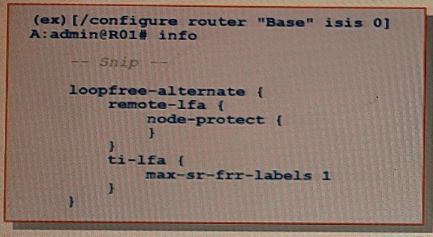
The exhibit shows the fast re-route configuration on router R1, in which both R-LFA and TI-LFA have been enabled. Assume that there are multiple potential backup paths for a given prefix. Which of the following options will router R1 use?
Suggested Answer: D

The exhibit shows that both R-LFA and TI-LFA have been enabled on router R1. R-LFA (Remote Loop-Free Alternate) is a method that is used to protect the active segment of a tunnel, and it allows the router to find a backup path that coincides with the path that will become active after IGP reconvergence. TI-LFA (Topology Independent LFA) is a method that is used to protect an end-to-end multi-segment tunnel, it allows the router to find a backup path that does not rely on the IGP topology, but on the segment routing topology.

With R-LFA and TI-LFA enabled, router R1 will use a D-LFA (Dual-Loop-Free Alternate) path, which is a combination of both R-LFA and TI-LFA, this path will coincide with the path after IGP re-convergence.

A standard LFA, R-LFA, and D-LFA which do not coincide with the path after IGP re-convergence are not the options.


Get Premium 4A0-116 Questions as Interactive Web-Based Practice Test or PDF Real Exam Format Detailed Explanations Instant Access Get Your Practice Test
15 comments · newest first
WI
Willard 11 months ago
Wait, I thought D-LFA was better for this situation!
MI
Micaela 12 months ago
I think it has to be R-LFA, right?
EL
Elden 12 months ago
Isn't it possible that a standard LFA could be chosen instead?
EM
Emiko 1 year ago
Totally agree, R-LFA is the way to go!
CO
Colette 1 year ago
R1 will prefer R-LFA paths first.
RY
Ryan 1 year ago
If I recall correctly, R-LFA paths are preferred when available, but I’m not sure if they would coincide with the path after convergence. I feel like it might be option B.
AR
Aron 1 year ago
I’m a bit confused about the difference between D-LFA and R-LFA in this context. I remember something about how they handle IGP convergence, but I can't recall the specifics.
VA
Vallie 1 year ago
I think the question is similar to one we practiced where we had to choose between R-LFA and D-LFA. I feel like R-LFA might be the right choice here.
WE
Wenona 1 year ago
I remember that R-LFA is supposed to be more efficient than standard LFA, but I'm not entirely sure how it interacts with multiple backup paths.
DE
Deane 1 year ago
This looks like a tricky networking question. I'll need to carefully review the requirements and the exhibit to determine the best approach.
ZA
Zack 1 year ago
Hmm, I'm a little unsure about this one. There are a lot of options to consider, and I'm not sure which two would be the most effective. I think I'd want to do some more research on the different strategies before deciding. Maybe I'll mark a couple and come back to it later in the exam.
MY
My 1 year ago
This is a pretty straightforward question, in my opinion. The image clearly shows that the RAID array is missing one disk and is not fully redundant, which is the information provided in option C. And option A also seems to be correct based on the information given.
MA
Malcolm 1 year ago
Enabling SSL (option D) doesn't seem relevant to preventing crawling. That's more about securing the connection, not controlling access.
LE
Lettie 1 year ago
Okay, I'm leaning towards option C. If the data subject can prove the legitimacy of the corrections, that seems like a reasonable requirement under the rules.
LO
Lorrie 1 year ago
This seems like a straightforward question about security principles in software design. I'll focus on understanding the key concept of "Security by Design" and how it's defined.
0/2000 characters

Save Cancel