New Year Sale 2026! Hurry Up, Grab the Special Discount - Save 25% - Ends In 00:00:00 Coupon code: SAVE25

Welcome to Pass4Success

- Free Preparation Discussions

Nokia 4A0-116 Exam - Topic 12 Question 32 Discussion

Actual exam question for Nokia's 4A0-116 exam
Question #: 32
Topic #: 12
[All 4A0-116 Questions]

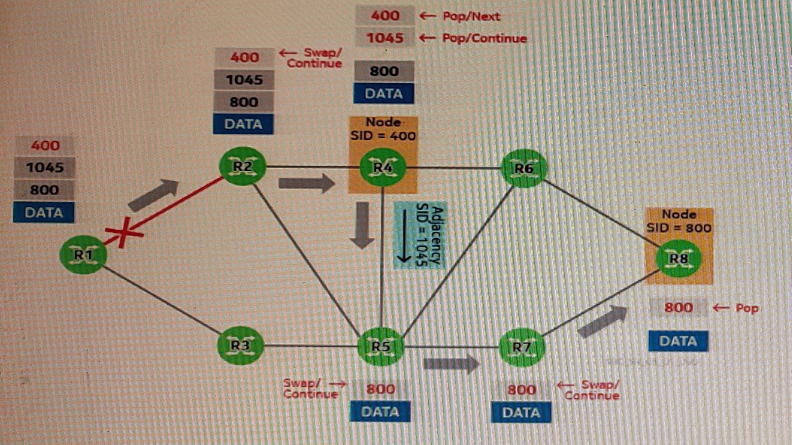
The exhibit presents packets being transmitted inside an LSP's multi-segment primary path going from router R1 to router R8. The LSP also has a standby secondary path, and Seamless-BFD has been enabled on the primary path. The link between routers R1 and R2 fails, and fast re-route (FRR) is triggered. As a result, router R1 forwards the packets to router R3 and adds the proper FRR encapsulation to reach which router?
Show Suggested Answer Hide Answer
Suggested Answer: B

Contribute your Thoughts:

0/2000 characters
Donte
3 months ago
R2 is the intended next-hop, right?
upvoted 0 times
...
Portia
3 months ago
Wait, are we sure about R4? Seems off to me.
upvoted 0 times
...
Quiana
3 months ago
No way, it's R5 for the shortest path back!
upvoted 0 times
...
Rebecka
4 months ago
I think it's R8, that's where the LSP ends.
upvoted 0 times
...
Coral
4 months ago
It's definitely R4, since it's the tail-end of the segment.
upvoted 0 times
...
Rory
4 months ago
I keep mixing up the roles of R4 and R8 in these setups. I think R1 should forward to R8 since it's the end of the LSP, but I'm not entirely confident.
upvoted 0 times
...
Long
4 months ago
I thought the goal of FRR was to quickly reroute to the original path, so maybe R5 is the right answer?
upvoted 0 times
...
Vallie
4 months ago
This question feels similar to one we practiced about LSPs and FRR. I think R3 would forward to R4 since it's the next segment.
upvoted 0 times
...
Naomi
5 months ago
I remember we discussed FRR in class, but I'm not sure if R1 would forward to R2 or R5 in this scenario.
upvoted 0 times
...
Venita
5 months ago
I'm not entirely sure about this one. The exhibit shows the LSP path, but I'm not sure how the FRR encapsulation works in this case. I'll need to carefully read through the question again and think it through.
upvoted 0 times
...
Margurite
5 months ago
Okay, let me think this through step-by-step. The link between R1 and R2 failed, so FRR was triggered. R1 needs to forward the packets to the next router, and the question is asking which router that will be. I'm pretty confident I can figure this out.
upvoted 0 times
...
Jamika
5 months ago
Hmm, I'm a bit confused about the FRR encapsulation part. I'll need to review my notes on that to make sure I understand how it works in this scenario.
upvoted 0 times
...
Ollie
5 months ago
This question seems pretty straightforward. I think I know the answer, but I'll double-check the details in the exhibit to be sure.
upvoted 0 times
...
Edelmira
5 months ago
Ah, I see what's going on here. Since the link between R1 and R2 failed, R1 needs to forward the packets to the next router in the FRR path. Based on the information provided, I think the answer is C.
upvoted 0 times
...
Lawanda
5 months ago
Okay, I think I've got it. The key is to focus on the "intended outcome" part of the question. Option A seems to capture that the best - developing a customer-centric view to achieve value. I'll go with that one.
upvoted 0 times
...
Lura
5 months ago
Hmm, this looks like a tricky one. I'll need to carefully analyze the network topology and the given information to determine the correct steps.
upvoted 0 times
...
Nichelle
5 months ago
Hmm, I'm a bit unsure about the different options here. I'll need to carefully read through each one and make sure I understand the differences before selecting my answers.
upvoted 0 times
...
Walton
2 years ago
This question is about as straightforward as a labyrinth. But I'll go with C and hope for the best.
upvoted 0 times
Lenna
2 years ago
I agree, C makes sense because it is the tail-end of the active segment.
upvoted 0 times
...
Billy
2 years ago
I think the answer is C, to reach router R4.
upvoted 0 times
...
...
Na
2 years ago
But the question mentions fast re-route (FRR) being triggered, so it makes sense to reach the tail-end of the LSP, which is router R8.
upvoted 0 times
...
Helaine
2 years ago
I disagree, I believe the correct answer is D) To reach router R8.
upvoted 0 times
...
Na
2 years ago
I think the answer is C) To reach router R4.
upvoted 0 times
...
Wilda
2 years ago
Haha, I bet the exam writers thought this one was really clever. But I'm sticking with C - can't fool me that easily!
upvoted 0 times
...
Moira
2 years ago
I've got to go with C. It just makes the most sense that the packets would be forwarded to the tail-end of the active segment.
upvoted 0 times
...
Ming
2 years ago
Hmm, this is a tricky one. I'm leaning towards D though. Reaching the tail-end of the LSP, which is R8, seems like the intended result of the FRR process.
upvoted 0 times
Markus
2 years ago
D) To reach router R8, which is the tail-end of the LSP.
upvoted 0 times
...
Lenny
2 years ago
A) To reach router R2, which is the LSP's intended next-hop.
upvoted 0 times
...
...
Bambi
2 years ago
B sounds more logical to me. Going back to the original path through R5 seems like the shortest way to get to the destination.
upvoted 0 times
...
Micheline
2 years ago
I think the answer is C. R4 is the tail-end of the active segment, so that's where the packets need to be forwarded after the link failure.
upvoted 0 times
Flo
2 years ago
C) To reach router R4, which is the tail-end of the active segment.
upvoted 0 times
...
Ma
2 years ago
A) To reach router R2, which is the LSP's intended next-hop.
upvoted 0 times
...
...

Save Cancel