New Year Sale 2026! Hurry Up, Grab the Special Discount - Save 25% - Ends In 00:00:00 Coupon code: SAVE25

Welcome to Pass4Success

- Free Preparation Discussions

Nokia 4A0-105 Exam - Topic 2 Question 8 Discussion

Actual exam question for Nokia's 4A0-105 exam
Question #: 8
Topic #: 2
[All 4A0-105 Questions]

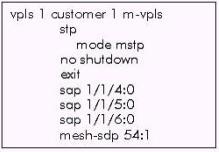
Click on the exhibit below.

Based on the following configuration which VLANs will be managed by the management VPLS?

Show Suggested Answer Hide Answer
Suggested Answer: A

Contribute your Thoughts:

0/2000 characters
Felicitas
4 months ago
Definitely not D, that config looks valid to me!
upvoted 0 times
...
Anglea
4 months ago
Not enough info here, I’m not sure.
upvoted 0 times
...
Reita
4 months ago
Wait, can VLAN 0 even be managed?
upvoted 0 times
...
Rebbecca
4 months ago
I agree, option A seems correct.
upvoted 0 times
...
Desmond
5 months ago
VLANs 1-4094 are typically managed.
upvoted 0 times
...
Felice
5 months ago
I vaguely recall that VLAN 0 is sometimes mentioned in configurations, but I don't think it would be managed like the others.
upvoted 0 times
...
Paris
5 months ago
I feel like there might not be enough context here to make a solid choice. Could it really be option C?
upvoted 0 times
...
Leonora
5 months ago
This kind of question seems familiar; I think we discussed how management VPLS typically handles specific VLANs.
upvoted 0 times
...
Elvera
5 months ago
I remember something about VLAN ranges, but I'm not sure if it's all 4094 or just a subset.
upvoted 0 times
...
Frankie
5 months ago
I'm pretty confident this is a self-optimizing SON feature. The 50N feature sounds like it's about optimizing network performance by automatically managing neighbor relations.
upvoted 0 times
...
Hermila
5 months ago
Hmm, I'm a bit confused by all the different preprocessing options. I'm not sure which one would have the biggest impact on improving the testing accuracy. Maybe I should review the concepts of one-hot encoding, binning, and regularization again before deciding.
upvoted 0 times
...
Stefany
5 months ago
This looks like a straightforward present value calculation. I'll need to use the formula PV = FV / (1 + r)^n, where FV is the future value, r is the rate of return, and n is the number of periods.
upvoted 0 times
...

Save Cancel