
Free Preparation Discussions
 MENU
MENU
Netskope NSK101 Exam Questions
- Topic 1: Cloud Security Concept: This topic includes common industry compliance standards, cloud service model concepts, data protection methods, web security, and traffic steering. This topic covers essential cloud security theory and best practices.
- Topic 2: Netskope Platform Concepts Basics: Netskope Platform Concepts Basics covers deployment modes, architecture, security control, and risk management. This foundational topic explains the platform's key features, configurations, and benefits for cloud security.
- Topic 3: Netskope Platform Management: This topic involves traffic steering, basic configuration, and administration.
- Topic 4: Netskope Platform Monitoring: Its subtopics includethe identification of cloud risk by using the Cloud Confidence Index (CCI). It also deals with event monitoring.
- Topic 5: Netskope Platform Troubleshooting: This troubleshooting topic deals with common issues like steering, policies, decryption, and log collection. It aims to identify and resolve problems related to the platform's operations.
Free Netskope NSK101 Exam Actual Questions
Note: Premium Questions for NSK101 were last updated On Oct. 05, 2026 (see below)
You want to see the actual data that caused the policy violation within a DLP Incident view.
In this scenario, which profile must be set up?
DLP Incident View:
To see the actual data that caused a policy violation within a DLP incident, detailed logging and data capture are required.
Forensics Profile:
A Forensics Profile in Netskope is designed to capture and store detailed information about policy violations, including the actual data that triggered the incident.
It provides a comprehensive view of the incident for investigation and compliance purposes.
Setup Process:
Navigate to the DLP settings in the Netskope admin console.
Configure a Forensics Profile to capture detailed logs and data for policy violations.
Ensure that this profile is associated with the relevant DLP policies.
Reference:
For detailed configuration steps, refer to the Netskope documentation on setting up Forensics Profiles for DLP incidents.
Which three security controls are offered by the Netskope Cloud platform? (Choose three.)
Three security controls that are offered by the Netskope Cloud platform are: C. cloud security posture management, E. threat protection, and B. data loss prevention for SMTP.
Cloud security posture management is a service that provides continuous assessment and remediation of public cloud deployments for risks, threats, and compliance issues. Netskope CSPM leverages the APIs available from cloud service providers such as AWS, Azure, and GCP to scan the cloud infrastructure for misconfigurations, such as insecure permissions, open ports, unencrypted data, etc. Netskope CSPM also provides security posture policies, profiles, and rules that can be customized to match the security standards and best practices of the organization or industry.
Threat protection is a capability to detect and block malware, ransomware, phishing, and other cyber threats that may compromise cloud data or users. Netskope threat protection uses advanced techniques such as machine learning, sandboxing, threat intelligence, and behavioral analysis to identify and prevent malicious activities in real time. Netskope threat protection also integrates with third-party solutions such as antivirus engines, firewalls, SIEMs, etc., to provide comprehensive defense across the cloud and web1.
Data loss prevention for SMTP is a feature that allows you to protect sensitive data that is sent or received via email. Netskope DLP for SMTP can scan email messages and attachments for predefined or custom data patterns, such as credit card numbers, social security numbers, health records, etc., and apply appropriate actions, such as block, quarantine, encrypt, notify, etc., based on the DLP policies. Netskope DLP for SMTP can also support multiple email domains and routing rules for different groups of users2.
You are required to mitigate malicious scripts from being downloaded into your corporate devices every time a user goes to a website. Users need to access websites from a variety of categories, including new websites.
Which two actions would help you accomplish this task while allowing the user to work? (Choose two.)
To mitigate malicious scripts from being downloaded into your corporate devices every time a user goes to a website, you need to use Netskope's threat protection features to block or isolate potentially harmful web traffic. Two actions that would help you accomplish this task while allowing the user to work are: block malware detected on download activity for all remaining categories and block known bad websites and enable RBI to uncategorized domains. The first action will prevent any files that contain malware from being downloaded to your devices from any website category, except those that are explicitly allowed or excluded by your policies. The second action will prevent any websites that are classified as malicious or phishing by Netskope from being accessed by your users and enable Remote Browser Isolation (RBI) to uncategorized domains, which are domains that have not been assigned a category by Netskope. RBI is a feature that allows users to browse websites in a virtual browser hosted in the cloud, without exposing their devices to any scripts or content from the website. Allowing the user to browse uncategorized domains but restrict edit activities or allowing a limited amount of domains and block everything else are not effective actions, as they may either limit the user's productivity or expose them to unknown risks.Reference:[Netskope Threat Protection], [Netskope Remote Browser Isolation].
Which two common security frameworks are used today to assess and validate a vendor's security practices? (Choose two.)
The Building Security in Maturity Model (BSIMM) is a framework that measures and compares the security activities of different organizations. It helps organizations to assess their current security practices and identify areas for improvement. ISO 27001 is an international standard that specifies the requirements for establishing, implementing, maintaining, and improving an information security management system. It helps organizations to manage their information security risks and demonstrate their compliance with best practices. Data Science Council of America (DASCA) is not a security framework, but a credentialing body for data science professionals. NIST Cybersecurity Framework (NIST CSF) is a security framework, but it is not commonly used to assess and validate a vendor's security practices, as it is more focused on improving the cybersecurity of critical infrastructure sectors in the United States.Reference:[BSIMM], [ISO 27001], [DASCA], [NIST CSF].
Click the Exhibit button.
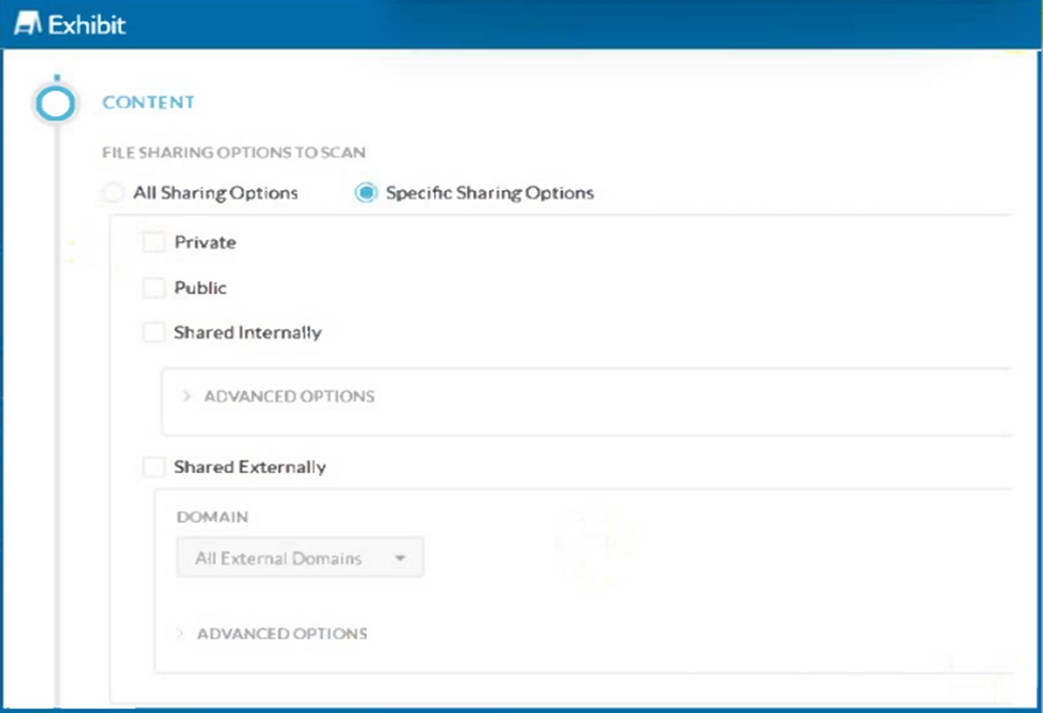
A customer has created a CASB API-enabled Protection policy to detect files containing sensitive data that are shared outside of their organization.
Referring to the exhibit, which statement is correct?
To detect files containing sensitive data that are shared outside of the organization, the administrator should select both 'Shared Externally' and 'Public' sharing options. These settings ensure that any files shared externally (outside the organization) or publicly are scanned for sensitive data. This comprehensive approach covers all potential scenarios where data could be exposed outside the organization.
Step-by-Step Configuration:
Select Specific Sharing Options:
Navigate to the CASB API-enabled Protection policy configuration page.
Choose the option for 'Specific Sharing Options' to limit the scan to files shared under certain conditions.
Enable Shared Externally and Public:
Check both 'Shared Externally' and 'Public' options. This setting ensures that files shared either publicly or with external domains are included in the scan.
Configure Advanced Options:
For further granularity, configure the advanced options under each sharing type if needed (e.g., specifying particular external domains).
This configuration aligns with the best practices for CASB policies and ensures that all files potentially leaving the organization are scanned for sensitive data.
Netskope CASB Policy Configuration Documentation
- Select Question Types you want
- Set your Desired Pass Percentage
- Allocate Time (Hours : Minutes)
- Create Multiple Practice tests with Limited Questions
- Customer Support
Brenda Wright
20 days agoDonald Jones
23 days agoPatricia Roberts
1 month agoStephanie Roberts
2 months agoLaura Anderson
2 months agoOlivia Ramirez
2 months agoRebecca Williams
3 months agoTiffany Lee
3 months agoGary Mitchell
3 months agoCharles Clark
4 months agoJason Thomas
4 months agoAndrew Evans
4 months agoGary King
5 months agoKaren Wilson
5 months agoElizabeth Williams
5 months agoDonna Hall
6 months agoStephanie Williams
5 months agoHarold Collins
5 months agoAmy Flores
5 months agoJason Torres
5 months agoHeather Howard
5 months agoMinna
6 months agoChantell
7 months agoEmile
7 months agoAriel
7 months agoKerrie
7 months agoMertie
8 months agoTammara
8 months agoKarrie
8 months agoZita
8 months agoWinifred
9 months agoWalton
9 months agoArgelia
9 months agoClay
10 months agoSunshine
10 months agoEdelmira
10 months agoEmerson
10 months agoPhyliss
11 months agoLenna
11 months agoJosephine
11 months agoDusti
11 months agoIdella
12 months agoWilda
12 months agoJerry
1 year agoWillard
1 year agoOtis
1 year agoWilda
1 year agoAlyssa
1 year agoTonja
1 year agoFrancoise
1 year agoZona
1 year agoKyoko
1 year agoTricia
2 years agoCory
2 years agoJess
2 years agoRonnie
2 years agoWade
2 years agoSarah
2 years agoFletcher
2 years agoCatarina
2 years agoOtis
2 years agoHana
2 years agoShawna
2 years agoLuz
2 years agoAriel
2 years agoAvery
2 years agoLovetta
2 years agoLisha
2 years agoHan
2 years agoShaniqua
2 years agoOctavio
2 years agoGail
2 years agoBelen
2 years agoCarrol
2 years agoLawrence
2 years agoAsha
2 years agoRemona
2 years agoZona
2 years agoDelfina
3 years agoLore
3 years ago