
Free Preparation Discussions
 MENU
MENU
NCARB Project-Management Exam Questions
- Topic 1: Resource Management: This section of the exam measures the skills of project managers and covers how to determine the right team composition and manage time allocation for successful project delivery. It focuses on evaluating criteria for assembling teams and ensuring resources are properly managed to execute the project within agreed terms.
- Topic 2: Project Work Planning: This section of the exam measures the skills of architectural associates and covers the development and communication of an effective project work plan. It emphasizes maintaining schedules, setting clear criteria for work planning, and ensuring consistent communication with stakeholders, including owners, contractors, consultants, and internal staff.
- Topic 3: Contracts: This section of the exam measures the skills of project managers and covers the analysis of contracts that govern the relationships between architects, owners, contractors, and consultants. It highlights verifying adherence to agreements, interpreting key contractual elements, and ensuring consultant work is properly integrated into the project.
- Topic 4: Project Execution: This section of the exam measures skills of architectural associates and covers the management of project execution through administrative procedures rather than design decisions. It addresses evaluating budgets, managing scope changes, preparing project documentation in line with delivery methods, and securing necessary approvals from relevant authorities.
- Topic 5: Project Quality Control: This section of the exam measures skills of project managers and covers procedures for ensuring quality and maintaining the Standard of Care throughout the project. It focuses on applying regulatory requirements, reviewing documentation for quality, reducing risks and liabilities, and managing the design process to preserve its objectives
Free NCARB Project-Management Exam Actual Questions
Note: Premium Questions for Project-Management were last updated On Sep. 18, 2026 (see below)
Which of the following considerations would support the use of separate bid packages and a fast-track schedule?
Check the four that apply.
Fast-track scheduling involves overlapping design and construction by issuing separate bid packages (e.g., site work, foundations, structure). This allows construction to begin before the entire design is complete.
A . Cost: Fast-track can potentially reduce escalation and shorten time-related costs.
B . Schedule: Primary benefit---saves time by overlapping design and construction phases.
E . Phased construction: Necessary to allow portions of the work to begin early.
F . Multiple prime contractors: Often used with fast-track and separate bid packages.
C and D are incorrect:
C . Risk is typically increased in fast-track due to incomplete design during bidding.
D . Coordination is more complex, not easier, in a fast-track/multi-package approach.
NCARB ARE 5.0 Handbook -- Project delivery methods
AIA A201 & AIA CMc contracts -- Construction Manager as Constructor, fast-tracking provisions
Refer to the exhibit.
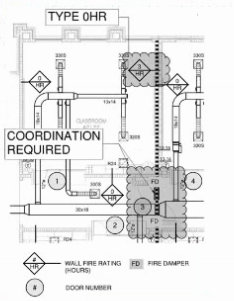
Refer to the exhibit.
Construction documents are 75% complete for a design-bid-build project. As part of an architecture firm's quality control plan, the senior architect reviews the drawings and specifications for coordination. Following the review, the project architect distributes the senior architect's markups to the consultants.
What should the mechanical engineer do next to maintain quality control?
The mechanical engineer is responsible for responding to coordination markups---such as conflicts between ductwork and fire-rated walls, dampers, or structural components. By requesting a redline work session, the mechanical engineer can collaborate directly with the project architect to resolve spatial, code, and fire protection conflicts, ensuring the integrity of both mechanical systems and building code compliance.
This action aligns with best practices in Quality Control/Assurance (QA/QC) procedures, where inter-disciplinary coordination during the Construction Documents (CD) phase is essential to reduce RFIs and change orders later.
ARE 5.0 PjM Reference:
NCARB ARE 5.0 Handbook -- PjM: 'Coordination of drawings and consultant input during documentation'
AIA Best Practices: Consultant collaboration and redline review during CD phase
AHPP (Architect's Handbook of Professional Practice), 15th ed., Chapter 9: Quality Management
What is a critical factor in managing project risk?
Effective risk management begins with early identification of potential risks and developing strategies to mitigate or respond to them. This includes scheduling, budget, design, and regulatory risks. Assigning all risk to contractors is unrealistic; avoiding communication worsens issues. ARE 5.0 PjM stresses proactive risk identification, communication, and management as key to project success.
The owner and architect sign a Basic Services Agreement for the design of a museum.
Based on AIA Document B101-2017, Owner and Architect Agreement, which line items should be excluded from the architect's cost estimate? Check the two that apply.
Per AIA B101-2017 6.1, the 'Cost of the Work' includes items designed or specified by the architect in the construction contract. FF&E and owner-provided landscape features (like plants, art, and loose furniture) are typically excluded, as these may be contracted separately by the owner or coordinated outside basic architectural services.
AIA B101-2017 6.1--6.3
NCARB ARE 5.0 Handbook -- PjM & PPD: Project Cost Estimating
AHPP, Chapter 11: Cost Estimating Procedures
A key Project Manager leaves an architectural firm halfway through a project. Several days of lost productivity pass while the new Project Manager determines the customized organization that the previous Project Manager used. The new Project Manager recommends implementing new office policies to create standards and quality control methods for the entire office.
Which methods should be implemented? Check the four that apply.
Comprehensive Detailed Explanation:
Best practices in quality management include:
A . Reviewing existing methods to identify inefficiencies
B . Standardizing workflow to prevent variability and loss of knowledge
D . Measuring performance to track productivity and outcomes
E . Continuous improvement ensures the office adapts and grows
C is incorrect as customization contradicts standardization and is the root of the issue. F is a drastic step not warranted by the situation.
NCARB ARE 5.0 PjM Handbook -- Quality management and office standards
Ballast ARE 5 Review Manual -- Project Management tools and quality assurance
AIA Best Practices -- Office workflow documentation and training
- Select Question Types you want
- Set your Desired Pass Percentage
- Allocate Time (Hours : Minutes)
- Create Multiple Practice tests with Limited Questions
- Customer Support
Donald Hernandez
3 days agoJustin Taylor
25 days agoLaura Flores
1 month agoAshley Green
2 months agoLisa Thomas
2 months agoOlivia Turner
3 months agoSandra Smith
3 months agoChristopher Flores
4 months agoJeffrey Stewart
4 months agoDavid Thomas
5 months agoDonald Taylor
5 months agoDennis Bailey
5 months agoSteven Moore
5 months agoMark Lee
5 months agoBrian Phillips
4 months agoNathan Anderson
4 months agoDorothy
6 months agoAntonio
6 months agoGracia
6 months agoBenton
7 months agoJerry
7 months agoSalena
7 months agoHorace
7 months agoSamira
8 months agoGearldine
8 months agoGail
8 months agoGail
8 months agoCatrice
9 months agoVilma
9 months agoTeddy
9 months agoGeorgiann
9 months agoColene
10 months agoMalinda
10 months agoTelma
10 months agoLorrie
10 months agoElke
11 months agoMary
11 months agoDulce
11 months agoWalker
11 months agoNana
12 months agoMonte
12 months agoIlda
1 year agoJoni
1 year agoVenita
1 year agoMarshall
1 year agoCheryl
1 year ago