
 MENU

You have an Azure SQL database named DB3.
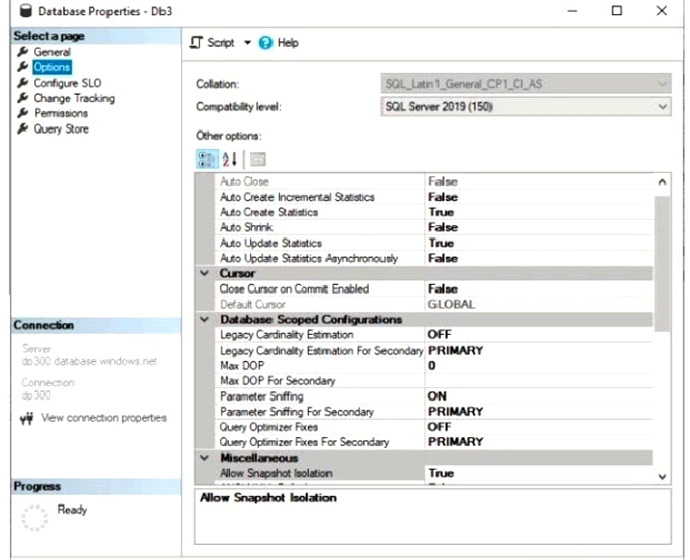
You need to provide a user named DevUser with the ability to view the properties of DB3 from Microsoft SQL Server Management Studio (SSMS) as shown in the exhibit. (Click the Exhibit tab.)
Which Transact-SQL command should you run?
Suggested Answer: C
Get Premium DP-300 Questions
as Interactive Web-Based Practice Test or PDF
Real Exam Format
Detailed Explanations
Instant Access
Get Your Practice Test
The exhibits displays Database [State] properties.
To query a dynamic management view or function requires SELECT permission on object and VIEW SERVER STATE or VIEW DATABASE STATE permission.
https://docs.microsoft.com/en-us/sql/relational-databases/databases/database-properties-options-page
13 comments · newest first
NI
Nickole
12 months ago
No way, I thought SELECT was enough for viewing properties!
JA
Jaime
1 year ago
I just learned that VIEW DEFINITION is super useful!
FE
Felix
1 year ago
Wait, are we sure about that? What if it's C instead?
MA
Marya
1 year ago
Totally agree, B is the right choice!
NI
Nina
1 year ago
I think the answer is B, GRANT VIEW DEFINITION.
WY
Wynell
1 year ago
I’m a bit confused about the difference between VIEW DEFINITION and VIEW DATABASE STATE. I feel like both could be relevant here.
AS
Ashlyn
1 year ago
I remember practicing a similar question where we had to grant permissions, and I think "GRANT VIEW DEFINITION" was the right choice for that.
PH
Phung
1 year ago
I think the command we need is related to permissions, but I'm not entirely sure which one allows viewing properties specifically.
CA
Casey
1 year ago
I know "GRANT SELECT" is for querying data, so it can't be the right answer for viewing properties. I’m leaning towards option B.
RA
Rachael
1 year ago
This seems like a straightforward question on expected monetary value. I'm confident I can solve this one.
AN
Annice
1 year ago
Hmm, I'm a bit unsure about this one. There are a few different Service Cloud features that could be relevant, but I'll need to think it through carefully.
FR
Francoise
1 year ago
I'm pretty confident that the answer is B. The "git merge -- --squash" command is specifically designed to merge changes from a branch into the current branch, while collapsing all the individual commits into a single new commit. That seems like exactly what this question is asking for.
VE
Veronika
1 year ago
I'm a bit unsure on this one. Is TDE the only option for encrypting the data warehouse? I'll need to double-check the other choices to make sure I'm not missing something.