
Free Preparation Discussions
 MENU
MENU
Juniper JN0-683 Exam Questions
- Topic 1: Data Center Deployment and Management: This section assesses the expertise of data center networking professionals like architects and engineers, focusing on key deployment concepts. Topics include Zero-touch provisioning (ZTP), which automates device setup in data centers without manual input.
- Topic 2: Layer 3 Fabrics: This section measures the knowledge of professionals managing IP-based networks in data centers. It covers IP fabric architecture and routing, ensuring candidates understand how the network is structured for scalability and how traffic is routed efficiently.
- Topic 3: VXLAN: This part requires knowledge of VXLAN, particularly how the control plane manages communication between devices, while the data plane handles traffic flow. Demonstrate knowledge of how to configure, Monitor, or Troubleshoot VXLAN.
- Topic 4: EVPN-VXLAN Signaling: This section assesses an understanding of Ethernet VPN (EVPN) concepts, including route types, multicast handling, and Multiprotocol BGP (MBGP). It also covers EVPN architectures like CRB and ERB, MAC learning, and symmetric routing.
- Topic 5: Data Center Interconnect: For Data Center Engineers, this part focuses on interconnecting data centers, covering Layer 2 and Layer 3 stretching, stitching fabrics together, and using EVPN-signaled VXLAN for seamless communication between data centers.
- Topic 6: Data Center Multitenancy and Security: This section tests knowledge of single-tenant and multitenant data center setups. Candidates such as Data Center Professionals are evaluated on ensuring tenant traffic isolation at both Layer 2 and Layer 3 levels in shared infrastructure environments.
Free Juniper JN0-683 Exam Actual Questions
Note: Premium Questions for JN0-683 were last updated On Mar. 04, 2026 (see below)
Exhibit.
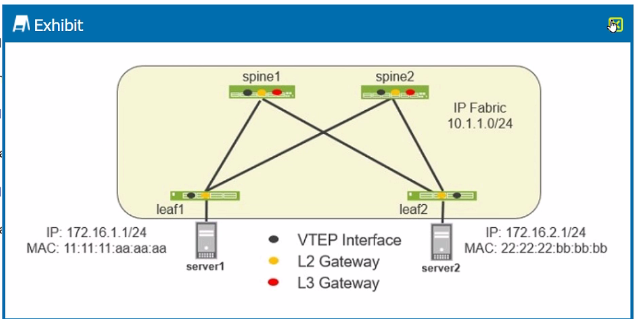
You have implemented an EVPN-VXLAN data center. Device served must be able to communicate with device server2.
Referring to the exhibit, which two statements are correct? (Choose two.)
Understanding the Exhibit Setup:
The network diagram shows an EVPN-VXLAN setup, a common design for modern data centers enabling Layer 2 and Layer 3 services over an IP fabric.
Leaf1 and Leaf2 are the leaf switches connected to Server1 and Server2, respectively, with each server in a different subnet (172.16.1.0/24 and 172.16.2.0/24).
Spine1 and Spine2 are part of the IP fabric, interconnecting the leaf switches.
EVPN-VXLAN Basics:
EVPN (Ethernet VPN) provides Layer 2 and Layer 3 VPN services using MP-BGP.
VXLAN (Virtual Extensible LAN) encapsulates Layer 2 frames into Layer 3 packets for transmission across an IP network.
VTEP (VXLAN Tunnel Endpoint) interfaces on leaf devices handle VXLAN encapsulation and decapsulation.
Integrated Routing and Bridging (IRB):
IRB interfaces are required on leaf1 and leaf2 (where the endpoints are directly connected) to route between different subnets (in this case, between 172.16.1.0/24 and 172.16.2.0/24).
The IRB interfaces provide the necessary L3 gateway functions for inter-subnet communication.
Traffic Flow Analysis:
Traffic from Server1 (172.16.1.1) destined for Server2 (172.16.2.1) must traverse from leaf1 to leaf2.
The traffic will be VXLAN encapsulated on leaf1, sent over the IP fabric, and decapsulated on leaf2.
Since the communication is between different subnets, the IRB interfaces on leaf1 and leaf2 are crucial for routing the traffic correctly.
Correct Statements:
C . An IRB Interface must be configured on leaf1 and leaf2: This is necessary to perform the inter-subnet routing for traffic between Server1 and Server2.
D . Traffic from server1 to server2 will transit the VXLAN tunnel between leaf1 and leaf2: This describes the correct VXLAN operation where the traffic is encapsulated by leaf1 and decapsulated by leaf2.
Data Center Reference:
In EVPN-VXLAN architectures, the leaf switches often handle both Layer 2 switching and Layer 3 routing via IRB interfaces. This allows for efficient routing within the data center fabric without the need to involve the spine switches for every routing decision.
The described traffic flow aligns with standard EVPN-VXLAN designs, where direct VXLAN tunnels between leaf switches enable seamless and scalable communication across a data center network.
Exhibit.

Given the configuration shown in the exhibit, why has the next hop remained the same for the EVPN routes advertised to the peer 203.0.113.2?
Understanding the Configuration:
The configuration shown in the exhibit involves an EVPN (Ethernet VPN) setup using BGP as the routing protocol. The export policy named CHANGE_NH is applied to the BGP group evpn-peer, which includes a rule to change the next hop for routes that match the policy.
Issue with Next Hop Not Changing:
The policy CHANGE_NH is correctly configured to change the next hop to 203.0.113.10 for the matching routes. However, the next hop remains unchanged when advertising EVPN routes to the peer 203.0.113.2.
Reason for the Issue:
In Junos OS, when exporting routes for VPNs (including EVPN), the next-hop change defined in a policy will not take effect unless the vpn-apply-export parameter is used in the BGP configuration. This parameter ensures that the export policy is applied specifically to VPN routes.
The vpn-apply-export parameter must be included to apply the next-hop change to EVPN routes.
Correct Answer Explanation:
D . The vpn-apply-export parameter must be applied to this peer: This is the correct solution because the next hop in EVPN routes won't be altered without this parameter in the BGP configuration. It instructs the BGP process to apply the export policy to the EVPN routes.
Data Center Reference:
This behavior is standard in EVPN deployments with Juniper Networks devices, where the export policies applied to VPN routes require explicit invocation using vpn-apply-export to take effect.
You manage an IP fabric with an EVPN-VXLAN overlay. You have multiple tenants separated using multiple unique VRF instances. You want to determine the routing information that belongs in each routing instance's routing table.
In this scenario, which property is used for this purpose?
Understanding VRF and Routing Instances:
In an EVPN-VXLAN overlay network, multiple tenants are separated using unique VRF (Virtual Routing and Forwarding) instances. Each VRF instance maintains its own routing table, allowing for isolated routing domains within the same network infrastructure.
Role of Route Distinguisher:
Route Distinguisher (RD): The RD is a unique identifier used in MPLS and EVPN environments to distinguish routes belonging to different VRFs. The RD is prepended to the IP address in the route advertisement, ensuring that routes from different tenants remain unique even if they use the same IP address range.
Correct Property:
What are two ways in which an EVPN-signaled VXLAN is different from a multicast-signaled VXLAN? (Choose two.)
Multicast-Signaled VXLAN:
In traditional multicast-signaled VXLAN, VTEPs (VXLAN Tunnel Endpoints) use multicast to flood and learn about remote VTEPs. This method relies on multicast in the underlay network to distribute BUM (Broadcast, Unknown unicast, and Multicast) traffic.
This approach can be resource-intensive due to the need for multicast group management and increased network traffic, especially in large deployments.
EVPN-Signaled VXLAN:
EVPN-signaled VXLAN uses BGP (Border Gateway Protocol) to signal the presence of VTEPs and distribute MAC address information. BGP is used for VTEP autodiscovery and the distribution of endpoint information.
This method is more efficient because it reduces the reliance on multicast, instead using BGP control-plane signaling to handle VTEP discovery and MAC learning, which reduces the overhead on the network and improves scalability.
Correct Statements:
B . An EVPN-signaled VXLAN can perform autodiscovery of VTEPs using BGP: This is correct because EVPN uses BGP for VTEP autodiscovery, making it more efficient and scalable compared to multicast-based methods.
C . An EVPN-signaled VXLAN is less resource-intensive: This is correct because it eliminates the need for multicast flooding in the underlay, instead using BGP for signaling, which is less demanding on network resources.
Incorrect Statements:
A . An EVPN-signaled VXLAN can perform autodiscovery of VTEPs using IS-IS: This is incorrect because EVPN relies on BGP, not IS-IS, for VTEP discovery and signaling.
D . An EVPN-signaled VXLAN features slower and more complete convergence: This is incorrect; EVPN with BGP typically provides faster convergence due to its use of a control plane rather than relying on data plane learning.
Data Center Reference:
EVPN-VXLAN is widely adopted in modern data center designs due to its scalability, efficiency, and reduced resource consumption compared to multicast-based VXLAN solutions. It leverages the strengths of BGP for control-plane-driven operations, resulting in more efficient and scalable networks.
Exhibit.

Referring to the configuration shown in the exhibit, assume that there is no external router present, and that the configuration is fabric-only.
Which two statements are true about the example configuration? (Choose two.)
Understanding the Configuration:
The exhibit shows configurations for two VRFs (Customer_A and Customer_B) with specific VLANs and VNIs assigned. Each VRF has interfaces (IRBs) associated with particular VLANs.
Communication Between VLANs and Routing Instances:
Option B: VLAN 400 (irb.400) is part of Customer_B, and there is no direct connection or routing between Customer_A and Customer_B in the configuration provided. Therefore, devices in irb.400 cannot communicate directly with devices in the Customer_A routing instance.
Option D: Since irb.400 (VLAN 400) and irb.800 (VLAN 800) are part of the same routing instance (Customer_B), they can communicate over the fabric using VXLAN encapsulation.
Conclusion:
Option B: Correct---There is no direct communication between devices in irb.400 (Customer_B) and routing instance Customer_A.
Option D: Correct---Devices in VLAN 400 and VLAN 800 can communicate within the Customer_B routing instance over the fabric.
- Select Question Types you want
- Set your Desired Pass Percentage
- Allocate Time (Hours : Minutes)
- Create Multiple Practice tests with Limited Questions
- Customer Support
Louis
5 days agoJeanice
18 days agoJeannetta
26 days agoRolande
1 month agoTamesha
1 month agoLouisa
2 months agoLeonor
2 months agoSabina
2 months agoKiley
2 months agoGussie
3 months agoKaran
3 months agoTonette
3 months agoAllene
3 months agoSherita
4 months agoLezlie
4 months agoTegan
4 months agoCarylon
4 months agoEllsworth
5 months agoEdgar
5 months agoTracey
5 months agoCharlette
5 months agoGianna
6 months agoKati
6 months agoTonette
6 months agoMillie
6 months agoDong
6 months agoBillye
8 months agoPamella
8 months agoElza
9 months agoJess
9 months agoCecilia
9 months agoAaron
10 months agoMarylin
11 months agoMarva
11 months agoSueann
12 months agoMirta
12 months agoTricia
1 year agoMonte
1 year agoOretha
1 year agoRegenia
1 year agoCassie
1 year agoEdwin
1 year agoStevie
1 year agoJean
1 year agoGerri
1 year agoBrynn
1 year agoAmos
1 year agoJohnson
1 year agoEvan
1 year agoHerminia
1 year agoRessie
1 year agoDella
1 year agoMerlyn
1 year agoFrederica
1 year agoQueenie
1 year agoKeshia
1 year agoViki
1 year agoChu
1 year agoRyan
1 year agoJade
1 year agoDalene
1 year agoWilford
1 year agoPa
2 years agoKimbery
2 years agoAnnabelle
2 years ago