
 MENU

Exhibit.
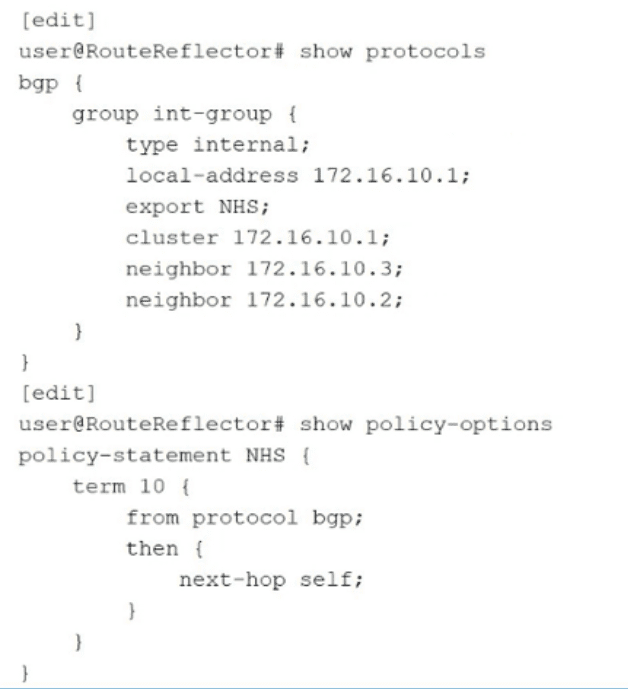
You have determined that traffic in your network is being routed through your route reflector instead of using the optimal path. Referring to the exhibit, what are two configuration changes on the route reflector that would solve the problem? (Choose two.)
The exhibit shows a BGP Route Reflector (RR) configuration where an export policy named NHS (Next-Hop Self) is applied to the internal BGP group int-group. The policy NHS sets the next-hop self attribute for BGP routes.
The Problem (Traffic Tromboning): In a standard BGP Route Reflector design, the RR should reflect routes without modifying the BGP next-hop attribute. By applying a next-hop self policy on the export to clients, the RR tells all its clients that it is the exit point for those routes. Consequently, all data plane traffic is sent to the RR first before being forwarded to the actual destination, rather than following the optimal direct path between clients. This is known as 'traffic tromboning' or suboptimal routing.
The Solution (Option C): The most direct way to fix this is to delete the export policy that is forcing the next-hop to be the RR. By deleting protocols bgp group int-group export NHS, the RR will resume standard behavior and reflect the original next-hop received from the route source, allowing clients to route traffic directly to the correct destination.
The Refined Solution (Option D): If you must keep the NHS policy (perhaps for routes learned from external peers), you should ensure it only applies to those specific routes. By adding from route-type internal to the policy term and then potentially changing the logic (or simply narrowing the scope), you can prevent the RR from incorrectly applying next-hop self to internal routes that it is merely reflecting. In the context of this specific problem, Option D combined with a change in the policy's action or scope helps ensure reflected internal routes maintain their original, optimal next-hops.
Option A is incorrect because setting next-hop self for external routes is common practice, but it doesn't solve the problem of internal reflected routes being diverted to the RR.
Option B is incorrect because applying this as an import policy would change how the RR itself sees the routes, but it wouldn't fix the attributes being sent out to the clients in the reflection process.
Currently there are no comments in this discussion, be the first to comment!