
 MENU
MENU
You are troubleshooting an issue and notice that an interface is down.
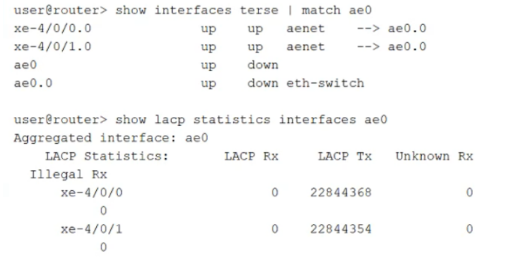
Referring to the exhibit, what is the cause of the problem?
The exhibit shows the physical member interfaces xe-4/0/0 and xe-4/0/1 are up, but the aggregated Ethernet interface ae0 is down. This commonly indicates that the bundle is not successfully forming at the link aggregation control plane level, even though the physical links are operational. The key evidence is in the LACP statistics. The local device is transmitting LACP packets at a very high count on both member links, but the LACP receive counters remain at zero. That means the local system is actively sending LACP Data Units but is not receiving any LACP Data Units back from the far end.
When an LACP-based bundle is configured, the two sides must exchange LACP control packets to negotiate membership and move the links into collecting and distributing state. If the remote side is not configured for LACP, or is configured for a static aggregate without LACP, it will not send LACP packets. In that situation, the Junos device continues transmitting LACP but never receives a response, and the aggregate does not come up, leaving the logical ae interface down even though the member links are physically up.
Therefore, the cause is that the remote device does not have LACP configured. The routing protocol choices on either side are irrelevant to LACP negotiation, and the local device clearly has LACP enabled because it is transmitting LACP packets.