
Free Preparation Discussions
 MENU
MENU
Juniper JN0-106 Exam - Topic 3 Question 4 Discussion
Topic #: 3
Exhibit:
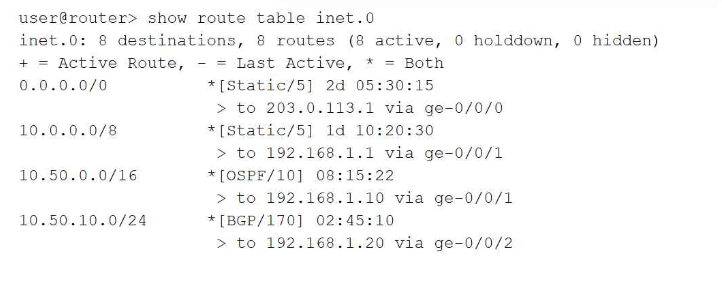
Referring to the exhibit, which route will be selected for a packet destined to IP address 10.50.10.55?
In Junos OS, the Routing Information Base (RIB) selection process follows a strict hierarchy where the Longest Prefix Match (LPM) is the absolute primary tie-breaker. When a packet is destined for 10.50.10.55, the Routing Engine searches the inet.0 table for all matching entries. In this exhibit, four routes match: the default route (0.0.0.0/0), a general static route (10.0.0.0/8), an OSPF route (10.50.0.0/16), and a BGP route (10.50.10.0/24).
The LPM rule dictates that the router must select the most specific route available, which is defined as the entry with the highest number of matching bits in the subnet mask. The 10.50.10.0/24 route matches 24 bits of the destination address, making it more specific than the 16-bit, 8-bit, or 0-bit alternatives. It is critical to understand that route preference (e.g., Static at 5, OSPF at 10, or BGP at 170) is only evaluated if there are multiple paths to the exact same prefix and length. Because these prefixes vary in length, the length takes precedence over the protocol preference. Therefore, the BGP-learned route via 192.168.1.20 is selected as the active path, ensuring traffic follows the most granular routing information provided to the device. Reference: Routing Fundamentals, Routing Table Selection, Longest Prefix Match.
Roy
3 days agoLemuel
8 days agoRyan
13 days agoNadine
18 days agoEvette
23 days agoCarrol
28 days agoDemetra
1 month agoLynda
1 month agoSamira
1 month agoGwen
2 months agoKristian
2 months agoIsaiah
2 months agoPhyliss
2 months agoJuliann
2 months agoTamala
4 months ago