Free Preparation Discussions
 MENU
MENU
Free ISTQB ATM Exam Dumps October 2026
Here you can find all the free questions related with ISTQB Advanced Test Manager (ATM) exam. You can also find on this page links to recently updated premium files with which you can practice for actual ISTQB Advanced Test Manager Exam. These premium versions are provided as ATM exam practice tests, both as desktop software and browser based application, you can use whatever suits your style. Feel free to try the Advanced Test Manager Exam premium files for free, Good luck with your ISTQB Advanced Test Manager Exam.MultipleChoice
Assume you have some data related to confirmation testing during system testing of a past project.
In that project 240 bug reports have been opened once, 80 were opened twice, 10 were opened three times and no bug reports have been opened more than three times.
You estimate that a bug report, which has failed its confirmation test, costs, on average, 3 personhours.
Which of the following statements correctly describe the value of these confirmatory testing activities based on cost of quality?
K3 2 credits
OptionsMultipleChoice
You are the Test Manager for a project to develop a client-server application that allows wine vendors to order custom-assorted packages of wines of several winemakers to sell special packages in their wine shops.
You decide to apply a blended risk-based and reactive testing strategy. Below the exit criteria for the system testing.
EXCR1- Each ''critical'' quality risk item must be covered by at least one test condition EXCR2- Each ''critical'' requirement must be covered by at least one test condition
The following are the ''critical'' requirements of the application:
REQ-SEL-1. The application shall allow the user to order only one package at a time
REQ-SEL-2. The application shall allow the user to select between four different packages (2-bottles, 6-bottles, 12-bottles, 15-bottles)
REQ-SEL-3. The application shall allow the user to order a package containing at least 1 bottle and no more bottles than the package size. No error messages shall be displayed if the user selects a valid number of bottles (at least 1 bottle and no more than the package size)
REQ-SEL-4. The application shall display an error message ''Invalid number of bottles'' if an invalid number of bottles is selected by the user (zero bottles or a number higher than the package size)
REQ-PAY-1. The application shall allow the user to pay with the three accepted credit cards (Visa,
MasterCard, American Express)
REQ-PAY-2. The application shall display an error message ''Invalid credit card'' if invalid credit card data are given by the user
The following is the unique ''critical'' quality risk item that has been identified:
CR-RSK-1. The GUI of the application might accept non-integer values for the input field designed to get the number of bottles from the user
Test analysis for system testing has just begun and the following test conditions have been identified.
TC-SEL-2. Test the selection of the package sizes
TC-SEL-4. Test wrong numbers of bottles for an order
TC-CR-RSK-1. Test the accepted values from the input field designed to get the number of bottles from the user
What is the MINIMUM number of test conditions that must be added to fulfill both the EXCR1 and EXCR2 exit criteria?
K3 2 credits
OptionsMultipleChoice
The following chart plots the cumulative number of defects opened against the cumulative number of defects closed during system testing of a software product.
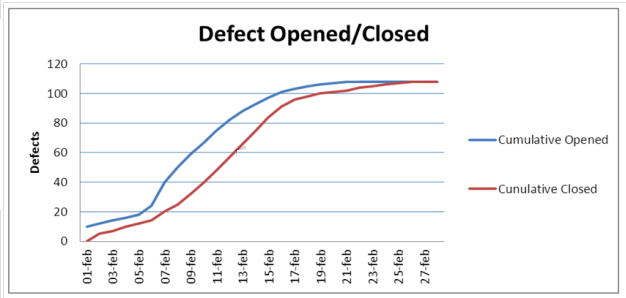
Which of the following statements is true? K2 1 credit
OptionsMultipleChoice
During the follow-up phase the following conditions are checked:
X1. The code has been completely reviewed
X2. All the identified defects have been correctly fixed and the modified code has been compiled successfully and run through all the static analyzers used by the project without warnings and errors X3. The modified code is available under the configuration management system with a new version number for the specified CI
If these conditions are fulfilled then the review process terminates.
Which of the following characteristics of a formal review is missing in this description? K2 1 credit
OptionsMultipleChoice
Consider the following test strategies:
Consultative test strategy
Reactive test strategy
Analytical test strategy
Process-compliant test strategy
Consider also the following examples of test activities:
1. Prioritize the test cases, based on the results of a FMEA analysis, to ensure early coverage of the most important areas and discovery of the most important defects during test execution
2. Execute usability testing driven by the guidance of a sample of users (external to the test team)
3. Perform exploratory testing sessions throughout the system test phase
4. On an Agile project, execute tests that cover the test conditions identified for each user story of a feature planned for an iteration
Which of the following correctly matches each test strategy with an appropriate example?
K2 1 credit
OptionsMultipleChoice
Consider an information system of a Pay-Tv company based on a SOA architecture.
The integrated system currently consists of three core systems:
- a CRM (Customer Relationship Management) system
- a BRM (Billing and Revenue Management) system
- a CAS (Conditional Access System) system all of them communicating with SOA Middleware.
You have been asked to manage the testing activities for the integration of two additional off-theshelf systems from two different vendors: a SMS (Short Message Service) server and an IVR (Interactive Voice Response) system.
Assume that there is a high likelihood that the two off-the-shelf systems will be low-quality and that you have a clear proof that the testing performed by the two vendors on their systems has been unsystematic and unprofessional. This obviously leads to higher quality risk for the overall integrated system.
You are the Test Manager of this project. Your main goal is to plan for testing activities to mitigate this risk.
Which of the following answers best describes the test activities (assuming it is possible to perform all of them) you should plan for?
K4 3 credits
OptionsMultipleChoice
During the system testing phase a tester from your test team observes a failure in the system under test and he/she decides to create an incident report. The incident report is currently in a ''new'' state, indicating it needs to be investigated.
Which THREE of the following information items can't yet be present in the incident report? K3 2 credits (2 credits out of 3 credits correct, 1 credit point)
OptionsMultipleChoice
You are managing the system testing for a SOA based system. The integrated system consists of several subsystems:
- A SOA middleware
- A CRM (Customer Relationship Management) system
- A BRM (Billing and Revenue Management) system
- A SMS (Subscriber Management System) system and you performed a risk analysis based on these subsystems.

At the end of the scheduled period for test execution you produce a first classical report based on the traditional metrics of testing. Test pass/fail status and bug status (open/resolved) That table provides you a distorted picture of the quality risk, because there is no indication of the risk level of the failed tests, the tests not run, or the open bugs. Thus, you produce the following table to solve this distortion issue:
In the table above, where you have introduced the concept of risk weighting, the highest risk test or bug report has a score of 1, while the lowest risk test or bug report has a score of 0.04. Which of the following subsystems, based on the risk scores of the table, is most risky? K4 3 credits
Options