
 MENU

The following figure shows the network diagram of the Huawei flash storage active-active DR solution for an enterprise. Data center A is the preferred site, and data center B is the non-preferred site. The administrator checks the storage system and finds that the HyperMetro pair is in the to-be-synchronized state, the LUNs in data center A are running services, and the LUNs in data center B stop providing services. In this scenario, the fault point is______. (Enter a number in the figure.)
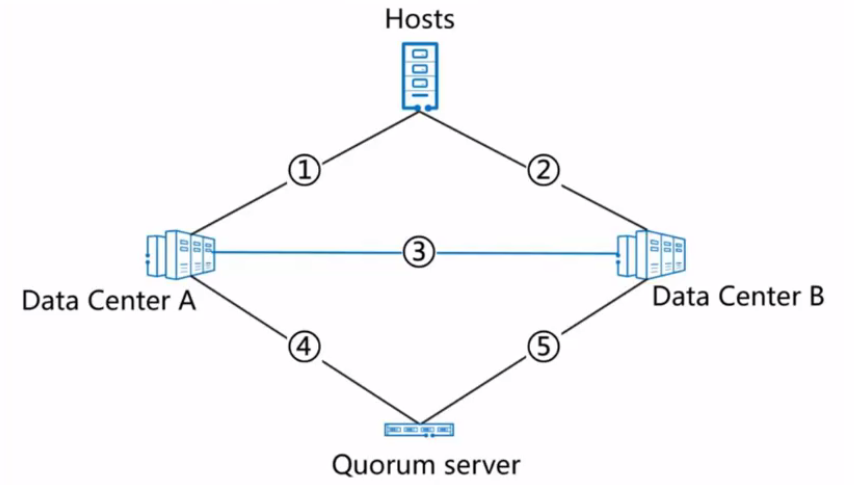
Huawei states that when communication between the two HyperMetro storage systems is interrupted, ''the preferred site continues to provide services while the other site stops providing services.'' In static-priority arbitration, the preset preferred site wins arbitration and continues service delivery. The arbitration table makes the scenario even more explicit. For a HyperMetro pair in To be synchronized state, it states: ''If DC A is the preferred site, the LUN in DC A continues providing services while the LUN in DC B stops.'' These symptoms identify interruption of the HyperMetro communication/replication connection between the two storage arrays. In the topology, that connection is fault point 3. A host-access link failure would affect host connectivity rather than produce this exact arbitration state. A quorum-link-only failure also does not match the combination of To-be-synchronized status and one-site service suspension. Therefore, the failed component is the inter-storage HyperMetro link represented by 3.
Study Guide Topics: Data Protection Solution HyperMetro Arbitration Mechanism Quorum Server Mode Static Priority Mode Link Failure Scenarios.
Currently there are no comments in this discussion, be the first to comment!