
 MENU

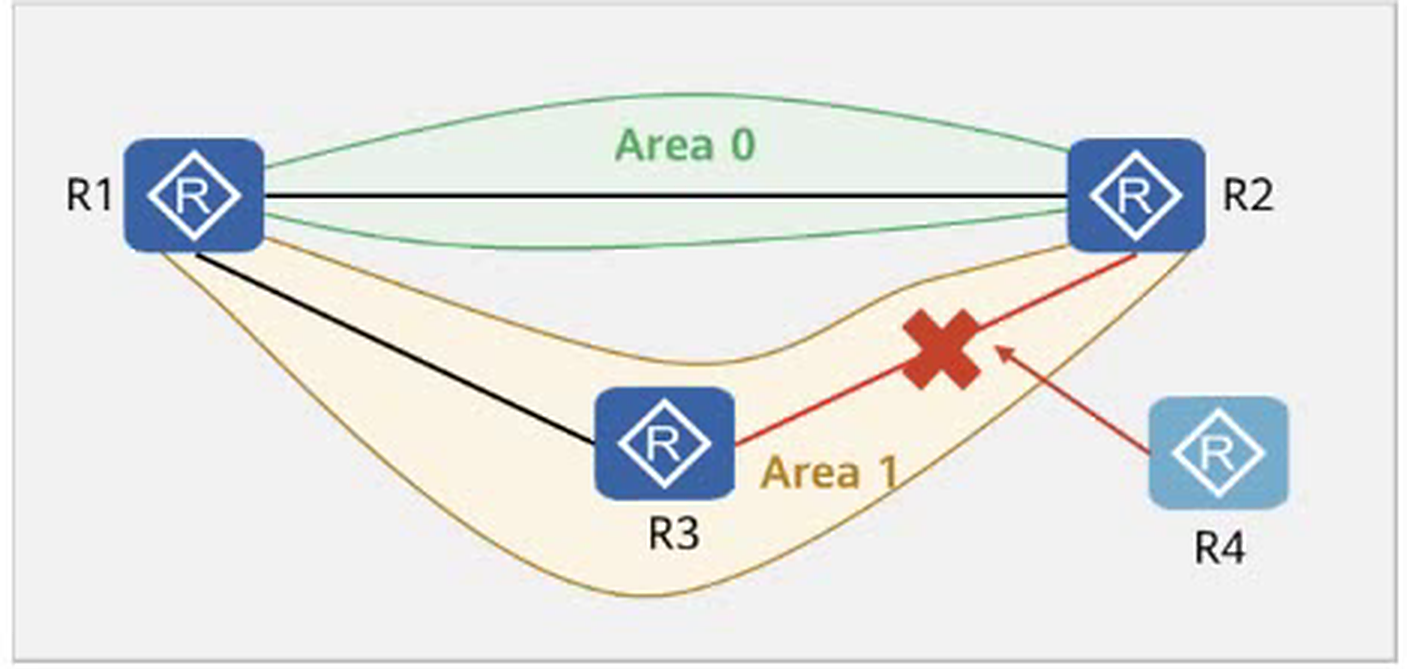
The figure shows the logical network architecture of a migration project. The purpose of the migration is to add network device R4 between R2 and R3. The router IDs of R1, R2, and R3 are 10.0.1.1, 10.0.2.2, and 10.0.3.3, respectively. OSPF runs between network devices. After the physical network is connected, a network engineer incorrectly imports the backup configuration of R3 to R4 during the migration. Given this, which of the following statements are true?
OSPF maintains Link-State Databases (LSDBs) that contain link-state advertisements describing the topology of an area. Router-LSAs are flooded within their originating area, allowing connected routers in that area to maintain synchronized topology information.
In the exhibit, the original R2--R3 connection is interrupted during the migration. R3 remains connected to R1 in Area 1, while R4 becomes connected to R2.
Because R4 receives R3's backup configuration, both devices use the same OSPF router ID. However, their portions of Area 1 are separated by the disconnected link.
Therefore, R2 receives R4's Router-LSA, while R1 receives R3's Router-LSA.
R3 cannot receive R4's area-scoped Router-LSA through the Area 0 connection, and R2 does not receive R3's Router-LSA through the broken Area 1 path.
Thus, B and C are correct.
Currently there are no comments in this discussion, be the first to comment!