
Free Preparation Discussions
 MENU
MENU
Huawei H12-811_V2.0 Exam - Topic 4 Question 13 Discussion
Topic #: 4
In the figure, a TCP connection has been established between PC1 and PC2. After PC1 sends a data segment to PC2, which of the following is the acknowledgment number in the packet returned by PC2?
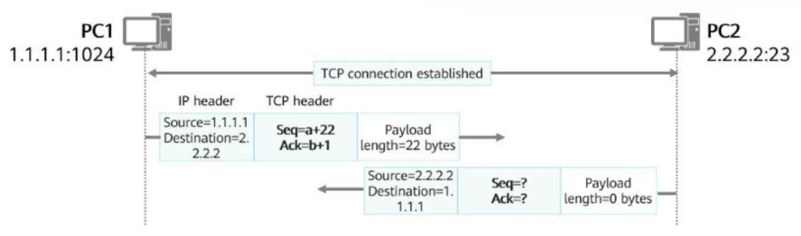
In TCP, the acknowledgment number indicates the next byte that the receiver expects to receive. In the figure, PC1 sends a TCP segment to PC2 with sequence number = a+22 and payload length = 22 bytes. Since TCP sequence numbers count bytes, the last byte carried in this segment corresponds to sequence number a+43. Therefore, after PC2 successfully receives this data, it sends back an ACK indicating that the next expected byte is a+44.
That is why option B is correct. This is a standard TCP reliability mechanism. TCP does not acknowledge ''packets'' as units; it acknowledges the byte stream. The ACK number always points to the next byte expected from the peer. The source and destination port numbers identify the session, but the sequence and acknowledgment numbers track ordered delivery. HCIA-Datacom uses this mechanism to explain connection-oriented transport, reliable delivery, retransmission, and traffic control. Understanding how the payload length affects sequence progression is essential when analyzing packet captures and troubleshooting TCP communication problems in enterprise networks.
Currently there are no comments in this discussion, be the first to comment!