
Free Preparation Discussions
 MENU
MENU
HPE7-V01 Exam Questions
- HPE Master ASE Certifications
- HP Edge-to-Cloud Architect MASE - EdgCldAr Certifications
- Topic 1: Describe, Differentiate, and Apply IT Industry Trends, Standard Architectures, Technologies, and Cloud Delivery Models: This domain covers understanding cloud delivery models, workload characteristics, compute/storage/network architecture selection, and business continuity planning for optimized customer solutions.
- Topic 2: Gather and Analyze Customer Business and Technical Requirements: This domain focuses on identifying customer business and technical needs, desired outcomes, and collecting key performance metrics from existing infrastructure and applications.
- Topic 3: Recommend and Position HPE Offerings for Customer Use Cases: This domain covers positioning HPE security, GreenLake, traditional, and hybrid solutions based on customer use cases, along with using the right resources to demonstrate business value.
- Topic 4: Architect and Design an HPE Solution Based on Customer Needs: This domain involves selecting the right delivery model, designing traditional and GreenLake solutions, and sizing, reviewing, and validating proposals to meet business outcomes.
- Topic 5: Present and Demonstrate the Solution to the Customer and Coordinate Implementation Planning: This domain covers presenting the proposed solution along with its business and financial impact to the customer.
- Topic 6: Demonstrate an Understanding of Ongoing Enhancements (Upgrade, Migrate, Optimize, etc.): This domain covers comparing existing architecture to proposed changes and designing upgrades or expansions that align with customer requirements and non-technical service factors.
Free HP HPE7-V01 Exam Actual Questions
Note: Premium Questions for HPE7-V01 were last updated On Sep. 08, 2026 (see below)
A customer is about to do a server refresh with the intent of using HPE ProLiant DL360 Gen11 servers, with CPUs exceeding 270 watt power usage. The customer has existing third-party, 42U, air-cooled racks they are planning to reuse.
Which cooling option will allow your customer to install the servers with their existing racks, with the least amount of changes to the setup?
The correct answer is B because the CPU power level exceeds the range normally handled by standard or high-performance air-cooling options for this server design. For HPE ProLiant DL360 Gen11 configurations with very high-wattage processors, HPE design guidance identifies closed-loop liquid cooling as the required or appropriate cooling mechanism for processors at or above the higher thermal threshold. The key phrase in the scenario is that the customer wants to reuse existing third-party, 42U, air-cooled racks with the least amount of change. Closed-loop liquid cooling is self-contained inside the server cooling assembly and does not require the customer to deploy facility-level liquid-cooled racks or direct-liquid-cooling infrastructure. Option A introduces a larger rack and facility change, which violates the ''least amount of changes'' requirement. Option C implies external liquid-cooling infrastructure and is therefore more disruptive. Option D is incorrect because high-performance fans are intended for lower thermal design power ranges and are not sufficient for CPUs exceeding the stated 270-watt threshold. This aligns with the course's ProLiant Gen11/Gen12 server design and validation objectives.
Your customer has a requirement to support 500K IOP/s write speeds in their environment.
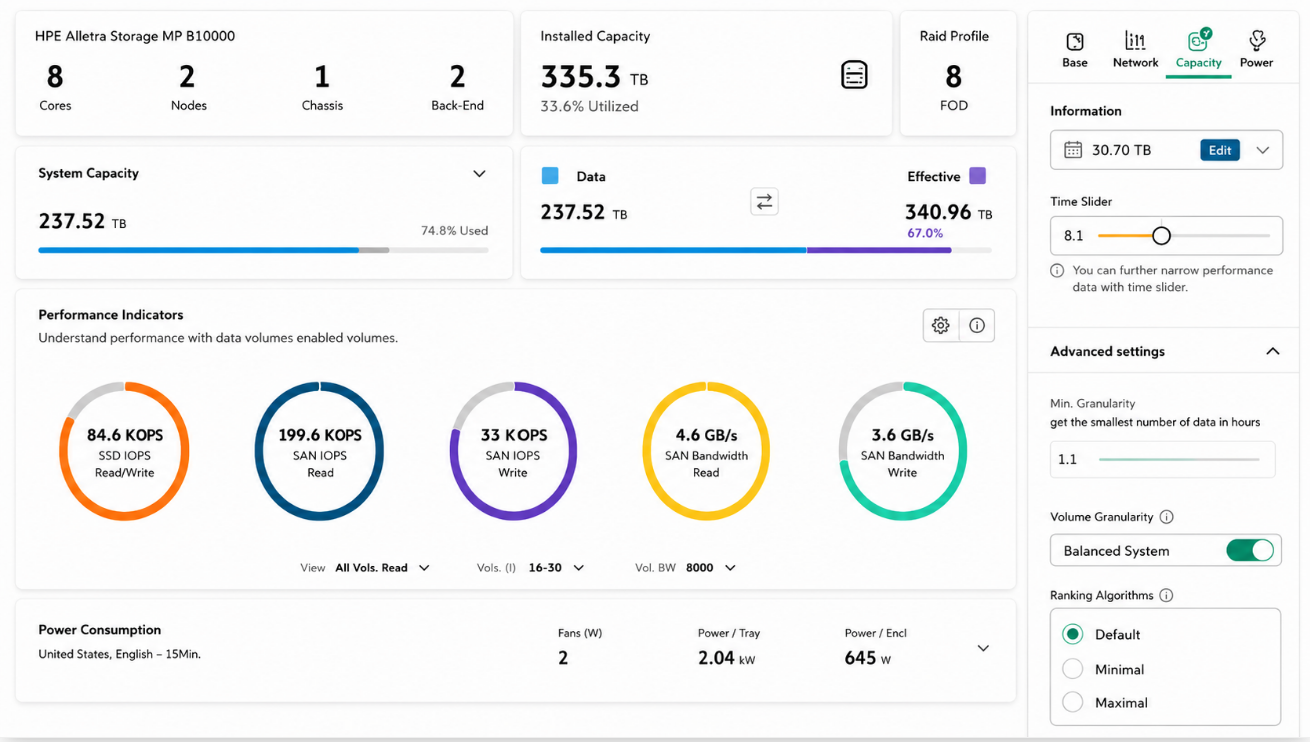
What change should you make to the configuration to achieve this?
The correct answer is D because the requirement is not simply additional raw capacity; it is a write-performance target of 500K IOP/s. For HPE Alletra Storage MP B10000 designs, controller-node model selection, node count, shelf count, drive population, and media layout collectively determine whether the configuration can satisfy the performance envelope. Merely increasing the number of drives, as suggested in option C, does not guarantee that the front-end controller resources, CPU, cache, and back-end connectivity can sustain the required write workload. Options A and B use lower or inappropriate node selections for this stated requirement. The B10230 model, combined with additional shelf and drive resources, is the configuration change that aligns the controller and media resources with the required write I/O target. HPE's course outline places HPE Alletra Storage MP B10000 in both general enterprise solution design and database workload solution design, which is exactly the kind of workload-sensitive sizing exercise represented here. The proposal must be validated against the customer's required I/O profile, not only against usable capacity.
Your customer would like to implement Peer Persistence for their HPE Alletra 6000 remote replication configuration.
Which two statements are true? (Select two.)
The correct answers are B and C. In HPE Alletra 6000 / NimbleOS synchronous replication and Peer Persistence designs, the upstream and downstream volume relationship determines the active and standby host path behavior. HPE documentation states that when synchronous replication is configured, upstream and downstream volumes share the same serial number, and host paths are presented so that active paths are mapped to the upstream volume while standby paths are mapped to the downstream volume. That validates option B. Option C is also correct because in a bidirectional design, each array can host upstream volumes for some protected workloads and downstream volumes for others; the role is per replicated volume collection, not a permanent identity of the entire array. Options A and D are wrong because the witness is a separate arbitration component, not the upstream or downstream array. Option E is wrong because Alletra 6000 synchronous replication uses Ethernet connectivity between arrays, and Peer Persistence is not limited to FC-only host access. Reference/topics: HPE Alletra 6000 Peer Persistence, synchronous replication, upstream/downstream roles, witness design.
Your customer's environment includes HPE Private Cloud Business Edition with deployed HPE SimpliVity 380 Gen11 nodes.
They have asked you to upgrade the vSphere, OmniStack, and firmware components of the environment in a fully controlled operation.
Which tool should you use?
The correct answer is A. In an HPE Private Cloud Business Edition environment, the proper operational model is to use the HPE GreenLake / Data Services Cloud Console workflow for system-level lifecycle activities rather than treating the environment as a standalone SimpliVity-only deployment. HPE documentation for Private Cloud Business Edition identifies Data Services Cloud Console as the interface used to set up, upgrade, and manage PCBE environments, and the ''Updating system software'' workflow is specifically tied to PCBE administration through DSCC. The customer's requirement is broader than a single OmniStack upgrade: it includes vSphere, OmniStack, and firmware in a controlled operation. That makes a PCBE site-upgrade workflow the best match. Option B is associated with traditional SimpliVity software and firmware upgrade processes, but it is not the most complete answer for a PCBE-managed environment. Options C and D mix plugin/update-manager concepts and do not represent the correct PCBE lifecycle mechanism. Reference/topics: PCBE lifecycle operations, DSCC, SimpliVity upgrade planning, HPE GreenLake operational management.
Your customer plans to deploy multiple virtual machines running database workloads. They plan to re-use and extend an existing Synergy, 3PAR, and VMware infrastructure.
What is true regarding a possible upgrade?
The correct answer is A because HPE OneView for VMware vCenter provides VMware administrators with integrated HPE infrastructure management from within vCenter and supports deployment workflows for ESXi hosts on supported HPE platforms such as HPE Synergy and HPE ProLiant. In this scenario, the customer already has a Synergy, 3PAR, and VMware environment and wants to extend it for additional virtual machines running database workloads. Adding ESXi hosts through the HPE OneView for VMware vCenter integration is a valid upgrade path because it aligns server provisioning and VMware lifecycle operations with the existing management model. Option B is incorrect because it confuses infrastructure automation with the specific HPE OneView for VMware vCenter ESXi deployment function. Option C is false because HPE 3PAR has long been supported in VMware environments and can be part of Synergy-based infrastructure. Option D is imprecise: HPE OneView composes and manages infrastructure; it is not primarily a rapid VM deployment tool. The course covers database workload architectures, Synergy, HPE storage, VMware integration, and the use of HPE tools for validated traditional solution design.
- Select Question Types you want
- Set your Desired Pass Percentage
- Allocate Time (Hours : Minutes)
- Create Multiple Practice tests with Limited Questions
- Customer Support
Patricia Smith
10 hours agoGaurav Rao
5 days agoLisa Wilson
1 month agoManon Simon
1 month ago