
 MENU

You want to configure SD-WAN on a network, as shown in the exhibit.
The network contains many FortiGate devices. Some are used as next-generation firewalls (NGFW), and some are installed with extensions such as FortiSwitch, FortiAP, or FortiExtender.
Which factors should you consider when planning your deployment?
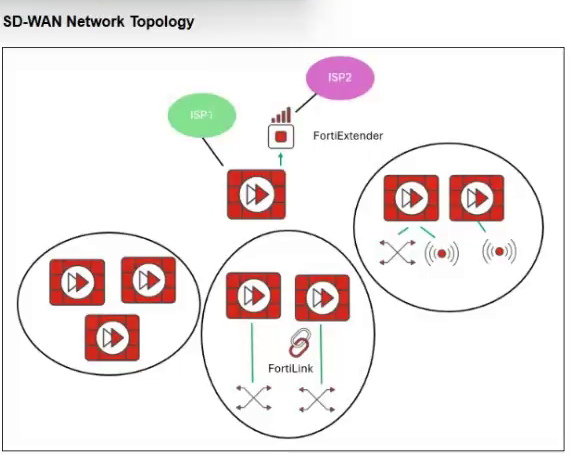
Exhibit --- SD-WAN network topology
Fortinet Secure SD-WAN supports an integrated networking architecture in which FortiGate appliances provide routing, traffic steering, and security enforcement while extending connectivity through FortiSwitch, FortiAP, and FortiExtender devices.
Option C is correct because a FortiGate configured as an SD-WAN hub can also utilize FortiExtender connectivity. FortiExtender provides cellular WAN transport, including 4G and 5G connectivity, and can be integrated as a logical WAN interface and SD-WAN member.
FortiSwitch provides wired access-layer connectivity through FortiLink, while FortiAP extends wireless LAN access. These components are complementary and do not require separate SD-WAN topologies.
Option A is incorrect because FortiGate devices supporting multiple extension types remain eligible for inclusion in the SD-WAN architecture.
Option B is incorrect because SD-WAN topology design is not restricted to a single extension product category. Multiple Fortinet networking components can be centrally orchestrated within the same deployment.
Option D is incorrect because regional segmentation is determined by network architecture, geographical requirements, routing domains, and operational considerations---not simply the types of extensions attached to each FortiGate.
FortiManager can centrally manage FortiGate devices and associated extensions, applying consistent SD-WAN templates and provisioning policies across enterprise branches and hubs.
==========
Currently there are no comments in this discussion, be the first to comment!