
 MENU

Refer to the exhibit. The exhibit shows the BGP configuration on the hub in a hub-and-spoke topology. The administrator wants BGP to advertise prefixes from spokes to other spokes over the IPsec overlays, including additional paths. However, when looking at the spoke routing table, the administrator does not see the prefixes from other spokes and the additional paths Which three settings must the administrator configure inside each BGP neighbor group so spokes can learn the prefixes of other spokes and their additional paths? (Choose three.)
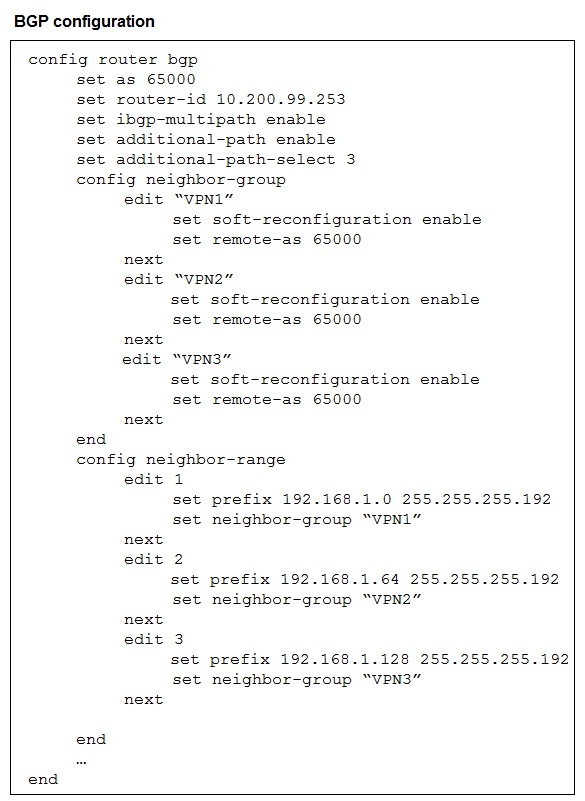
Exhibit 1
The hub must send additional paths to spokes (set additional-path send). The hub must treat each spoke as a route-reflector client so spoke routes are reflected to other spokes. The hub must specify how many additional paths to advertise (set adv-additional-path <n>). An operational review should distinguish the rule that matches the traffic from the interface that is ultimately selected. Valid forwarding also depends on destination route eligibility, current member state and the applicable SLA or quality-selection algorithm. A diagnostic showing configured members alone is not conclusive evidence that all those members will carry a particular flow. When troubleshooting, correlate the configured SD-WAN service with diagnose sys sdwan service4, the live session entry and the routing table. An application signature, an IP route and a health-check result describe different decision stages; treating them as interchangeable can produce incorrect conclusions about the egress interface. In the relevant Fortinet FortiOS documentation, the applicable feature should be verified against the deployed software version, the selected configuration mode and the live operational state before the answer is treated as a definitive implementation requirement.
==========
Currently there are no comments in this discussion, be the first to comment!