
Free Preparation Discussions
 MENU
MENU
Fortinet NSE6_OTS_AR-7.6 Exam - Topic 2 Question 5 Discussion
Topic #: 2
Refer to the exhibits.
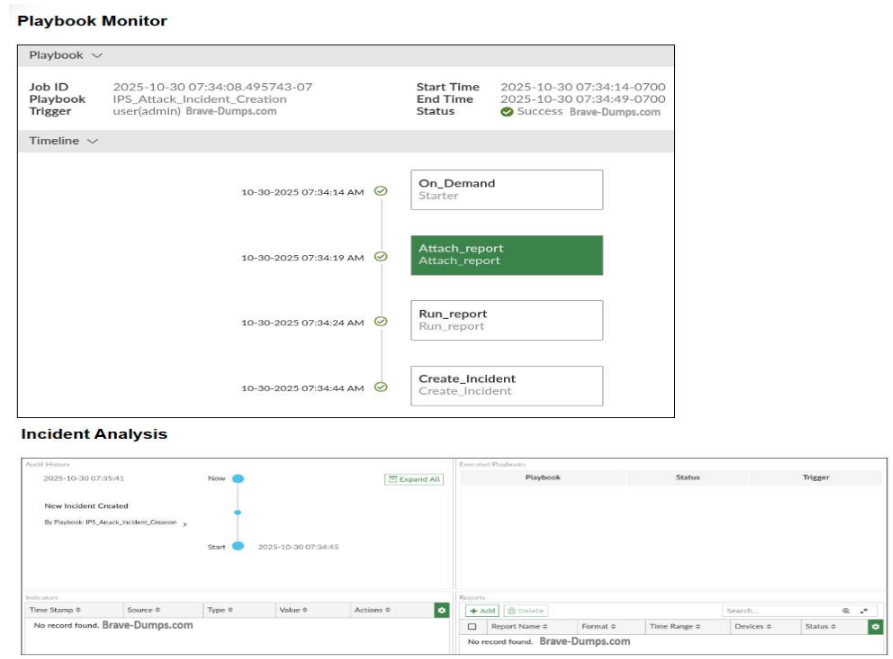
The Playbook Monitor dashboard and the analysis of the corresponding incident analysis are shown. You created the playbook with the objective of automatically attaching the report to the incident that was created. Which two statements are correct? (Choose two answers)
The correct answers are C and D.
Option D is correct because the Playbook Monitor clearly shows the starter as On_Demand and the trigger as user(admin). The study guide states that ''ON_DEMAND: The playbook runs when an administrator manually starts it'' and also notes that to run it manually, you select the playbook and click Run. This exactly matches the exhibit, so the playbook was manually triggered.
Option C is also correct. The study guide explains that ''tasks run one after another'' and that ''if needed, the output of one task can be used by the tasks that follow it.'' It also gives an example where workflow logic matters, such as creating an incident and then attaching details to it. In the exhibit, the sequence shown is Attach_report, then Run_report, then Create_Incident, while the incident analysis shows no report attached. Since the report must exist and the incident must already be available before it can be attached properly, the task order is wrong and must be reordered.
Option B is incorrect because the monitor shows multiple tasks completed successfully, not only Create_Incident. Option A is not the best answer because the main problem demonstrated by the exhibits is not simply waiting time, but the incorrect workflow order. The playbook completed successfully, yet the report is still not attached, which indicates a design issue in the task sequence rather than just a delay.
Jules
1 month agoKrissy
1 month agoHector
2 months agoSusy
2 months agoDavida
2 months agoAzalee
2 months ago