
 MENU

Refer to the exhibit.
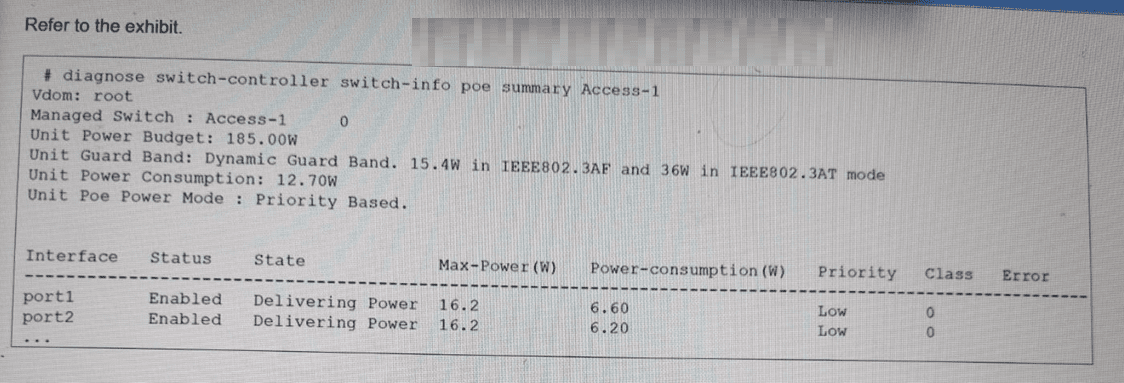
The FortiSwitch CLI output of the diagnose switch-controller switch-info poe summary command for the switch Access-1 is shown. It shows that two ports have Power over Ethernet (PoE) enabled and are already in use. What is the most important consideration if you want to connect additional PoE devices to FortiSwitch? (Choose one answer)
According to theFortiSwitchOS 7.6 Administration Guideand theFortiSwitch 7.6 Study Guide, the primary physical constraint when deploying PoE devices is the total power capacity of the switch's internal power supply unit (PSU). The provided exhibit shows the PoE status forAccess-1, highlighting three critical metrics: theUnit Power Budget (185.00W), the currentUnit Power Consumption (12.70W), and theUnit Guard Band.
TheUnit Power Budgetrepresents the maximum amount of power the switch can provide to all connected Powered Devices (PDs) simultaneously. As more devices (such as access points, VoIP phones, or cameras) are connected, the cumulative power draw increases. The most important consideration is ensuring that thetotal PoE consumption does not exceed this budget. If the budget is exceeded, the switch will stop providing power to new devices or, depending on the configuration, may shut down lower-priority ports to protect the system hardware.
In this specific exhibit, theUnit Poe Power Modeis set toPriority Based. This means that if the power consumption approaches the budget limit, the switch will use the configured port priorities (seen as 'Low' for port1 and port2) to decide which devices to keep powered. TheGuard Band(set to a dynamic value) also plays a role by reserving a small amount of power to handle spikes when devices initialize, further emphasizing that the power budget is a hard limit that must be actively managed by the administrator.
Currently there are no comments in this discussion, be the first to comment!