
Free Preparation Discussions
 MENU
MENU
Fortinet NSE5_FSW_AD-7.6 Exam - Topic 4 Question 16 Discussion
Topic #: 4
(Full question statement start from here)
Refer to the exhibits.
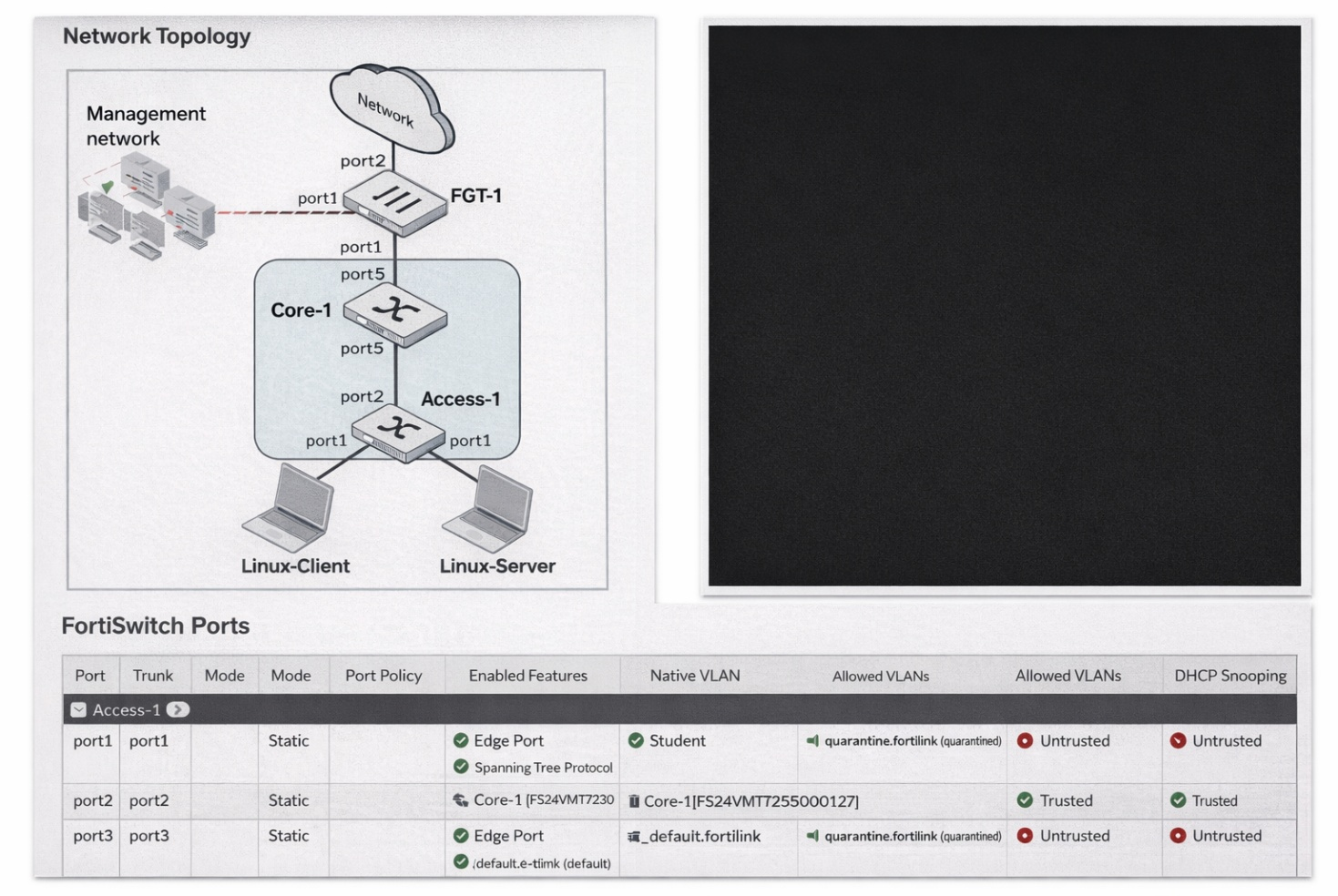
You enable Dynamic Host Configuration Protocol (DHCP) snooping on the VLAN,Student. The Linux-Client VM sends DHCP requests, and tcpdump confirms the broadcasts. However, the Linux-Server VM, acting as a DHCP server, receives no DHCP traffic. What is the most likely cause of this intra-VLAN traffic being blocked? (Choose one answer)
In FortiSwitchOS 7.6,DHCP snoopingis a Layer 2 security feature that validates DHCP traffic and protects the LAN from rogue DHCP servers. The feature enforces atrust modelon switch ports: ports connected toward legitimate DHCP server infrastructure must be markedtrusted, while edge/access ports facing clients are typicallyuntrusted. When DHCP snooping is enabled on a VLAN (in this case,Student), FortiSwitch inspects DHCP messages and applies filtering rules based on port trust status.
From the exhibit, bothport1(connected to the Linux-Server DHCP server) andport4(connected to the Linux-Client) showDHCP Snooping: Untrusted. In this configuration, the switch treats the DHCP server-facing port as untrusted and, by design, willblock DHCP server-originated messages(such as DHCPOFFER/DHCPACK) arriving on that interface. This prevents the DHCP handshake from completing and effectively stops DHCP from functioning across that VLAN segment. Operationally, this is commonly observed as ''no DHCP traffic'' at the server/application layer because the exchange cannot progress normally when the server side is not trusted.
Option C is incorrect because the client-facing port is expected to be untrusted. Options A and D do not align with the exhibit: the ports are already placed in the Student VLAN as native VLAN, so the primary issue is the DHCP snooping trust role.
Therefore, the most likely cause is thatport1 is configured as an untrusted port(it must be trusted for a DHCP server), makingBthe correct answer.
Currently there are no comments in this discussion, be the first to comment!