
 MENU
MENU
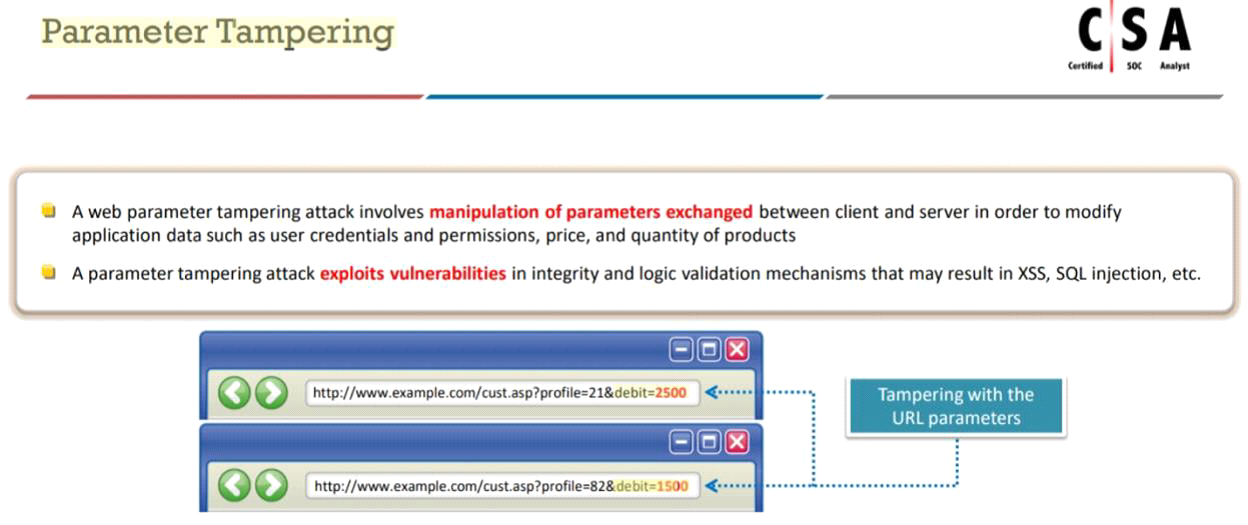
An attacker exploits the logic validation mechanisms of an e-commerce website. He successfully purchases a product worth $100 for $10 by modifying the URL exchanged between the client and the server.
Identify the attack depicted in the above scenario.
Suggested Answer: C
Get Premium 312-39 Questions
as Interactive Web-Based Practice Test or PDF
Real Exam Format
Detailed Explanations
Instant Access
Get Your Practice Test
11 comments · newest first
TR
Truman
11 months ago
I can't believe it was that easy to exploit!
SE
Selma
11 months ago
Nope, it's clearly parameter tampering. No doubt about it.
DA
Darnell
12 months ago
Wait, are you sure? Could it be SQL injection?
LA
Laticia
12 months ago
I agree, modifying the URL is a classic move.
PH
Phuong
1 year ago
That's definitely parameter tampering!
GE
Genevieve
1 year ago
I could be wrong, but I thought session fixation attacks were more about hijacking sessions rather than altering prices in URLs.
JA
Jacquelyne
1 year ago
This reminds me of a practice question we did on URL manipulation. I feel like parameter tampering fits the scenario best.
GA
Gail
1 year ago
I'm not entirely sure, but I remember something about SQL injection being related to database queries, so that doesn't seem right here.
AL
Alesia
1 year ago
I think this might be a parameter tampering attack since the attacker modified the URL to change the price.
AL
Aleta
1 year ago
Okay, I've got this. In a defined contribution plan, the employer contributes a set amount, but the employee's benefit depends on the performance of their investments. So the employees are the ones who assume the investment risk, not the employer. I'm confident A is the right answer.
KA
Kanisha
1 year ago
Okay, I've got a strategy here. I need to focus on the key control points in the purchasing process and determine which one would be the most effective in preventing fraud. I think I'll go with option A.