
Free Preparation Discussions
 MENU
MENU
CSI CSC2 Exam Questions
- Topic 1: The Canadian Investment Marketplace: This section of the exam measures the skills of a Securities Industry Professional and covers the structure and operation of Canada's investment marketplace. It includes the roles of investment dealers and financial intermediaries, capital market functions, financial instruments, and the complete Canadian regulatory environment with its regulatory bodies, principles of regulation, client remediation options, and ethical standards for financial services professionals.
- Topic 2: The Economy: This section of the exam measures the skills of an Economic Analyst and covers fundamental economic concepts including microeconomics and macroeconomics, economic growth measurement, business cycles, labor markets, interest rates, inflation, international trade, and both fiscal and monetary policy with emphasis on the Bank of Canada's role and government policy challenges.
- Topic 3: Investment Products: This section of the exam measures the skills of an Investment Products Analyst and covers fixed-income securities features, pricing, and trading; equity securities including common and preferred shares; derivatives including options, forwards, futures, rights and warrants; and the characteristics and uses of all these investment instruments in Canadian markets.
- Topic 4: The Corporation: This section of the exam measures the skills of a Corporate Finance Analyst and covers corporate structures, financial statements, disclosure requirements, investor rights, financing methods, capital raising processes, prospectus requirements, securities distribution, and exchange listing procedures for corporations.
- Topic 5: Investment Analysis: This section of the exam measures the skills of a Research Analyst and covers both fundamental and technical analysis methods, including macroeconomic, industry and company analysis techniques, financial statement interpretation, ratio analysis, and security valuation approaches.
- Topic 6: Portfolio Analysis: This section of the exam measures the skills of a Portfolio Manager and covers portfolio management approaches including risk and return measurement, portfolio optimization strategies, management styles, and the complete portfolio management process from objective setting to performance evaluation and rebalancing.
- Topic 7: Analysis of Managed and Structured Products: This section of the exam measures the skills of an Investment Products Specialist and covers mutual funds, exchange-traded funds, alternative investments, structured products, and other managed products including their structures, regulations, features, risks, strategies, performance measurement, and tax implications within the Canadian investment landscape.
- Topic 8: Additional Topics: This section of the exam measures the skills of a Wealth Management Professional and covers Canadian taxation systems, tax-advantaged accounts, fee-based account structures, retail client financial planning and estate planning, institutional client management, and ethical standards for financial advisors serving both individual and institutional clients.
Free CSI CSC2 Exam Actual Questions
Note: Premium Questions for CSC2 were last updated On Oct. 05, 2026 (see below)
The following table presents annual returns on TUV common stock and the S&P/TSX Composite Index
over a three-year period.
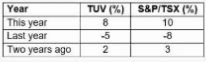
What is TUV's beta relative to the S&P/TSX Composite Index over this three-year period?
What is typically a key tax attribute of dividends?
Dividends are taxed at a preferential rate in Canada due to the dividend tax credit, which reduces the effective tax rate on dividend income. This is intended to prevent double taxation because corporations have already paid taxes on their profits before distributing dividends to shareholders.
Why Other Options are Incorrect:
B . Dividends from preferred shares are ineligible for the dividend tax credit: This is incorrect; dividends from both common and preferred shares are eligible for the dividend tax credit.
C . Stock dividends are treated differently than regular cash dividends for tax purposes: Stock dividends are generally taxed similarly to cash dividends.
D . Reinvested dividends are non-taxable to the shareholders: Reinvested dividends are taxable in the year they are earned, even if reinvested.
Reference: CSC Volume 2, Chapter 24, 'Taxation of Dividend Income' discusses the tax treatment of dividends and the dividend tax credit.
What economic outcome does the government set out to achieve by increasing their own spending?
- Select Question Types you want
- Set your Desired Pass Percentage
- Allocate Time (Hours : Minutes)
- Create Multiple Practice tests with Limited Questions
- Customer Support
Joseph Stewart
11 days agoCharles Wilson
1 month agoPaul Parker
1 month agoEmily Rodriguez
2 months agoMichael Mitchell
2 months agoJoseph Roberts
3 months agoPatricia Rogers
3 months agoJames Perez
4 months agoHarold Collins
4 months agoTiffany Flores
5 months agoJoshua Wilson
6 months agoSarah Perez
5 months agoRichard Stewart
5 months agoKimberly Walker
5 months agoAmanda Torres
5 months agoDaniel Evans
6 months agoTitus
6 months agoAllene
7 months agoJulieta
7 months agoLoren
7 months agoTamekia
7 months agoTasia
8 months agoLisbeth
8 months agoSherell
8 months agoDelmy
8 months agoBecky
9 months agoGayla
9 months agoMan
9 months agoBuck
9 months agoGlenn
10 months agoBok
10 months agoTammi
10 months agoHerminia
10 months agoMarvel
11 months agoElvera
11 months agoElden
11 months agoAliza
11 months agoCelestine
12 months agoLyla
12 months agoYuette
1 year agoGeraldine
1 year agoCletus
1 year agoLaquanda
1 year agoBlair
1 year agoCarin
1 year agoBlondell
1 year agoDerick
1 year agoJanella
1 year ago